
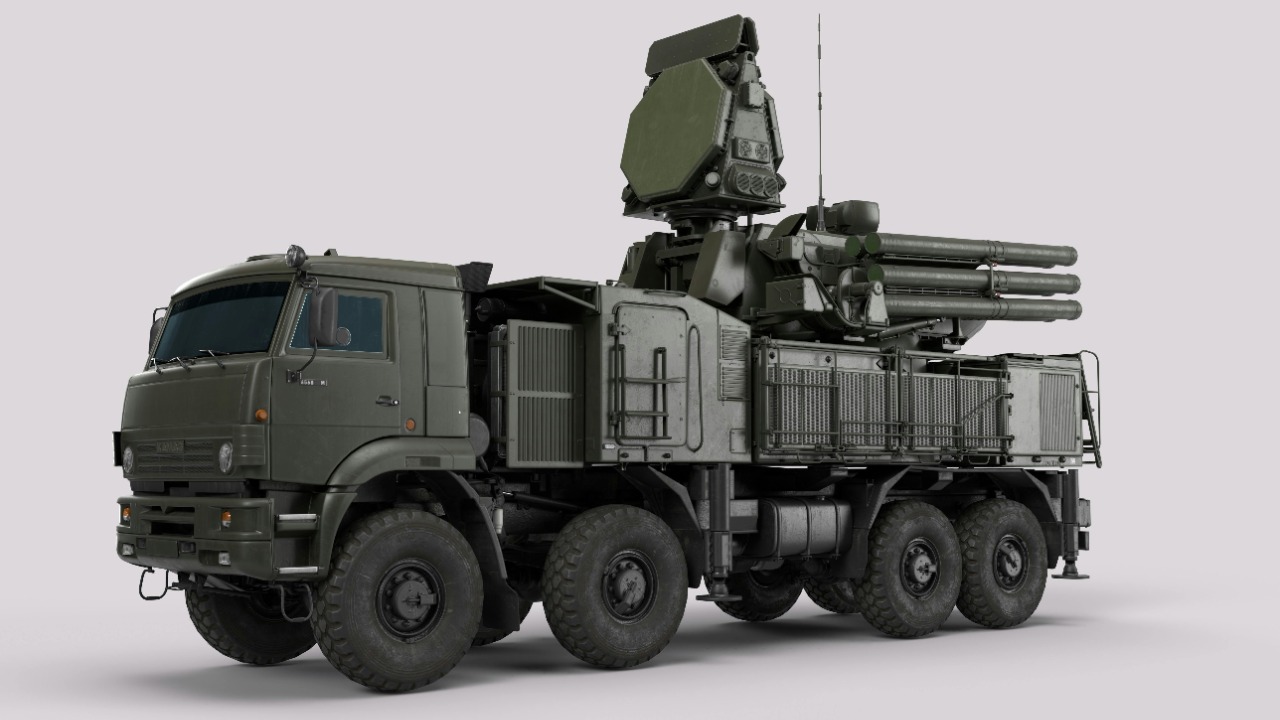
China has quietly moved a new kind of air defense into operational service, a truck-mounted system that uses concentrated microwave energy to burn out the electronics of hostile drones. Branded Hurricane 3000, the high power microwave array is designed to disrupt and destroy entire swarms at ranges beyond 3 kilometers, turning the invisible part of the spectrum into a battlefield weapon. Its arrival signals that Beijing now sees directed energy not as an experiment, but as a frontline answer to the age of cheap, expendable unmanned aircraft.
The Hurricane 3000 is part of the Hurricane family of Chinese high power microwave air defense systems, and it reflects a broader shift in how militaries intend to control the skies. Instead of relying only on missiles or guns, China is betting that pulses of radio frequency energy can provide a low-cost way to defend critical sites against massed quadcopters and small unmanned aerial vehicles that are difficult to track and expensive to shoot down one by one.
From parade showpiece to operational counter-drone asset
The Hurricane series, known in Chinese as Jùfēng, first appeared as a symbol of technological ambition, with the Hurricane 3000 high-power microwave system displayed on a large truck chassis with a planar antenna array. That public debut in Beijing framed it as a showcase of HPM capability, but recent reporting indicates that the system has now moved into active counter-drone roles rather than remaining a parade prop. The shift from ceremonial display to field deployment suggests that engineers have resolved enough technical risk for commanders to trust the system in real operations, at least in controlled environments.
Analysts note that Beijing is prioritizing low-cost, high-volume air defense solutions as unmanned threats reshape modern warfare, and the decision to deploy Hurricane 3000 fits that pattern. The truck-mounted platform can be repositioned to protect air bases, radar sites, or coastal facilities, and it is intended to neutralize drone swarms at distances of up to three kilometers, a range that Chinese sources describe as longer than a comparable Army high-power microwave system in the United States. That emphasis on range and mobility aligns with a wider Chinese push into high-power microwave weapons as a practical tool for air defense rather than a laboratory curiosity.
How Hurricane 3000 hunts and fries drone swarms
At the heart of Hurricane 3000 is a large planar microwave array that emits rapid, high-energy pulses across a wide beam, saturating the electronics of drones that fly into its field. Instead of trying to punch a hole in an airframe, the system aims to overload circuit boards, communication links, and flight controllers, causing targets to lose control or fail outright. Chinese descriptions state that the weapon is designed to disable drone swarms beyond 3 kilometers, and that it can support broader area denial missions by sweeping sectors of airspace where small unmanned aircraft might attempt to penetrate.
To find and track those targets, the truck-mounted system uses a layered sensor suite. Norinco, the developer, has said that Hurricane 3000 relies first on radar to detect and follow incoming drones, then hands off to electro-optical sensor packages for precise visual identification and targeting. That combination allows the crew to classify small and light drones that might otherwise be lost in clutter, before the high-power microwave emitter is cued to fire. According to Norinco expert Yu Jianjun, the effective interception range against such small drones exceeds that of comparable systems, a claim that aligns with separate reporting that highlights the system’s reach and its role in countering rapid advances in drone warfare.
Why microwaves, not missiles, are China’s answer to drone swarms
China’s embrace of microwave air defense reflects a hard lesson from recent conflicts, where cheap quadcopters and loitering munitions have forced militaries to expend expensive interceptors on low-cost threats. Missiles and guns can be very effective, but they are optimized for a limited number of high-value targets, not for dozens or hundreds of small drones arriving at once. By contrast, a high-power microwave system like Hurricane 3000 can engage multiple drones inside its beam volume with a single pulse, which makes it attractive as a way to conserve interceptors and reduce the cost per engagement.
Chinese commentary has framed this as a deliberate choice to “forget” traditional interceptors for certain missions and instead use the same basic physics that power household microwave ovens, scaled up and focused into a weapon. Reporting on China’s interest in invisible microwave weapons stresses that they can fry electronics on quadcopters and small unmanned aerial vehicles, provided the system has line of sight and sufficient proximity. United States Army analysts have similarly assessed that high-power microwave weapons represent a major shift in future warfighting, since they promise a reusable, magazine-free way to counter dense salvos of unmanned systems without the logistical burden of restocking missiles after every engagement.
Strategic signals from Beijing’s new electric storm
The decision by Beijing to field Hurricane 3000 sends a clear signal about how Chinese planners expect the next air war to unfold. By investing in a truck-mounted, high-power microwave platform that can move with ground forces or protect fixed installations, China is preparing for a battlespace saturated with small drones, including in sensitive areas such as the Taiwan Strait. Regional reporting has already described the system as casting an “electric storm” in that theater, and the presence of a mobile HPM asset there would complicate any adversary’s planning for reconnaissance or strike operations that rely on unmanned aircraft.
There is also a technological signaling effect. By highlighting that Hurricane 3000 has a longer range than a comparable Army system and can carry out what Norinco calls “diverse air defence missions,” Beijing is positioning its HPM program as a marker of cutting-edge capability. Detailed accounts of new details on the truck-mounted Hurricane 3000 microwave weapon describe it as part of an expanding counter-drone toolkit that includes jammers and more traditional interceptors. Taken together, those systems indicate that China is not only trying to keep pace with unmanned threats but to shape the norms of how states defend against them, using high-power microwaves as a central pillar of its strategy.