
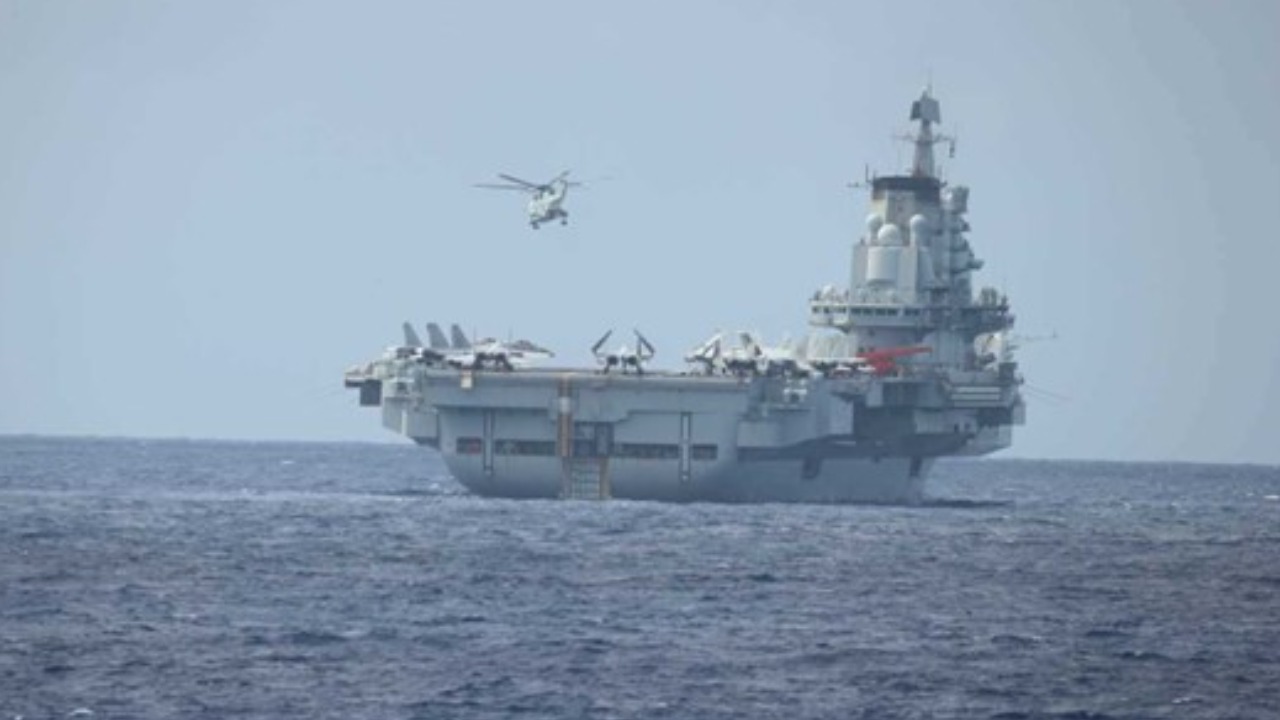
China’s rapid naval buildup is forcing Washington to contemplate a Western Pacific in which the United States no longer enjoys clear carrier dominance. A new Pentagon assessment warns that Beijing could operate nine aircraft carriers by 2035, tripling its current fleet and transforming the balance of power at sea. The projection underscores how industrial capacity, political will, and a focused maritime strategy are converging to reshape the region’s security architecture.
The warning is not abstract. China commissioned its first carrier, Liaoning, only in 2012 after acquiring an unfinished Soviet hull, yet it now sails three flattops and is preparing to add six more within roughly a decade. For U.S. planners, the question is no longer whether China can build such a fleet, but how that force might be used to challenge American presence and reassure, or pressure, states across the Indo-Pacific.
From Liaoning to a projected nine-carrier fleet
In barely more than a decade, China has moved from having no carriers at all to fielding a small but growing strike group capability. The first step was the Liaoning, commissioned after Beijing purchased and completed an unfinished Soviet vessel, which served as a training platform and symbol of blue-water ambition. Since then, China has added two more carriers and is now assessed by the U.S. Defense Department to be on a trajectory that could yield nine operational decks by 2035, a scale that would rival or exceed the U.S. presence in the Western Pacific.
The United States has publicly warned that the China’s Navy, could field a fleet of nine carriers by that date, highlighting not only hull numbers but also the country’s growing ability to project maritime power far from its shores. A separate Pentagon report, circulated through U.S. defense channels and amplified in public debate, confirms that China plans to move from three carriers today to nine by 2035, in part by leaping from ski-jump designs to more advanced catapult-equipped ships such as the Type 003. That evolution suggests not only more decks, but more capable air wings and more sophisticated operations.
Industrial ambition and expert skepticism
Achieving nine carriers in less than a decade and a half would require a sustained industrial surge that even some U.S. analysts view as aggressive. According to a Pentagon-linked assessment, China’s navy plans to build six new aircraft carriers, expanding from the current three to nine and mixing nuclear-powered and conventionally powered designs. In its annual report to Congress, the Pentagon has stated that Beijing intends to construct six carriers in roughly ten years, a pace that prompted U.S. Naval War College professor Andrew Erickson to caution that, even assuming accelerating parallel work, he is not sure this schedule is achievable.
Yet skepticism about timelines has not erased concern about direction. The Pentagon’s broader view is that China plans to keep expanding its carrier fleet as part of a long-term maritime strategy that prioritizes power projection, sea control, and deterrence. Maritime analysts note that China’s naval aspirations are explicitly tied to projecting power in the Western Pacific, where carrier groups can support operations around Taiwan, the South China Sea, and key sea lanes. Even if shipyard bottlenecks or technical setbacks slow the program, the intent to field a large, modern carrier force appears deeply embedded in Beijing’s planning.
Strategic threat perceptions in Washington
For U.S. officials, the projected carrier expansion is one piece of a much larger puzzle that portrays China as a comprehensive military challenger. A Pentagon assessment circulated in Jan concludes that China’s military modernization poses a direct and growing threat to U.S. security, with an explicit goal of building a world-class force by 2049 that can deter, and if necessary defeat, the United States. Another detailed review, summarized under the banner Pentagon warns China Military Expansion Poses Direct Threat, stresses that Beijing is pursuing a historic military build-up that includes nuclear forces, long-range missiles, and advanced command structures alongside its carrier program.
These concerns are sharpened by the perception that Americans are becoming increasingly vulnerable to Chinese power projection. A detailed report on China’s historic military build-up notes that the PLA is developing capabilities to fight and win wars against what it calls a strong enemy, a phrase widely understood to refer to the United States. A separate analysis titled China Might Have Pentagon Says underscores that a recent Department of Defense report sees Beijing’s naval trajectory as placing it on a potential collision course with the United States if crisis management and deterrence fail. In that context, carriers are not just symbols of prestige, but mobile airfields that could support operations across the Pacific and beyond.
Regional balance and the future of carrier warfare
The most immediate geopolitical impact of a nine-carrier Chinese fleet would be felt in the Pacific, where U.S. and allied planners already worry about eroding naval superiority. Analysts cited by Nikkei Asia assess that China aircraft carriers are set to outnumber U.S. flattops in the Pacific by 2035, a shift that would complicate American efforts to reassure partners from Japan to Australia. The Pentagon’s own summary of China’s historic build-up notes that Americans are increasingly vulnerable to Chinese power projection as Beijing adds carriers, submarines, and long-range strike systems that can hold U.S. bases and ships at risk.
At the same time, the carrier race is prompting a reassessment of how these capital ships might fare in a high-end conflict. One recent analysis argues that U.S. Navy aircraft carriers now face a battleship problem, as precision missiles and undersea threats raise questions about survivability, even while China Believes In Aircraft Carriers and continues to invest heavily in them. Maritime specialists note that China’s naval aspirations are less about matching the U.S. globally and more about dominating key regional theaters, particularly the Western Pacific. As President Donald Trump’s administration weighs force posture and alliance commitments, the prospect of nine Chinese carriers by 2035 is becoming a central test of whether U.S. strategy, technology, and diplomacy can keep pace with a rival that has embraced the carrier era with striking speed.