
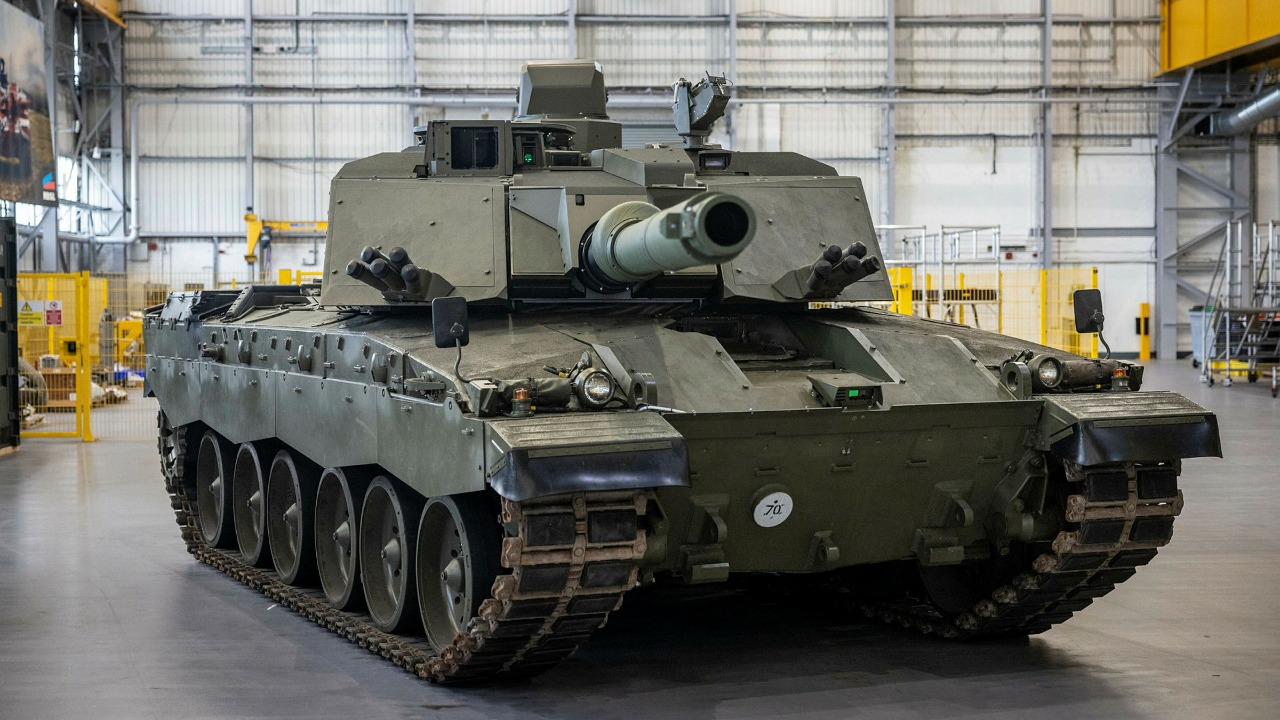
The first crewed live-fire test of the Challenger 3 has shifted the British Army’s next-generation tank from concept to credible combat asset. With a full crew on board and its new gun brought to life, the vehicle has moved beyond controlled range work into a phase that begins to resemble operational use. The trial marks a decisive moment for a program that aims to keep the United Kingdom’s heavy armor relevant on a battlefield defined by precision sensors and long-range fires.
The event also offers an early look at how the upgraded platform will change the way British armored units fight. From its new cannon to its digital backbone, Challenger 3 is designed to integrate more tightly with allies and to survive in a far harsher threat environment than its predecessor. The live-fire milestone suggests that the design is starting to match those ambitions in practice.
From test rig to fighting vehicle
The recent trial confirmed that Challenger 3 can operate as a complete system rather than as a collection of subsystems tested in isolation. Earlier work had focused on controlled firings and component checks, but the latest event put a full crew inside the tank and asked them to run the weapon system under realistic conditions. Reporting on the crewed trial describes it as a shift from laboratory-style evaluation toward a configuration that is closer to field service.
The British Army has framed Challenger 3 as its future main battle tank, and the first live firing with a full crew shows that this ambition is no longer confined to design briefs. The tank’s developers have stressed that the program is moving from early trials into a phase where soldiers can begin to shape tactics around the new platform. Analysts note that the completed firing is being treated inside the program as a proof point that the tank’s core combat functions are on track.
Scotland trial grounds and phased testing
The first crewed firing took place on a British military training area in Scotland, a location chosen for its ability to host heavy armor and live ammunition. The British Army used the range to test the Challenger 3 MBT in conditions that mirrored operational gunnery, with the crew engaging targets while managing the vehicle’s sensors and fire-control systems. According to reporting on the, the exercise formed part of a broader sequence of trials designed to validate the tank before it enters service.
Program officials have emphasized that the firing was not a one-off demonstration but a step in a phased testing approach. Before the crewed shoot, engineers had already run a careful progression of checks on the gun, turret, and automotive systems. The live-fire event with soldiers on board is described in program summaries as a key waypoint in that phased testing approach, which is intended to reduce risk and ensure that each upgrade over the current Challenger 2 is proven under live conditions.
Industry partners and next steps toward service
The Challenger 3 program is being delivered through a partnership that places Rheinmetall at the center of the upgrade effort. The company has outlined how the tank will now move through further trials as it progresses toward operational service, with attention on its new gun, digital systems, and modular armor. In its description of the roadmap, Rheinmetall has highlighted that the vehicle will continue to undergo structured testing as it transitions from prototype status to a deployable asset, a sequence captured in its outline of next.
For the British Army, the live-fire success is also a signal to political leaders and allies that the modernization of heavy armor is advancing. The tank is being presented as a featured element of the United Kingdom’s future force, with the upgrade program described as a milestone by its German manufacturer. Public statements on the featured milestone stress that Challenger 3 is intended to deliver improved lethality, better protection, and closer interoperability with allied armored units.
What the live-fire proves about the overall system
The successful firing with a full crew has been framed by program leaders as evidence that the tank is maturing as an integrated system. The test was conducted by Rheinmetall BAE Systems Land, which is responsible for bringing the design from blueprint to battlefield. Reports on the first successful trial state that the event demonstrated the readiness of the overall system, not only the cannon, by showing that the crew, fire-control software, and mechanical components could work together under live conditions.
Defence analysts point out that this kind of trial is where abstract performance promises meet the reality of human operators and battlefield stress. The British Army’s next-generation tank must not only fire accurately but also integrate its sensors, communications, and protection in a way that crews can manage under pressure. The description of the Challenger 3 as a main battle tank that completes a crewed live-fire trial underscores that the program is now testing those human and technical interfaces together, a necessary step before the vehicle can be declared ready for front-line duty.