

The CH-47 Chinook has spent decades hauling troops, artillery and vehicles into places that would otherwise be unreachable, yet it is still working at the edge of what helicopters can do. Its blend of raw lifting power, range and survivability has created a niche that newer aircraft programs have not matched, which is why militaries and civilian operators continue to rely on it for their hardest jobs. That enduring role, from combat assaults to disaster relief, is what now makes the Chinook effectively irreplaceable in heavy-lift aviation.
Far from being a Cold War relic, the Chinook has evolved into a platform that keeps absorbing new technology while preserving the fundamentals that made it indispensable in the first place. Its tandem rotors, powerful engines and rugged airframe have been refined rather than discarded, allowing the helicopter to keep operating where fixed-wing transports cannot land and where lighter rotorcraft cannot carry enough weight to matter.
Six decades of hard-earned credibility
The Chinook’s claim to uniqueness starts with time in service. For over 60 years, the CH-47 has been central to operations from Vietnam to modern deployments, proving it can survive combat, harsh climates and constant upgrades. That longevity is not nostalgia, it is evidence that the basic airframe and layout still meet front-line demands better than any alternative. A short documentary on the aircraft’s evolution notes that the CH-47 Chinook has been used by the US Army and other countries for more than 60 years, underscoring how widely its capabilities have been adopted.
That history is backed by a steady stream of technical improvements rather than a single frozen design. A recent short documentary on the Boeing platform highlights how, in the vast history of military aviation, few machines have earned as much respect, trust and admiration as the Boeing CH-47, precisely because it has been repeatedly modernized instead of retired. Another deep-dive video describes how The CH-47 Chinook is a powerful twin-engine, tandem-rotor heavy-lift helicopter developed by Boeing and used in troop transport, artillery movement, vehicle delivery and more, showing how its mission set has expanded as new variants arrive.
Tandem-rotor design and raw performance
The Chinook’s most recognizable feature, its twin rotors, is also the core of its irreplaceable performance. The CH-47 is powered by two turboshaft engines mounted on each side of the helicopter’s rear pylon and connected to the rotors, a layout that feeds all available power into lift and thrust instead of wasting energy on a tail rotor. That tandem configuration eliminates the need for anti-torque blades, which is why the Chinook can carry such heavy external loads while still maintaining stability in tight landing zones. Operators who specialize in heavy external work describe the CH-47 Chinook as combining internal cargo capacity with external sling-load capability in a way that makes it the ultimate heavy lift helicopter when both volume and weight matter.
Speed and maneuverability add another layer to that performance. The CH-47‘s top speed is around 170 knots, which translates to about 196 mph or 315 km/h, making it one of the fastest helicopters in the U.S. military’s arsenal. That speed, combined with the tandem layout, gives the Chinook a level of maneuverability that heavy-lift helicopters do not usually enjoy, something operators highlight when they describe the CH-47 Chinook’s Maneuverability as a key advantage of the Tandem rotor design.
Engines, lift and high-altitude capability
Behind that performance is a powerplant that has quietly kept pace with modern demands. The latest version of the T55 engine, Honeywell’s next-generation T55-714C, generates 6,000 shaft-horsepower at sea level, a figure that explains why the Chinook can lift artillery pieces, vehicles and large sling loads in thin mountain air. That kind of output is not just about brute force, it is what allows the helicopter to maintain safety margins when operating at high density altitudes where other aircraft struggle. The same engine family is used in missions ranging from combat resupply to supporting petroleum-extraction operations, underscoring how central Honeywell powerplants are to the type’s heavy-lift identity.
That power translates into real-world lifting capacity that few rivals can match. Civilian operators who fly the CH-47 Chinook for firefighting and construction describe The CH-47 Chinook as one of the most capable and proven heavy-lift helicopters in the world, with a lifting capacity that supports exceptional performance across demanding missions. Military-focused explainers add that the CH-47 Chinook is a versatile heavy-lift helicopter with a range of 400 nautical miles, allowing it to move large loads over significant distances without refueling, a combination of payload and reach that is central to its reputation as a platform that can operate where other helicopters cannot.
Mission versatility and frontline experience
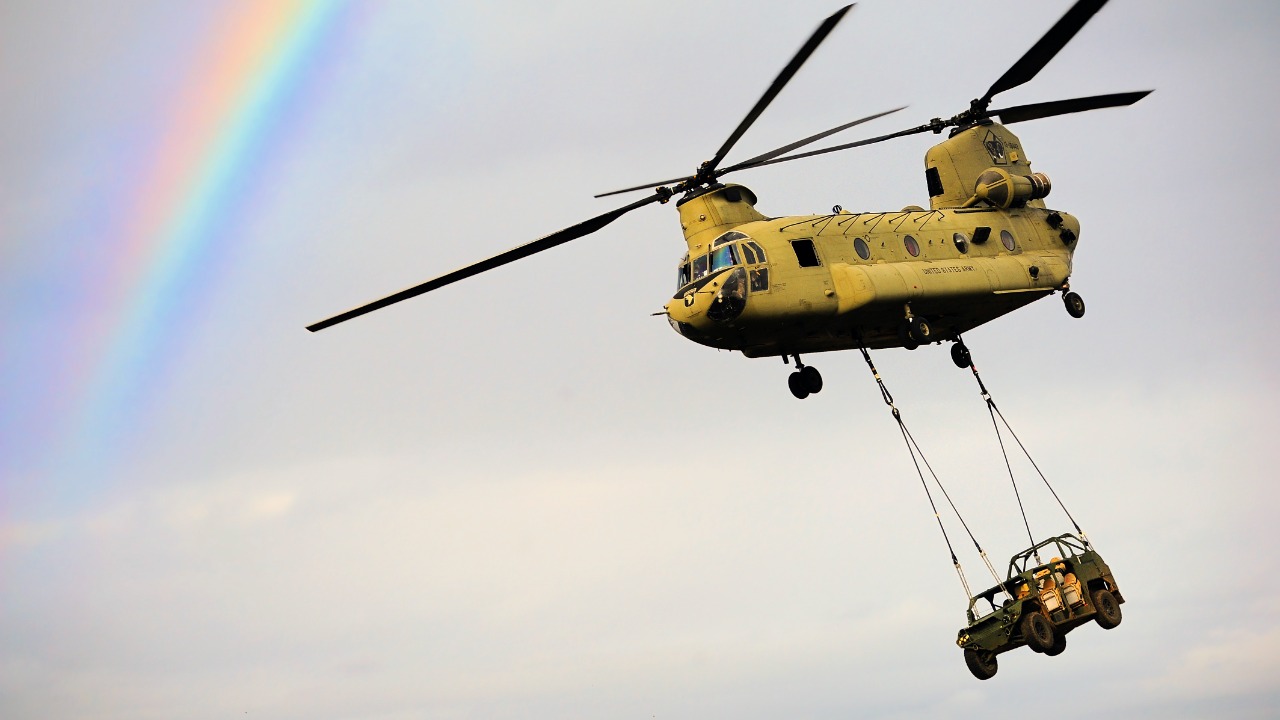
What makes the Chinook truly hard to replace is not just how much it can lift, but how many different missions it can perform without major reconfiguration. A detailed video profile notes that The CH-47 Chinook is a versatile heavy-lift helicopter used by the US Army and other countries for over 60 years, shifting between troop transport, cargo, and humanitarian roles as needed. Another explainer emphasizes that The CH-47 Chinook is a powerful twin-engine, tandem-rotor heavy-lift helicopter developed by Boeing and used in troop transport, artillery movement, vehicle delivery and other tasks, illustrating how a single airframe can cover missions that would otherwise require several specialized aircraft types.
Frontline perspectives reinforce that flexibility. In one discussion among helicopter pilots, a user identified as Finally a topic expert on the CH-47 side explains how the aircraft’s ability to work from slightly larger landing zones while carrying far more weight than smaller utility helicopters makes it uniquely valuable. Another conversation among Army aviators notes that while tactics are changing and some expect fewer landings directly “on the X,” there is still no aircraft fielded or proposed that can replace the Chinooks when the mission requires moving large chunks of combat power in a single lift.
Why no true replacement is on the horizon
Despite a new generation of rotorcraft programs, the Chinook’s specific role remains uncovered. A detailed look at future Army aviation plans explains that “The FARA — Future Attack Reconnaissance Aircraft — and the Future Long Range Assault Aircraft are the two plans” shaping the next wave of helicopters, but they are focused on reconnaissance and assault, not on replicating the CH-47’s extreme heavy-lift niche. That gap is why, even as these programs mature, the Chinook remains the only platform that can move entire artillery batteries, bridge sections or large engineer equipment in a single sortie.
Army planners themselves acknowledge this dependence. As the US Army looks toward its future force structure, the Chinook remains irreplaceable in the heavy-lift category, with expectations that it will stay in service for many years to come. A related analysis notes that As the US Army evaluates new technologies, the As the US Army sees the CH-47 Chinook as irreplaceable because of its combination of range, payload and versatility, and is even exploring autonomous capabilities to extend its relevance. That push to turn a Cold War-era airframe into an autonomous heavy-lift robot underscores a simple reality: it is easier to keep upgrading the Chinook than to design something entirely new that can do all the same jobs.
A heavy-lift workhorse built to endure
All of these factors, from tandem rotors to engine power and mission breadth, add up to a helicopter that has become more infrastructure than equipment. The CH-47 Chinook is described by civilian heavy-lift operators as one of the most capable and proven helicopters in the world, a judgment echoed by military histories that place the type at the center of air mobility efforts for decades. The CH-47 Chinook’s record in firefighting, disaster relief and remote construction shows that its value extends far beyond the battlefield.
At the same time, its design still has room to grow. Technical references point out that The CH-47 is powered by two turboshaft engines and built with redundant systems, giving it the resilience needed for autonomous upgrades and future mission systems. Analysts who track modernization efforts argue that as long as no single aircraft program is tasked with replacing the Chinook’s heavy-lift role outright, the CH-47 Chinook will continue to be the machine commanders reach for when they need to move the heaviest loads into the toughest environments.