
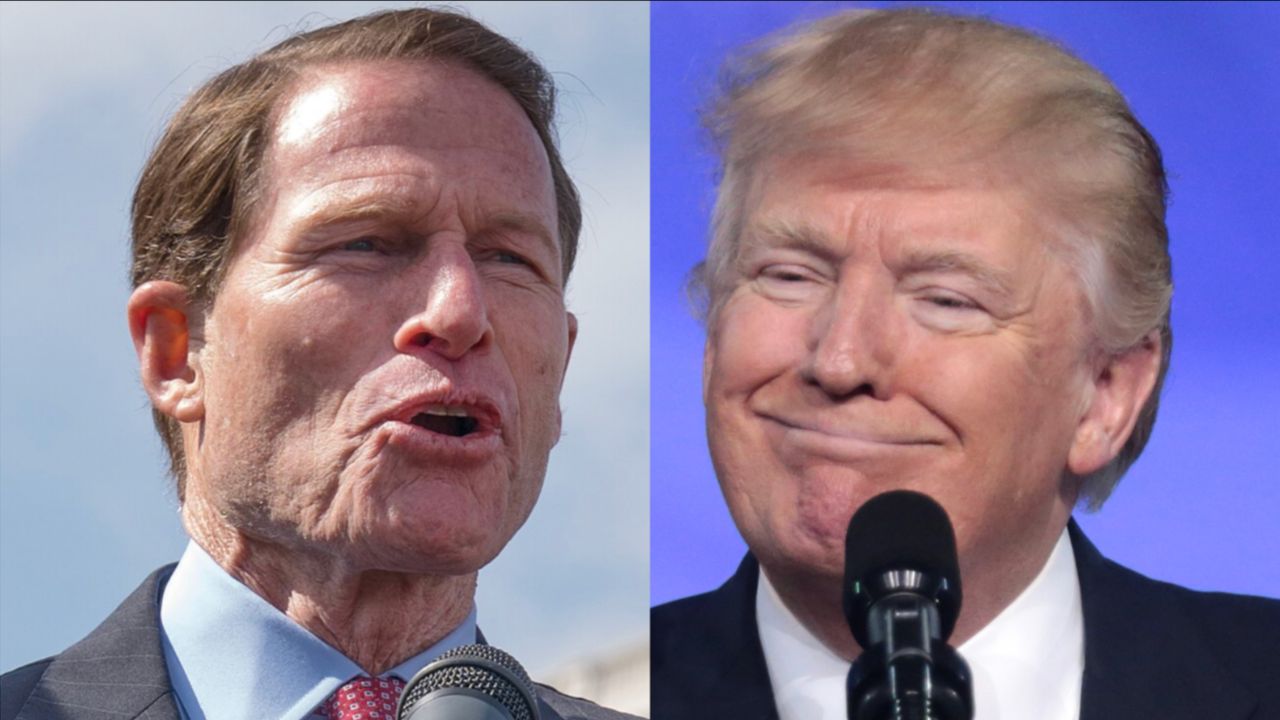
Sen. Richard Blumenthal (D-Conn.) on Saturday rejected President Donald Trump’s stated reason for barring three major news organizations from the White House, arguing that the outlets Trump accuses of writing negative stories are simply reporting accurately on policies that have hurt Americans. The senator’s post on X came hours after reporters for CNN, MS NOW and Politico were turned away at White House security and had their press passes taken.
The Full Post
Blumenthal published the post at 6:44 p.m. on Saturday, Sept. 19, 2026. It read in full:
“Reputable, reliable outlets you’re banning from the White House, Mr. President, don’t “purposely write negative news.” They report accurately on your negative policies that have negative impacts on Americans.”
The senator’s quoted phrase, “purposely write negative news,” comes from Trump’s own explanation of the ban. Speaking to reporters in the Oval Office on Friday, Trump said no particular story had prompted the decision. He said the outlets “purposely write negative news,” and described the tone of their coverage as the reason for the action.
What Trump Announced
The ban was first announced on Friday. Trump posted on Truth Social that he was banning CNN, MS NOW and Politico from the White House “effective immediately,” and warned that similar action could follow against other outlets. Trump wrote that the media outlets “shouldn’t be able to constantly write or report FICTION and LIES,” and added, “Other Fake News Media Outlets to
Speaking in the Oval Office, Trump told reporters there was no specific incident behind the decision. “It’s really just cumulative stories over the past few years,” he said, according to Reuters. He also said he does not have to let the outlets into “the people’s house.” Asked what he meant by other outlets to “follow,” Trump named The New York Times and The Washington Post, which he called “fake news.”
Trump also pointed to Politico’s finances. He alleged that the government under former President Joe Biden had given the outlet about $8 million to keep it afloat. Politico called that claim false and said it had been thoroughly debunked. Asked how far the ban would go, Trump said he did not want the outlets in his office.
The Ban Takes Effect
The announcement became a physical barrier on Saturday morning. A reporter and a cameraman from MS NOW were refused entry, and Secret Service officers confiscated their press badges at a security gate outside the West Wing. CNN later said White House reporter Betsy Klein was also denied access, and Politico’s editor-in-chief said the same of reporter Cheyenne Haslett. MS NOW reporter Akayla Gardner said an officer told her the decision was “above him.”
The outlets responded with statements defending their coverage. CNN said a ban would be “an illegal assault” on its constitutional right to report without government interference. MS NOW said it would take “any and all steps necessary” to defend its First Amendment rights. Politico said it would “vigorously defend” those rights. The White House Correspondents’ Association, which represents the wider press corps, said the ban violates the First Amendment.
The First Amendment Question
Free speech experts told Reuters the move conflicts with constitutional protections for a free press. Jameel Jaffer, executive director of the Knight First Amendment Institute at Columbia University, said that if Trump meant to expel the outlets from the White House press pool, the action would be “doubly unconstitutional.” He argued that the pool is a “public forum” from which journalists cannot be excluded because of their viewpoints. Reuters noted that courts have historically given presidents broad discretion over access to events such as Oval Office meetings and small press pools, while broader exclusions from press facilities or credentials could face stronger challenges.
The ban follows a pattern Reuters described as an escalating campaign against the press. Trump barred the Associated Press from the regular press pool last year after the agency declined to adopt his preferred name for the Gulf of Mexico. He has also sued The Wall Street Journal, The New York Times, the BBC and the Des Moines Register. His defamation suits against ABC and CBS ended in settlements of $15 million and $16 million. In his first term, federal judges ordered White House press passes restored to CNN’s Jim Acosta and Playboy correspondent Brian Karem.
Blumenthal’s Record on Press Freedom
Blumenthal’s post is consistent with years of statements on the subject. In May 2017, he wrote to then-Attorney General Jeff Sessions after reports that Trump had suggested to then-FBI Director James Comey that he consider jailing journalists who publish classified information. In the letter, Blumenthal called a free, unfettered press the “hallmark of our democracy” and said the president’s comments seemed calculated to chill First Amendment rights.
He later wrote to Federal Communications Commission officials after Trump publicly wondered whether NBC’s license should be challenged over coverage. Blumenthal called the president’s threat “an affront to the First Amendment” and warned of a chilling effect on newsrooms. He also led a Senate resolution in 2018 after the White House barred CNN’s Kaitlan Collins from a press event. The resolution condemned efforts to restrict media access. At the time, Blumenthal called punishing reporters “a strongman tactic that cannot be tolerated in a free democracy.”
Blumenthal’s more recent work has continued that focus. On Sept. 29, 2025, he and Sen. Elizabeth Warren (D-Mass.) hosted a forum on the administration’s use of the FCC and other government authority to chill protected speech and independent reporting. In February 2026, as ranking member of the Permanent Subcommittee on Investigations, he opened a preliminary inquiry into what he called the FCC’s abuse of power. He also joined Sen. Adam Schiff (D-Calif.) in a bipartisan amicus brief arguing that executive orders against law firms “stifle speech and distort public discourse.”
The Political and Defense Backdrop
The confrontation comes weeks before the Nov. 3 midterm elections, in which Republicans are defending narrow congressional majorities. Reuters/Ipsos polling shows the public souring on Republicans, and Trump’s approval ratings are near historic lows amid the Iran war he launched, which has driven up energy prices. Blumenthal, a member of the Senate Armed Services Committee, is among the Democrats who have criticized the administration over the war and its handling of information.
It remains unclear how far the ban will extend or whether it will be challenged in court. Trump has said other outlets are next, and the legality of any action may depend on its scope, Reuters reported. For now, the dispute stands as a direct exchange between a president who says the outlets “purposely” write negative news and a senator who says they are reporting accurately on negative policies.