
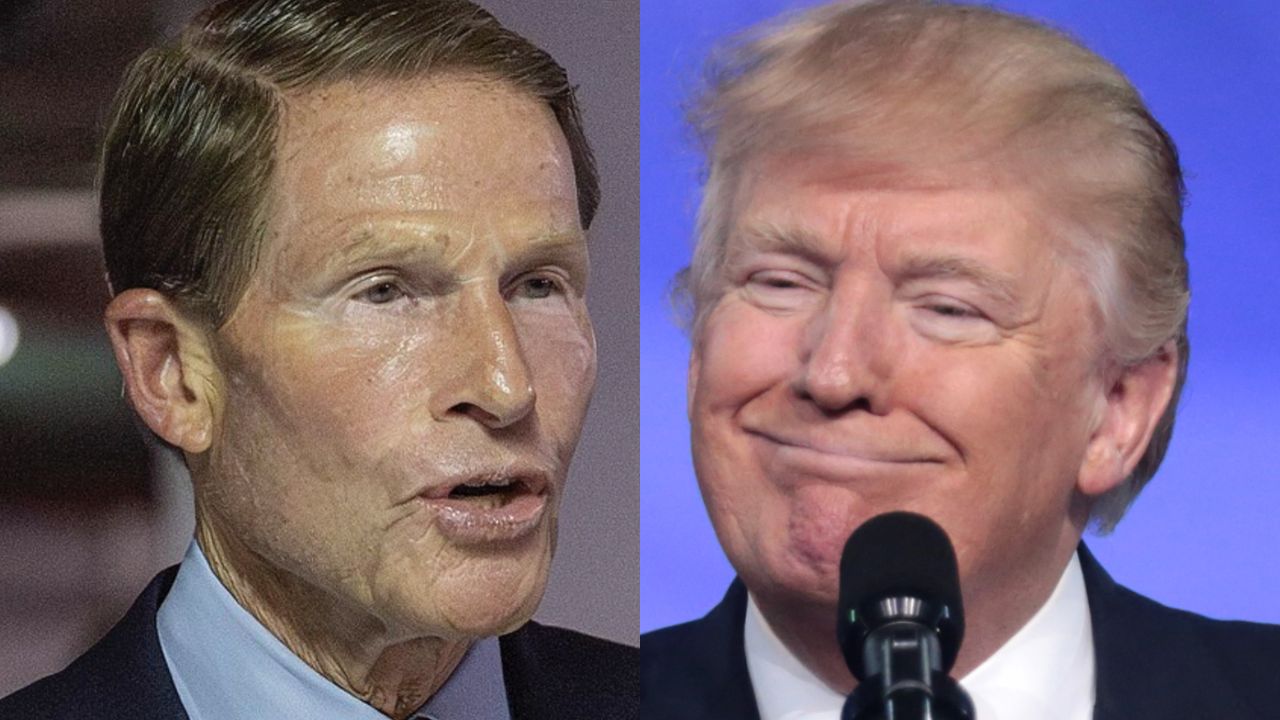
Sen. Richard Blumenthal, the Connecticut Democrat who co-wrote the Russia sanctions law President Donald Trump signed less than a month ago, accused the president Sunday night of putting “blood money” in Vladimir Putin’s pocket. He wrote that Trump “makes America complicit” in the killing of Ukrainian civilians, and the charge came as bipartisan opposition built in the Senate to a new U.S.-Russia diesel agreement.
The Post
Blumenthal published his statement on X at 9:55 PM on Sunday, Oct. 11, 2026. The full post read:
“Putting blood money in Putin’s pocket, Trump makes America complicit in Russia’s slaughtering innocent Ukrainians.”
He attached a Politico report on a bipartisan group of senators demanding that Trump kill the Russian diesel deal, which questions the legality of the decision under Congress’ 2022 ban on Russian energy imports.
The Deal That Set Off the Backlash
The post followed an announcement Trump made on social media Friday, Oct. 9, that he had struck a deal with Putin during a phone call. Trump said Russia would immediately supply more than 300,000 tons of diesel to the American and global market, followed by 500,000 tons in November and 1 million tons “immediately thereafter.” He added that Russia would deliver another 3 million tons “within a short period of time” after that.
The administration temporarily lifted U.S. sanctions on Russian fuel that had been designed to deprive Moscow of revenue for its war on Ukraine. Trump also declared an “ENERGY CEASEFIRE” in the war between Russia and Ukraine in a Truth Social post, but he gave no details or evidence that Moscow had agreed. The agreement overshadowed talks between U.S. and Ukrainian negotiators in Miami on Friday, and Ukrainian President Volodymyr Zelenskyy warned that easing sanctions without a lasting de-escalation agreement would signal weakness.
Seven Senators Demand a Reversal
On Sunday, seven senators issued a joint statement calling on the administration to “immediately reverse course.” Four Republicans signed it: Susan Collins of Maine, Lisa Murkowski of Alaska, Thom Tillis of North Carolina and John Curtis of Utah. They were joined by three Democrats: Jeanne Shaheen of New Hampshire, Richard Blumenthal of Connecticut and Ron Wyden of Oregon. The criticism marked a shift from the near-unanimous Republican support Trump’s foreign policy decisions have typically enjoyed, coming weeks before the Nov. 3 midterm elections that will determine control of Congress.
The senators wrote that Congress banned Russian energy imports in 2022 specifically to keep American dollars from financing Putin’s war against Ukraine, and that the ban was to remain until Russia ends its aggression and stops threatening NATO allies. They added that the administration had failed to consult Congress or submit any explanation to justify the decision, as the statute requires. “The United States should not provide Putin with a financial lifeline while Russia continues to kill Ukrainian civilians,” the senators wrote. “The Administration must immediately reverse course.”
Tillis: “Legitimate Case” That the President Is Not Following the Law
Tillis, a Republican who frequently splits with the Trump administration, had already questioned the deal’s legality Sunday on “Meet the Press.” He pointed to the conditions the 2022 law sets for lifting the import ban, including a full Russian withdrawal from Ukraine. “I do believe there’s a legitimate case for saying the president’s not following the law,” Tillis said. “We were very clear that Russia is the aggressor. Russia is the one who can end this war by backing out of territory they occupied.”
The Administration’s Response
The White House, responding to Tillis’ criticism, pointed to Trump’s Truth Social post and did not immediately respond to a request for comment on the senators’ joint statement. Treasury Secretary Scott Bessent said Sunday that the administration will follow through with the deal using existing legal authority, and that the agreement is good for Americans and will bring prices down. Sen. John Barrasso, R-Wyo., said Trump is focused on reducing the cost of energy when asked whether the action would violate U.S. law.
Fuel Prices and the Iran War
The move comes as Trump works to bring down fuel prices ahead of the midterms, with the U.S.-Iran war, now in its seventh month, driving the surge in costs. The war began Feb. 28 with U.S. and Israeli strikes on Iran, and Iran has since closed the Strait of Hormuz. In September, the average price of diesel hit a record $6.53 per gallon, according to AAA.
Blumenthal’s Long Record on Russia
Blumenthal’s position is consistent with years of public statements. A member of the Senate Ukraine Caucus, he pressed for tougher sanctions on Moscow as early as 2017, when he joined a bipartisan group introducing the Counteracting Russian Hostilities Act of 2017, which mandated sanctions for cyberattacks and military aggression in Ukraine. At the time he called Putin a “KGB thug” who would “exploit our weaknesses.”
For more than a year before the law’s passage, Blumenthal and the late Sen. Lindsey Graham, R-S.C., pushed sanctions legislation that would hit buyers of Russian oil and gas. After Trump threatened 100 percent secondary sanctions on Russia’s trading partners in July 2025, the two senators said “the days of doing this without consequences are coming to an end.” They added that their bill would implement up to 500 percent tariffs on countries that buy Russian oil and gas and do not help Ukraine.
In 2025, Blumenthal issued two statements criticizing Trump’s handling of Russia. When Trump’s self-imposed deadline for Russia to end the war passed, he said Trump was “dodging his own deadline” and that Putin continued to “murderously bomb Ukrainian children and families” while holding more than 20,000 kidnapped Ukrainian children. After a White House meeting with Zelenskyy at which Trump did not commit to providing long-range Tomahawk missiles, Blumenthal said Trump was “playing into Putin’s hands” by slow-walking aid Ukraine needs.
The Sanctions Law Trump Signed
Graham and Blumenthal announced a White House deal on the legislation on July 10, and Graham died suddenly the next day. The Senate passed the bill 86-11 on Aug. 7. “Today we say to Vladimir Putin: You will not conquer Ukraine,” Blumenthal said after the vote. The House followed 262-159 on Sept. 16, and Trump signed the Lindsey O. Graham Sanctioning Russia and Iran Act of 2026 on Sept. 18.
The law authorizes sanctions on Russian officials, banks, the energy sector and the “shadow fleet” of tankers used to evade existing restrictions. It allows tariffs of up to 100 percent on top buyers of Russian oil and gas, and it gives the president waiver authority when he deems it in the national interest. The diesel announcement came just weeks later.
Blumenthal on the Iran War and Gas Prices
A member of the Senate Armed Services Committee, Blumenthal has also been an outspoken critic of the Iran war. In April, after Senate Republicans voted down war powers resolutions, he said Trump’s actions had brought “U.S. servicemembers deployed and killed; civilians slaughtered; and Americans are seeing their bills skyrocket.” He pledged to continue “holding our colleagues and this Administration accountable for Trump’s costly, illegal war” with further votes under the War Powers Act. He also asked the Transportation Secretary to monitor and possibly investigate fuel price increases hitting airlines and consumers.
On gas prices, Blumenthal said they had risen about 60 percent since the war began and renewed a push for the Gas Prices Relief Act, which would lift the federal gas tax. He also promoted his Big Oil Windfall Profits Tax Act, which would tax the largest oil companies and return the revenue to consumers as rebates. The Senate rejected the most recent Iran war powers measure 49-50 on Sept. 24, which was expected to be the final such vote before the midterms.
Russia’s Escalating Strikes on Civilians
The deaths Blumenthal referenced have mounted in recent days. In the overnight hours of Oct. 7, Russia fired roughly 130 drones and 48 cruise and ballistic missiles at Kyiv and a dozen other Ukrainian regions, Ukraine’s air force said. The attack killed at least 21 civilians, including four children, and wounded about 60, Ukrainian officials said. Russia’s Defense Ministry said it struck military-industrial facilities. The UN humanitarian coordinator for Ukraine responded that all attacks targeting civilians and civilian infrastructure violate international humanitarian law and “must end immediately.”
The strikes continued through the week. On Oct. 8, a Russian glide bomb hit two passenger buses in Kramatorsk and reportedly killed at least 33 people, UN officials told the Security Council. A strike on a residential building in Zaporizhzhia later killed at least 23 civilians, including four children. Zelenskyy said Sunday that Russian forces carried out 196 strikes on Ukrainian electrical infrastructure and 20 on oil infrastructure over the past week, killing 153 civilians.
A Growing Civilian Toll
Zelenskyy said on Oct. 3 that Ukraine has new evidence Russia is purposefully targeting civilian infrastructure, describing a “new doctrine.” Ukrainian Ombudsman Dmytro Lubinets has said Russian strikes inflicted more Ukrainian casualties from January to August 2026 than in all of 2025. UN monitors have verified 2,222 civilians killed and more than 13,000 injured in Ukraine this year. UN officials warned the Security Council that the intensifying attacks threaten to leave millions without electricity, heating and water as winter approaches. Russian Security Council Chairman Dmitry Medvedev said Sunday that Russian forces and ballistic weapons are the only tools bringing Russia closer to victory.