
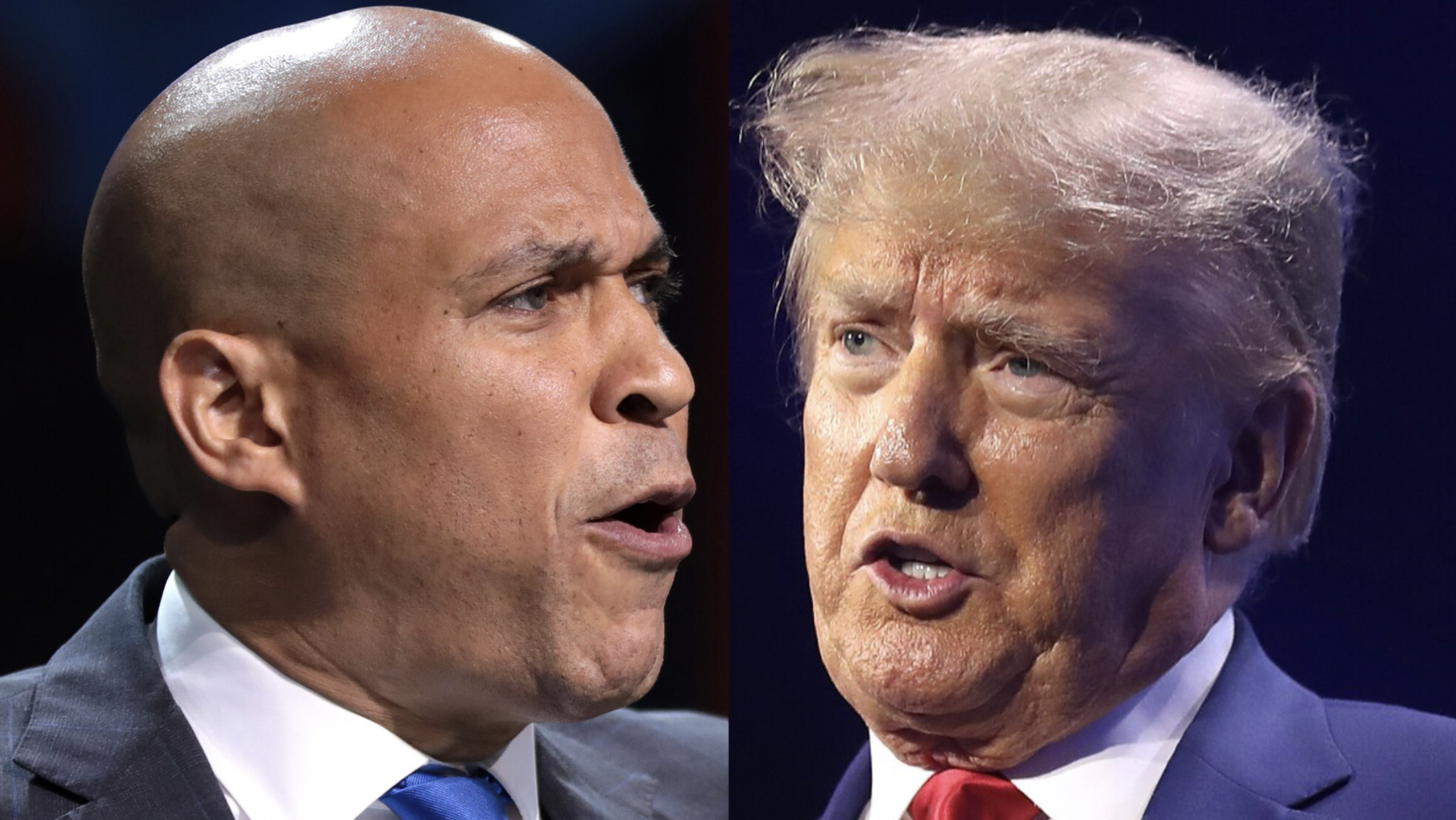
Sen. Cory Booker, D-N.J., rejected the notion that President Donald Trump deserves credit for bringing the Iran war to a close, comparing the president to an arsonist who sets a fire and then expects praise for escaping the building. Booker’s remarks, delivered Sunday on NBC News’ “Meet the Press,” came in direct response to comments made earlier in the week by Democratic strategist James Carville, who argued that Trump should be commended for recognizing a failing conflict and exiting it.
Host Garrett Haake introduced the exchange by playing a clip of Carville’s comments, made on NewsNation’s “Cuomo” program. “We start a war and we surrendered. Let’s be very clear about that,” Carville said. “Let’s give Trump credit where credit is due, he did what Lyndon Johnson did not do in Vietnam, just get out. I think the best thing Biden ever did was just leave Afghanistan. I will give Trump credit, he saw this thing was going the wrong way and he just quit and got out and sometimes you’ve got to do that.”
Haake then asked Booker directly whether Trump deserved any credit for ending the war rather than escalating it further. Booker’s answer was unequivocal. “That’s like giving somebody credit for literally an arsonist starting a fire and getting credit for running out of the burning building,” Booker said. “This president has led this nation into a disaster. We have surrendered our power, we have capitulated to the enemy, and they now are mocking us.”
Booker went on to argue that Iran’s government understood the outcome of the conflict differently than the Trump administration has portrayed it. “Look at everything that’s coming out of that country from their internal dialogue all the way to what they’re saying publicly,” Booker said. “They know that they’ve won this and they know Donald Trump is perhaps on the world stage right now the biggest loser with egg on his face.” He called for stronger congressional oversight of the administration going forward. “We need to curtail this chaotic, corrupt and cruel president,” he said. “We need to have checks and balances on his power.”
Booker also directed criticism toward congressional Republicans, whom he accused of enabling the war’s conduct only to object once its outcome became politically inconvenient. “I am really sorry that congressional Republicans from the start of this war has allowed him to do everything he wanted to do and now they’re crying foul because they don’t like the results,” he said. “Shame on Congress. It is time we get a Congress that will stand up to this president.”
Following the broadcast, Booker posted a clip of the exchange to X, accompanying it with a caption that distilled his argument into a single line: “Trump is like the arsonist who starts a fire and wants credit for running out of a burning building. He is the biggest loser on the world stage. It is time we get a Congress that stands up to this president.”
The exchange reflects a consistent thread in Booker’s public statements throughout the conflict, which began with U.S. and Israeli strikes on Iran in late February 2026. Booker has argued from the outset that the war was unauthorized by Congress and strategically unsound. In a statement issued shortly after the initial strikes, Booker said the operation amounted to “a consequential, dangerous gamble” that put American servicemembers at risk without a clear plan for what would follow. “We do not know the full consequences of the President’s actions,” Booker said at the time. “And there are too many unanswered questions — answers to which the president owes Congress and the American people.”
Booker has repeatedly framed the war’s costs in concrete terms throughout the months that followed. In March, after the Senate blocked a war powers resolution he had introduced with five Democratic colleagues, Booker noted that $25 billion had already been spent on the conflict “with zero accountability,” and that the same amount could have funded health insurance, school lunches or housing assistance for millions of Americans. That same month, Booker and dozens of Senate colleagues pressed Defense Secretary Pete Hegseth for answers after an airstrike in Minab, Iran, struck a girls’ elementary school, killing more than 168 people, most of them children. “To be clear, the war against Iran is a war of choice without Congressional authorization,” the senators wrote.
Booker’s “arsonist” framing on Sunday extended an argument he had made consistently as the war progressed: that responsibility for the conflict’s costs rests with the decision to start it, not with the manner of its conclusion. He has made this case while leading or co-sponsoring a series of War Powers Resolutions throughout the spring, including measures in March, April and May that sought to force a congressional vote on ending U.S. involvement in hostilities with Iran absent formal authorization. In May, the Senate advanced one such resolution led by Booker and Sen. Tim Kaine, D-Va., alongside Senate Democratic Leader Chuck Schumer and seven other senators — what Booker called “the first real step towards ending” the war.
The Carville exchange also highlighted a divide within Democratic ranks over how to characterize the war’s conclusion. While Carville credited Trump for recognizing a deteriorating situation and withdrawing from it, comparing the decision favorably to Biden’s exit from Afghanistan, Booker maintained that no credit was warranted for ending a conflict the administration itself had initiated without congressional authorization. Booker extended that critique to the terms of the resulting memorandum of understanding, which commits the United States to a $300 billion reconstruction fund for Iran and a schedule for lifting sanctions — provisions he has separately called “an abject surrender.”
Booker’s comments came as instability continued in the region. Iran said Saturday that the Strait of Hormuz had closed again following Israeli strikes in southern Lebanon, and Vice President JD Vance traveled to Switzerland on Sunday for continued negotiations toward a final agreement. Asked separately during the same interview whether Israel could be considered a reliable partner in the peace process, Booker offered a pointed assessment of both Trump and Israeli Prime Minister Benjamin Netanyahu. “Between Israel and America we have two criminal presidents,” he said, “these are two failed world leaders… that I cannot wait until they are off the world stage.”
Taken together, Booker’s remarks on Sunday — the arsonist comparison, the rejection of Carville’s argument, and the call for Congress to reassert its authority — represented a continuation of the case he has made since the war’s opening days: that the conflict was a choice, that its costs were avoidable, and that ending it does not erase the responsibility for having started it.