
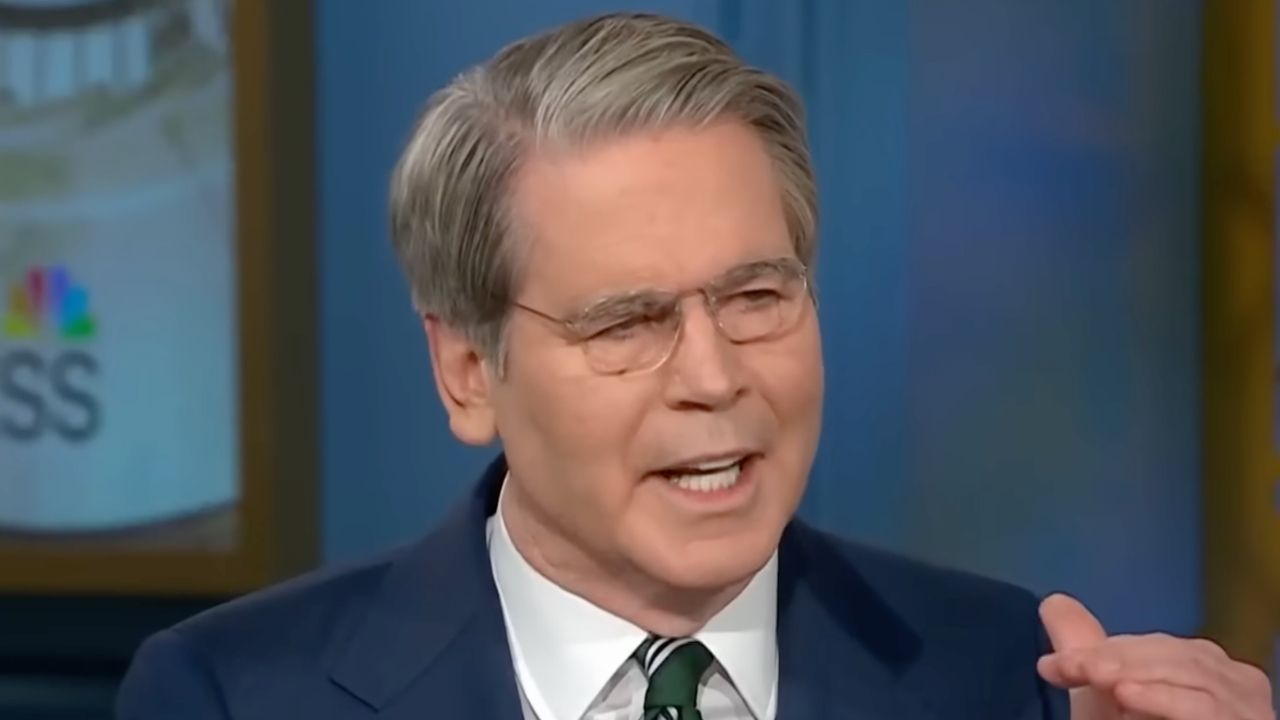
Treasury Secretary Scott Bessent said Sunday that the Trump administration plans to sanction another bank this week as part of an intensifying campaign to economically isolate Iran, warning financial institutions still doing business with Tehran that “this is going to be financial violence if we have to.” Bessent’s remarks, delivered in an interview ahead of Group of 20 finance meetings in Asheville, North Carolina, came on a day when U.S. forces carried out their first military strike on Iranian targets in a month, breaking weeks of relative calm in a war that has now stretched past the six-month mark.
“This is going to be financial violence if we have to,” Bessent said. “We are showing people that we know who you are, you know who you are, and this has got to stop.”
Treasury Widens Its Sanctions Campaign
Bessent’s comments build on an effort the Treasury Department launched last week under the internal designation “Operation Economic Outcast,” aimed at pressuring governments and financial institutions worldwide to sever economic ties with Iran. Bessent indicated the pace of penalties would accelerate in the coming weeks, with banks as the initial focus. “You’re going to see a lot more of these every week,” he said ahead of the G20 finance ministers’ gathering.
He described the underlying message to G20 counterparts in blunt terms, telling them there would be no exceptions for continued dealings with Tehran. “There can be no leakage,” Bessent said. “You’re either with us or you’re with the Iranians.”
Treasury’s first concrete step in the campaign came Friday with a proposed rulemaking that would, if finalized, cut off the United Arab Emirates branches of Banque Misr — Egypt’s second-largest bank — from access to the U.S. financial system over its alleged financial links to Iran. By stopping short of full sanctions on the bank itself, the administration signaled a degree of caution about penalizing major trading partners, including China and India, that continue to do business with Tehran.
Strait of Hormuz Strike Breaks a Month-Long Lull
The renewed sanctions push unfolded against the backdrop of fresh hostilities on the ground. U.S. forces struck two Iranian rocket launchers on Larak Island in the Strait of Hormuz on Sunday, the first American military action in the theater in roughly a month. U.S. Central Command spokesperson Captain Tim Hawkins said Islamic Revolutionary Guard Corps forces had been observed preparing to launch rockets carrying sea mines into the strait before the strike was carried out.
Iran’s Revolutionary Guard acknowledged the strike, reported casualties among its forces, and vowed to retaliate. A statement carried by Iran’s state broadcaster referenced “the martyrdom and injury of several of our fighters and compatriots.” Semiofficial Iranian outlets also reported hearing explosions near Larak Island following the strike.
The U.S. military had completed clearing sea mines from the strait’s international shipping routes only the week before. Iran continues to hold that even after finalizing a management arrangement for the strait with neighboring Oman, the United States cannot use the waterway until it meets its obligations under the memorandum of understanding the two countries signed in mid-June. President Trump has repeatedly stated that the Strait of Hormuz “is open,” citing 24 vessels that passed through last week — a fraction of the roughly 130 ships that transited daily before the war began.
China’s Role in the Pressure Campaign
Asked about Beijing’s continued purchases of Iranian oil, Bessent said he would raise the issue directly with his Chinese counterparts at the G20 meeting and that “all options are on the table” regarding potential sanctions against China. He rejected suggestions that the administration has been reluctant to confront Beijing over the matter, calling that characterization “a completely false narrative that the media picked up on.”
Bessent argued that Washington and Beijing share common ground on reopening the Strait of Hormuz and preventing Iran from developing a nuclear weapon. He also said the effectiveness of a U.S. naval blockade on Iranian ports had already curtailed most of China’s Iranian oil purchases, with stored Iranian crude aboard tankers continuing to dwindle. “Problem solved,” he said.
Media Access Restricted at G20 Summit
The Treasury Department barred certain reporters from The New York Times, The Wall Street Journal and Bloomberg News from covering the G20 meetings in Asheville. The Times characterized the move as “not just another disturbing effort by the administration to undermine independent journalism, but a blatant attempt to evade public scrutiny.” Treasury officials did not publicly explain the basis for the exclusions.
Bessent defended the decision when pressed by the AP, saying “it has nothing to do with point of view.”
Debt, Deficit and Bond Market Scrutiny
Beyond the Iran sanctions push, Bessent said he intended to use his one-on-one meetings with G20 counterparts to focus on global economic growth. “The world has this mountain of debt, and we do have to grow our way out of it because you know there are many countries that have very large budget deficits, but they also have zero growth,” he said.
The Treasury secretary has faced separate scrutiny in recent weeks over an unusual bond buyback intervention that surprised financial markets. The move, which came the same day U.S. national debt surpassed $40 trillion, was widely viewed as an attempt to cap rising bond yields that have driven up borrowing costs for consumers.
Among the sharpest critics has been Stan Druckenmiller, chief executive of Duquesne Family Office LLC and a former employer of Bessent’s in the 1990s, who wrote in The Wall Street Journal that the Treasury Department was on “the wrong side of that trade” and needed to do more to confront the deficit. Bessent responded to the criticism by noting the two remain in contact. “Stan’s a great money manager. He changes his mind a lot,” Bessent said. “He’s twice called for the U.S. to default on its debt — once in the 1990s, and once in 2011 — so he likes extreme measures. I don’t think we’re at the point where we need extreme measures yet.”
Bessent told the AP he is working with Office of Management and Budget Director Russ Vought on a fiscal package intended to reduce the debt and deficit, which he said would be unveiled in the coming weeks. He also argued that long-term U.S. bond yields had declined in August “for all the noise” and characterized rising yields more broadly as “a global phenomenon,” attributing part of the recent deficit increase to tariff refunds the government was compelled to issue after the U.S. Supreme Court ruled Trump had exceeded his authority with sweeping import tariffs.
Context: A War Approaching Seven Months
Sunday’s strike came as the U.S.-Iran conflict, launched February 28, 2026, under the codename Operation Epic Fury, passed the six-month mark. The administration has increasingly signaled a pivot from direct military strikes toward sustained economic pressure, a shift officials have described internally as an “economic D-Day” against a country already subject to decades of sanctions. Iran, for its part, has continued to assert leverage through intermittent strikes on shipping in the Strait of Hormuz, a waterway through which roughly 20 percent of the world’s oil normally flows.