
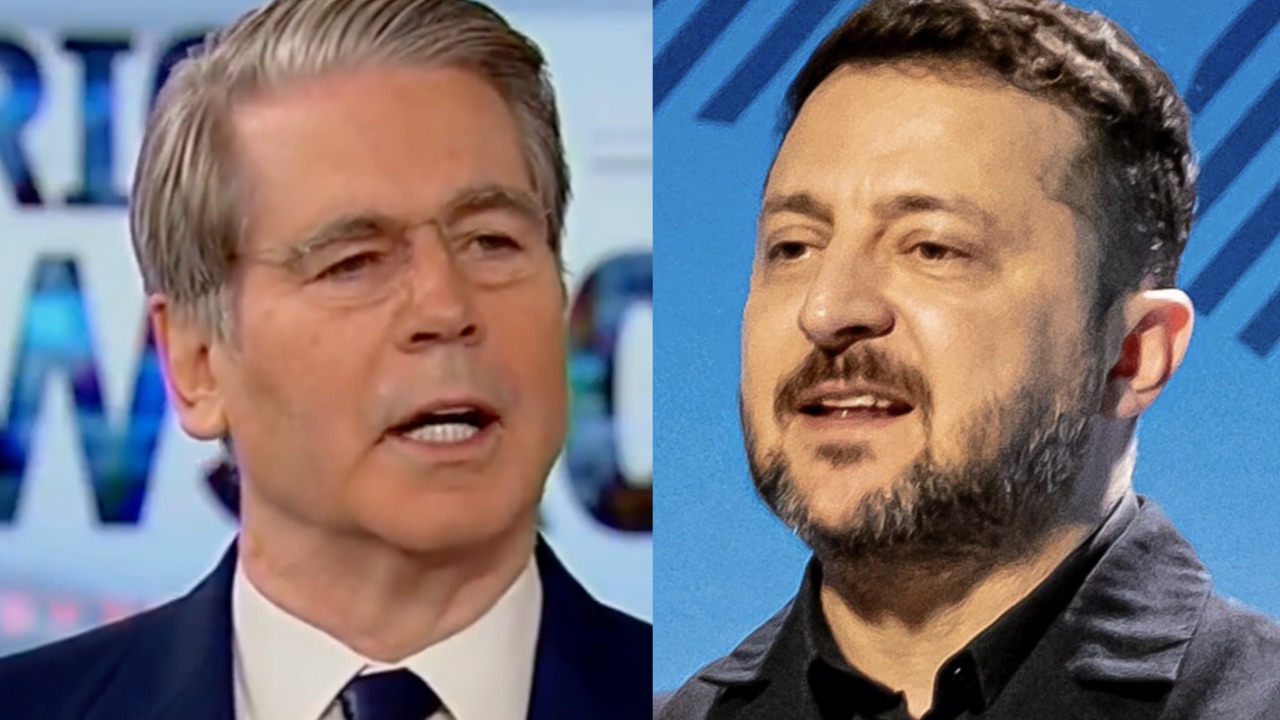
U.S. Treasury Secretary Scott Bessent on Sunday pointed to Britain’s decision in May to keep allowing imports of diesel and jet fuel made from Russian crude, and said that “President Zelenskyy does not criticize his European partners.” He was defending President Donald Trump’s move to waive most of a new Russia sanctions law, after Ukrainian President Volodymyr Zelenskyy criticized that move earlier in the same program.
“The only thing that has been lifted is the diesel embargo. And, you know, I will point out the U.K. in May waived their embargo on diesel and jet fuel made with Russian crude. So, you know, where’s the outrage for the rest of the world? President Zelenskyy does not criticize his European partners,” Bessent said on NBC’s “Meet the Press,” according to the network’s official transcript of the Oct. 18 broadcast.
He went on: “He seemed a bit disassembled in that interview. The Europeans are financing the Russian war machine. The U.S. imports $4 billion of Russian products. 1.8 billion of that fertilizer. Europeans import more than ten times that.”
Bessent made the remarks after moderator Kristen Welker asked what Russian President Vladimir Putin had done to deserve sanctions relief. Bessent said “no sanctions were lifted on Friday,” and when Welker asked whether they would be, he said, “There is a 60-day period so we can examine what’s going on.” NBC’s Meet the Press account posted the full interview on X at 10:30 a.m. EDT (1430 GMT) on Sunday.
Earlier in the program, Zelenskyy told Welker that Trump’s waiver was “strengthening Putin’s war against us.” He said Putin “feels victory with sanctions, and diesel deal,” and added, “This diesel deal is very dangerous. It doesn’t have influence, the real influence on the price in the United States. We understand that the price is because of blocking of Hormuz, the Strait of Hormuz.”
Trump signed an executive order on Oct. 16 waiving the duties in the Lindsey O. Graham Sanctioning Russia and Iran Act of 2026, including a 500% tariff on Russian goods, along with most of the law’s sanctions provisions. The order says the waivers remain in effect until the president or the secretary of state determines “further action is appropriate,” and that it does not affect sanctions under earlier executive orders on Russia.
The Senate passed the bill 86-11 on Aug. 7, according to the roll call. The House approved it 262-159 on Sept. 16, and Trump signed it into law on Sept. 18.
The diesel measure Bessent mentioned is separate from the executive order. On Oct. 9, the Treasury Department’s Office of Foreign Assets Control issued General License 135, which authorizes transactions involving the sale, delivery and import of diesel fuel of Russian origin, including into the United States, through April 7, 2027.
Trump explained his decision in a Truth Social post at 4:36 p.m. EDT on Sunday, hours after the broadcast, writing that he did not “want to do anything that will drive, foolishly, Russia away from the bargaining table.” He also wrote that Zelenskyy “is using Diesel Refineries in Russia as a target, knowing that these attacks are seriously hurting the world diesel markets.”
The British measure Bessent cited is a general trade licence published May 19. It allows imports of diesel and jet fuel processed in third countries from Russian crude. The licence came into force on May 20, the same day a new British ban on such products took effect, and it was amended on June 12 to expire by Jan. 1, 2027.
The British government described the licence as a temporary step to phase in that ban, not a rollback. “We are not lifting any existing sanctions at all,” Trade Minister Chris Bryant told Parliament on May 20, according to Hansard. Bryant said the licence was issued “in the light of the situation in the middle east” and said the decision had been handled “clumsily.” In a June 12 announcement, the government said it would review the licence every two weeks and lift it “as soon as possible.”
Ukraine did respond to the British decision at the time. Zelenskyy said on May 20 that his team had been in contact with London and that Ukraine had “conveyed our views” on the matter. That evening, Prime Minister Keir Starmer spoke with Zelenskyy and set out the new British sanctions package, according to Downing Street.
Ukrainian officials have also pressed Europe for tougher steps. Foreign Minister Andrii Sybiha wrote on X early Sunday that the EU should bar Russian combatants and their families from entering the bloc, adding, “Only tough pressure can stop Putin.” In the NBC interview, Zelenskyy said Ukraine had “support of Americans and have support from Europeans.”
Bessent also used the interview to criticize European purchases of Russian energy, saying Europe continued “to gorge” on it. He said 136 of the 140 cargoes that left Russia’s Yamal liquefied natural gas facility in the first six months of the year went to Europe, worth “over $8 billion,” and that European allies had refused his request in the spring to join the United States in putting secondary tariffs on China and India.
As of Monday morning, no public response to Bessent’s remarks from Zelenskyy or the British government could be found. Zelenskyy’s posts on X after the broadcast covered battlefield gains and a call with U.S. envoys Steve Witkoff and Jared Kushner, and did not address the Treasury secretary.
Several of Bessent’s points are his own characterizations. The British government’s documents describe a time-limited licence to phase in a new ban, not a waiver of an existing embargo. The Yamal cargo numbers and the import comparisons are Bessent’s figures and are not taken from any official release cited here. The executive order Trump signed sets no 60-day period. It keeps the waivers in place until the administration decides “further action is appropriate.”