
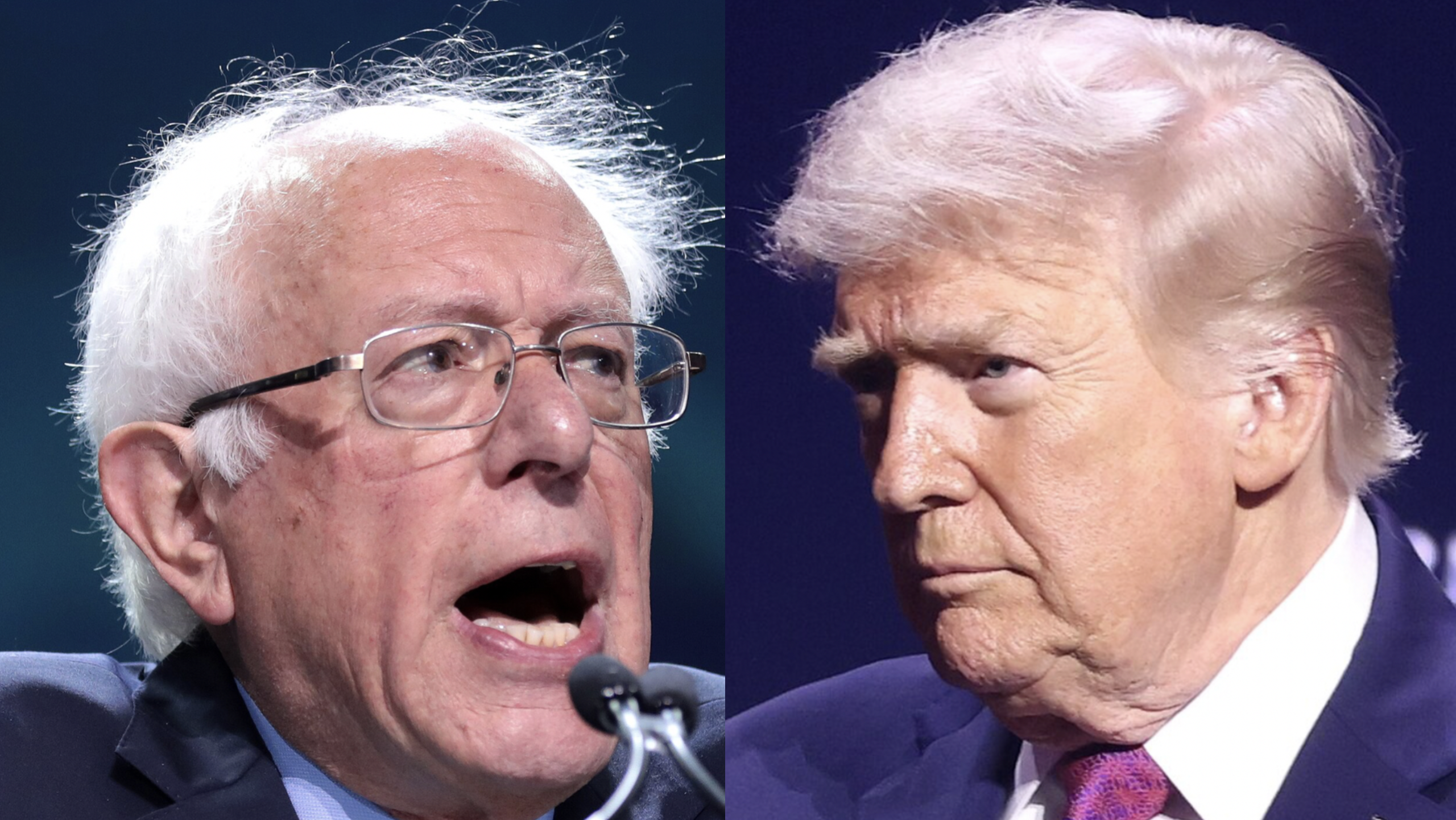
WASHINGTON — Senator Bernie Sanders (I-Vt.) struck back at President Donald Trump on Sunday after the president declared on camera that he “loves” the inflation gripping the American economy, with the Vermont senator drawing a sharp contrast between Trump’s 2024 campaign promises and the economic reality now facing millions of American households in the midst of an active war with Iran.
Sanders posted his response to social media at 4:28 p.m. on June 10, 2026, directly quoting Trump’s own words against him. “Candidate Trump: ‘I will end inflation on Day One,'” Sanders wrote. “President Trump today: ‘I love the inflation.’ You know who doesn’t love inflation, Mr. President? Working families struggling to afford gas, groceries and other necessities because of your disastrous actions.”
Trump’s “I Love It” Moment
The post came in direct response to video footage of Trump fielding a question from a reporter at the White House. Asked whether the latest government inflation report concerned him, the president was unequivocal. “No, I love it. I love the inflation,” Trump said. “You know why? Because as soon as this war is over — do you know we’ve been taking out millions of barrels of oil? Nobody knows it. You know who doesn’t know? Iran until right now.”
The remarks arrived hours after the U.S. Bureau of Labor Statistics released its Consumer Price Index report for May 2026, showing that the all-items index had climbed 4.2 percent over the prior 12 months — the highest annual rate in more than three years. The surge has been driven largely by a 3.9 percent spike in energy prices in May alone, placing the 12-month energy increase at 23.5 percent, with gasoline prices up 40.5 percent from a year earlier. Inflation has accelerated rapidly from an annual rate of 2.4 percent in January, fueled primarily by the energy shock stemming from the Iran war and the disruption of global supply chains following the closure of the Strait of Hormuz.
A Campaign Promise Revisited
The juxtaposition Sanders drew — between candidate Trump and President Trump — cuts to the heart of a tension that has defined the administration’s handling of the war’s economic fallout. Trump won the 2024 presidential election in significant part on a pledge to lower inflation and reduce the cost of living for American families, and his approval rating on economic issues has declined sharply since the Iran conflict began. His administration has since acknowledged the war is directly responsible for the inflationary spike, with Trump himself telling advisers before ordering strikes that oil could hit $250 a barrel and the stock market could fall 25 percent. “It was worth it to me,” Trump said Wednesday of the economic consequences. “It was worth it not to have a nuclear weapon.”
Sanders: A Long Record of Opposition
Sunday’s post is the latest in a sustained campaign by Sanders against both the Iran war and its domestic economic consequences. His opposition traces back well before the first shots were fired. In June 2025, when Israel launched unilateral strikes against Iran that threatened to draw the United States into the conflict, Sanders issued a statement declaring that the attack was “specifically designed to sabotage American diplomatic efforts” and that the U.S. “must not be dragged into another of Netanyahu’s wars.” That same week, he introduced the No War Against Iran Act, which would have prohibited the use of federal funds for any use of military force in or against Iran without specific congressional authorization.
When U.S. and Israeli strikes began in earnest on February 28, 2026, Sanders was unsparing. He described the conflict as “an illegal, premeditated and unconstitutional war,” and condemned the actions as an unconstitutional attempt by Trump and Prime Minister Benjamin Netanyahu to engage the United States in warfare without a congressional declaration of war.
“Unraveling International Law”
In a March 10 statement, Sanders broadened his critique beyond domestic politics, arguing that the U.S.-Israeli attacks on Iran were “unraveling international law, the Geneva Conventions and the legitimacy of the United Nations,” and warning that if the United States and Israel had the right to launch a unilateral attack against Iran, there was no longer any “moral or legal argument against China invading Taiwan, Russia attacking Poland or North Korea launching missiles into South Korea.”
By April, as Trump unleashed profanity-laced threats against Iran over the Strait of Hormuz and threatened to strike power plants and bridges, Sanders called the president’s comments “the ravings of a dangerous and mentally unbalanced individual” and renewed his call for Congress to act immediately to end the conflict.
War Costs vs. Domestic Needs
Sanders has also relentlessly linked the war’s financial cost to the struggles of American families — the same families his Sunday post invoked when confronting Trump’s inflation comments. In March, when the Trump administration signaled it would seek an additional $200 billion from Congress to fund the ongoing operations, Sanders called the request “absurd,” saying: “You got people all over this country, 20% of households, spending 50% of their income on housing. People can’t afford healthcare. People can’t afford childcare. And this guy, in addition to giving tax breaks to billionaires, now wants to spend another $200 billion on a war that should never have been fought.”
Sanders also offered a political forecast at the time: “I think the Trump people are in a bit of a panic. They’re losing ground. Gas prices are soaring. There is massive discontent against this war.”
“A Pathological Liar”
The senator has not confined his criticism to policy. In a separate interview, Sanders described Trump in deeply personal terms while discussing the war’s impact on working Americans. “We are living, as I think most people know, with a president who is a pathological liar,” Sanders said. “He is an authoritarian. What concerns most is wealth and power. I think he has very little empathy for his fellow human beings.”
The Economic Backdrop
Economists have largely echoed Sanders’ concern that working families are bearing the brunt of the inflationary surge. “Americans are getting squeezed financially by inflation that’s back at a 3-year high,” said Heather Long, chief economist at Navy Federal Credit Union, pointing to gas, food, electricity, and medical care as the most acute pain points. “Ending the war in Iran will help to moderate inflation, but the worst is likely still to come for rising food prices.”
Even if a ceasefire or deal materializes in the near term, analysts expect it to take months to restore supply flows through the Strait of Hormuz, with disruptions anticipated to continue through the remainder of 2026. The Federal Reserve, which had been widely expected to cut interest rates earlier this year, is now expected to hold borrowing costs steady at its June 17 meeting, with some analysts warning the next move could be a rate hike rather than a cut.
A Contrast That Cuts Both Ways
Trump, for his part, has insisted that current prices represent a success story compared to the worst-case projections his advisers presented before the Iran strikes, and has repeatedly promised that prices will fall sharply once the conflict ends. “It’s going to come down like a rock,” Trump said Wednesday. He also recalled a recent trip to Iowa where he passed gas stations charging $1.85 per gallon before the war began. “We’ll be back at those levels very soon,” he said.
Sanders and a growing coalition of Senate Democrats have shown no sign of accepting that framing. Multiple Democratic senators — including Tammy Baldwin, Cory Booker, Tammy Duckworth, Tim Kaine, Chris Murphy, and Adam Schiff — have launched a renewed effort to force new votes on war powers resolutions and demanded that Defense Secretary Pete Hegseth and Secretary of State Marco Rubio “immediately come before Congress for a public hearing and explain why we’re in this war, how it will end, and why they are prioritizing billions of dollars on an open-ended war instead of lowering costs for American families.” For Sanders, Sunday’s post was the latest — and perhaps the bluntest — expression of a message he has delivered in statements, interviews, and rallies for more than a year: the war’s costs fall hardest on the people who can least afford them.