
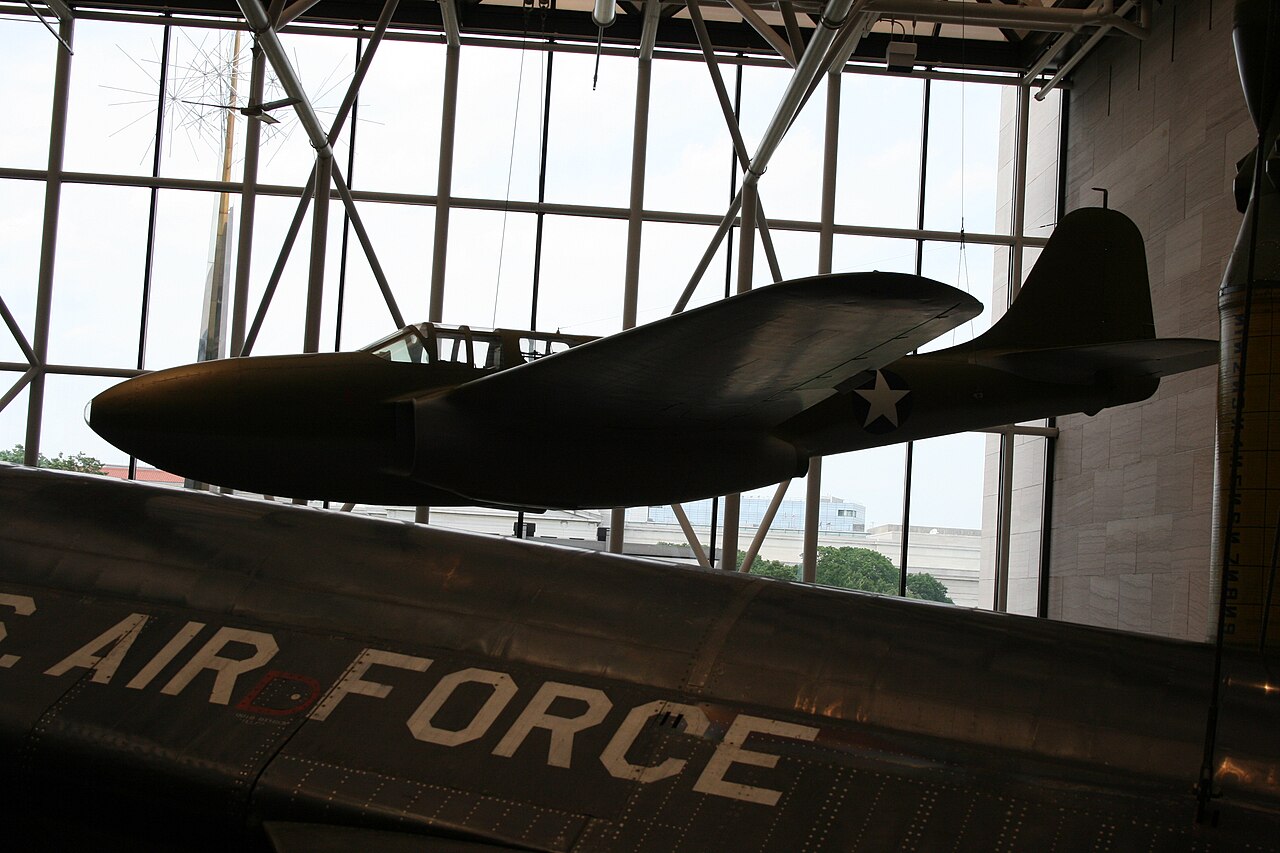
America entered the jet age in a twin-engine Bell airframe that never fired a shot in anger. Bell test pilot Robert M. Stanley took the XP-59A Airacomet into the air for the first time on Oct. 1, 1942, over the dry lakebed at Muroc, California. The design went on to a production run of just 50 aircraft, and none of them saw combat.
What the Airacomet delivered instead was experience. It gave the U.S. Army Air Forces and the U.S. Navy their first hands-on time with jet propulsion, and it helped pave the way for the more advanced jets that followed.
The Smithsonian’s National Air and Space Museum, which holds the first XP-59A, states it plainly in its collection record for the aircraft: “The XP-59A is the first American jet aircraft. It did not see combat but it did give the U. S. Army Air Forces (AAF) and the U. S. Navy valuable experience with jet aircraft technology and helped pave the way to more advanced designs.” The museum’s account gives the first flight as “On October 1, 1942, Bell test pilot Robert M. Stanley took the XP-59A into the air for the first time.”
A Whittle-derived engine from General Electric
The Airacomet’s power came from across the Atlantic. According to the Smithsonian, Bell shipped the first XP-59A to Muroc Dry Lake on Sept. 19, 1942, for its initial flight trials. It carried two General Electric Type I-A centrifugal-flow jet engines, a design with British roots: the museum notes that a W.1X turbojet designed by Frank Whittle powered the British E.28/39.
The museum’s separate record for the General Electric Type I-A engine says the I-A “was derived from the British Power Jets W.I.X., designed by Frank Whittle,” and that GE’s first engine, the Type I, “ran on March 18, 1942, in Lynn, Massachusetts—the first jet engine to run in America.” The same record lists the I-A at 1,450 pounds of thrust at 16,500 rpm, with an engine weight of 830 pounds. That engine record gives the XP-59A’s first flight as Oct. 2, 1942; the museum’s aircraft record, the more detailed account of the flight itself, gives Oct. 1.
The museum also records one reason the work went to Bell. Its account notes that the group involved “considered Larry Bell’s enthusiasm and reputation for making unorthodox designs fly.”
Low thrust and a 50-airplane production run
Low thrust held the airplane back. The Smithsonian says the two I-A engines “drove the unrefined XP-59A airframe to a maximum speed of only 628 kph (390 mph).”
The museum’s summary puts it in wartime context: Germany led the world with operational jet fighters and bombers, and Britain’s jet fighter briefly saw service, while U.S. leaders chose to put their weight behind mass production of conventional aircraft for immediate wartime use. The Airacomet was a learning tool, not a front-line answer.
Production reflected that. “Eventually, Bell completed only 50 production Airacomets-20 P-59As and 30 P-59Bs,” the Smithsonian record states.
The National Museum of the U.S. Air Force, which displays a P-59B, reaches the same verdict in its Bell P-59B Airacomet fact sheet. “Designed and built in great secrecy during World War II, the P-59 was America’s first jet aircraft,” the fact sheet says, and its disappointing performance came from “the relatively low thrust of the XP-59’s engines and its heavy, conventional airframe design.” Some production aircraft were flown by the 412th Fighter Group, which the museum calls the U.S.’s first jet fighter unit, and the Airacomet “provided training for USAAF personnel and invaluable data for the development of higher performance jet airplanes.”
The Air Force museum’s fact sheet lists these figures for the P-59B:
- Engines: two General Electric J-31s of 1,650 pounds thrust each
- Maximum speed: 450 mph
- Range: 440 miles
- Service ceiling: 43,400 feet
- Weight: 10,532 pounds loaded
- Armament: one 37mm cannon and three .50-caliber machine guns
The museum’s own P-59B arrived from Kirtland Air Force Base, New Mexico, in February 1956, according to the fact sheet.
Where the first XP-59A is today
The Smithsonian put in its claim for the prototype early. Its record says that on April 18, 1945, the Smithsonian asked for the aircraft, which came to the collection by transfer from the U.S. Department of War. Before the new National Air and Space Museum opened in 1976, staff restored the airplane to its original configuration and removed the observer’s open cockpit.
The museum lists the XP-59A’s wingspan at 586 inches, its length at 465 inches and its weight at 7,319 pounds. It remains in the national collection under inventory number A19450016000. A Smithsonian photo caption of Stanley with the aircraft identifies it as the same airframe: “Bell company test pilot Robert M. Stanley flew this XP-59A, America’s first jet-powered aircraft, for the first time, on October 1, 1942.”
Top image: The Bell XP-59A Airacomet at the Smithsonian’s National Air and Space Museum. Image Credit: Gary Todd — CC0 / Wikimedia Commons
This article was produced with the assistance of AI and reviewed by Combat Rated editors prior to publication.