
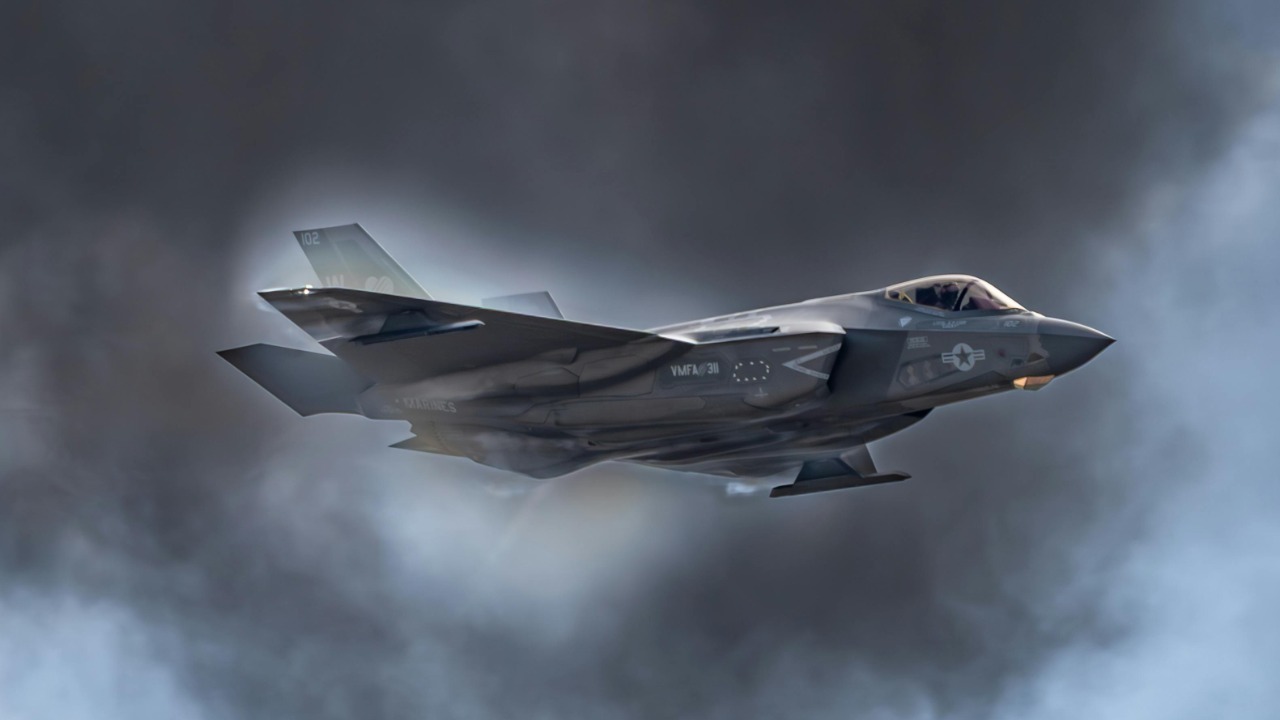
The F-35 Lightning II has moved from ambitious concept to central pillar of Western airpower, with its strike role at the heart of that transformation. Built to penetrate defended airspace and deliver precision weapons, it shapes U.S. and allied combat aviation strategy. Its combat effectiveness relies on stealth, speed, and the ability to convert information into coordinated firepower.
That evolution has been gradual rather than sudden, progressing from first flights and early squadron service to large scale exercises and operational deployments. The aircraft has been tested as a strike platform, intelligence node, and coalition integrator, where its full strike capability emerges.
From ambitious program to operational strike fighter
The F-35 program was conceived as a single family of aircraft that could replace a wide range of legacy fighters while giving pilots a step change in survivability and lethality. The first prototype flew in 2006, and the F-35 later entered U.S. service with the Marine Corps and Air Force, transitioning from prototype to frontline asset. Those milestones signaled that the aircraft was no longer a paper promise, but a weapon system that services were willing to send into demanding missions.
As the fleet expanded, the Lightning II became the Department of Defense’s largest procurement effort, with the F-35 Lightning II described in congressional analysis as a strike fighter at the core of the Joint Strike Fighter vision for the Department of Defense and the broader DOD enterprise, led by prime contractor Lockheed. That scale has strategic consequences, since it means the same aircraft family will underpin strike operations for multiple services and allied air arms for decades.
Stealth, payload and the mechanics of modern strike
The F-35’s strike power begins with its ability to reach targets that would be prohibitively risky for older jets. Its low observable design is paired with internal weapons bays so that, in its most survivable configuration, it can carry guided munitions without exposing pylons or bombs to radar, a feature highlighted in manufacturer data on the F-35. In less contested airspace, it can carry weapons externally, increasing payload to over 18,000 pounds and making a single aircraft a significant strike asset.
That flexibility is matched by the range and performance of the F-35A variant, which the Air Force describes as able to operate above 50,000 feet while employing a variety of United States and allied weapons. That combination of altitude, reach and weapons diversity allows the jet to service targets from close air support to deep interdiction, often in a single sortie, while remaining integrated with joint and coalition strike plans.
Sensor fusion and the networked kill chain
What most distinguishes the F-35 from earlier fighters is not a single performance number but how it fuses information. The aircraft’s onboard computers combine radar, infrared and electronic support data into a single picture, which is then shared with other platforms. Official descriptions of its 5th Gen Capabilities emphasize that the F-35 gives America and allied pilots an information advantage that modern fighter jets without such fusion simply cannot match. That situational awareness is central to how the jet finds and prioritizes strike targets.
The networking extends beyond the cockpit. The F-35 gathers battlefield data and shares it via secure networks, acting as a real-time sensor and coordinator for ground and air units. That same networking logic underpins the aircraft’s role in NATO, where Two key data links, Link 16 and the Multi Function Advanced Datalink, or MADL, are described as central to making the F-35 the backbone of next generation operations in alliance analysis.
Exercises, maritime tests and emerging combat experience
The F-35’s strike credentials have been built up through a mix of controlled testing and demanding exercises. The United States Air Force has reported that it successfully proved the F-35A’s maritime strike capability in a series of flights that evaluated sensor fusion, targeting precision and weapons employment against sea based threats, with the trials described as a key step in validating the jet’s performance in that environment in reporting that highlighted the role of sensor driven tactics. In Europe, During Exercise Ramstein Flag, Dutch F-35s were used to provide targeting information to rocket artillery, demonstrating how the aircraft can cue long range fires rather than simply dropping its own bombs.
Operationally, the Marine community has begun to document how carrier capable variants are being integrated into deployed air wings, with reports noting Marine F-35C activity and describing how those squadrons are learning to work from big deck carriers alongside other strike assets. At the same time, broader analyses of United States and allied operations have described how F-35 stealth fighters are positioned to play a central role in any future campaign that might involve strikes on hardened or heavily defended sites, including potential scenarios involving Iranian facilities such as Fordow, Natanz and Isfahan, with some assessments noting that planners envision the use of as many as 75 precision weapons in such contingencies,
Industrial scale, deterrence and the future of strike power
The F-35’s impact on strike warfare is magnified by the sheer number of aircraft now entering service. The United States Department of Defense has cleared the program for full rate production, a decision that signaled confidence in the design and locked in the jet’s role in modern military operations, as described in analyses of how the F-35 Stealth Fighter Is Now Cleared for Full Rate Production and how the Fighter Jet Achieves Full Rate Production, including assessments of What This Means for allied air forces. This production capacity ensures F-35 formations will play a central role in future coalition air campaigns.
Advocates argue that the aircraft’s combination of stealth, sensor fusion and connectivity turns it into a key node for deterrence as well as warfighting. Company material stresses that this capability transforms the F-35 from a single fighter into a vital node in a larger combat network, enhancing the effectiveness of every platform around it. That logic is echoed in official descriptions that note how, Along its development path, the F-35 has been designed to replace aging fighters and to integrate a wide variety of weapons, with Background documents from the Air Force underscoring that the aircraft is meant to remain relevant against evolving threats.
These attributes demonstrate how the F-35 enhances air dominance beyond incremental updates. Official program sites emphasize that the F-35 provides an unrivaled advantage to America and its allies, positioning it as a decisive enabler of joint and coalition strike operations, as highlighted in descriptions of its 5th Gen Capabilities. With the aircraft now fielded across multiple services and nations, and with more than one 35 series variant in operational use, its strike power is no longer a theoretical promise but a central fact of contemporary air planning.