
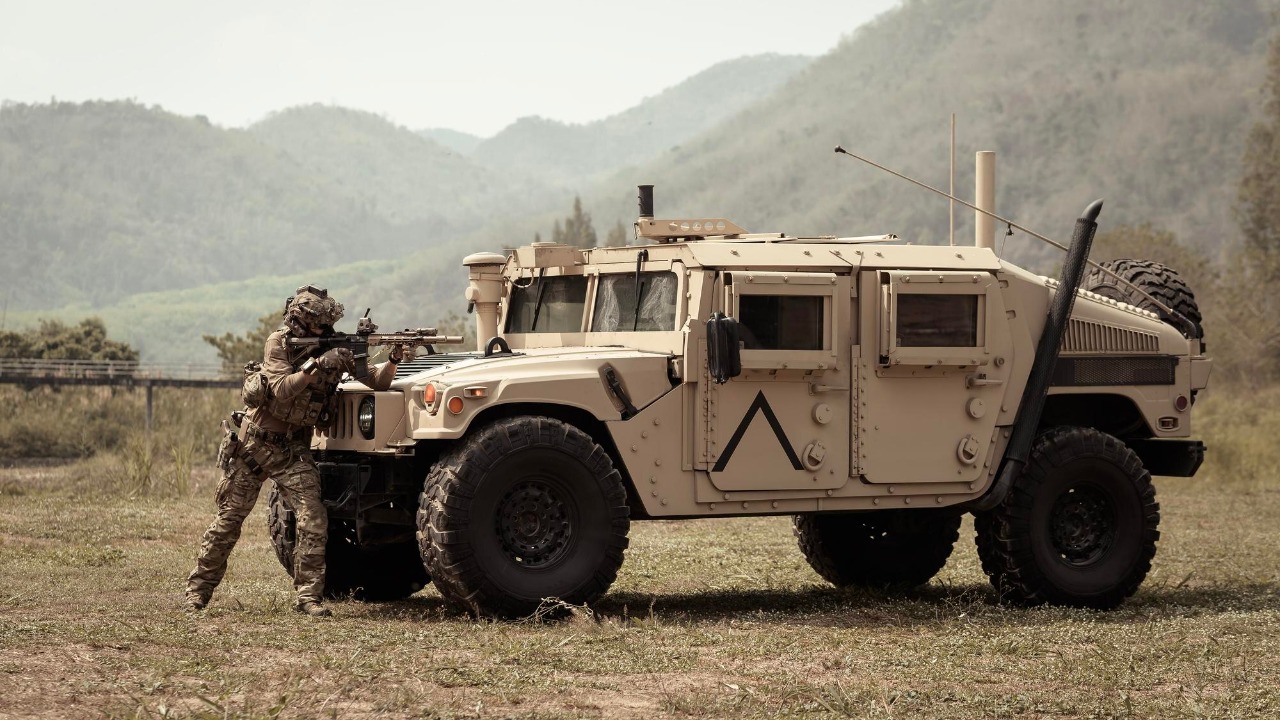
The Humvee has spent decades proving itself in combat, evolving from a bare‑bones utility truck into a symbol of American military power and adaptation. Designed to be punished by terrain, weather, and enemy fire, it has been refined in response to every new battlefield that exposed its limits. Its journey from Cold War prototype to hybrid‑ready workhorse shows how a vehicle becomes “battle approved” only after surviving the harshest real‑world tests.
That evolution has never been purely mechanical. Each redesign reflects shifting doctrine, from fast maneuver warfare to counterinsurgency and now to dispersed, high‑tech operations. The Humvee’s story is therefore less about a single machine and more about how the United States fights, learns, and prepares for the next conflict.
From Jeep Replacement to All‑Terrain Backbone
The Humvee began as an answer to a simple problem: the aging fleet of light trucks could no longer keep up with modern maneuver warfare. Planners wanted a successor to the World War II Jeep that could carry heavier loads, move faster off road, and support a wider range of missions. The Humvee was first introduced in January 1979 to replace the M151 Jeep, a shift driven by the need for greater battlefield mobility and versatility, as later chronicled in detailed program histories. Engineers envisioned a four‑wheel‑drive platform that could haul troops, tow artillery, and serve as a base for communications and weapons systems without swapping to a different chassis.
That ambition produced a wide, low vehicle with high ground clearance and a long‑travel suspension, built to traverse deserts, mud, and broken roads that would stop conventional trucks. Early development accounts describe it as a “four‑W wheeled behemoth” created to replace the legendary World War II, with designers expecting it to play a vital role in sandy theaters that would soon dominate U.S. operations. Before it ever deployed, prototypes were pushed through more than 600,000 miles of testing at Aberdeen Proving Ground, Maryland and Yuma, Arizona, a punishing regimen that signaled how central the vehicle was expected to become.
Battlefield Lessons and the Armor Revolution
Combat quickly validated the Humvee’s mobility but exposed its vulnerability. The original trucks were not designed as armored personnel carriers, and Humvees are not bulletproof, a fact that became painfully clear once they were routinely ambushed with rifles, machine guns, and roadside bombs. They are mostly made from hardened steel and bullet‑resistant glass, and when Humvees proved vulnerable to small arms and explosives, militaries responded by adding armor kits and structural reinforcements to Humvees in the field. Those ad hoc fixes, often improvised with scrap metal in the early years, foreshadowed a more systematic armor revolution.
Formal modification programs followed, turning what had been a lightly protected truck into a far heavier and more specialized platform. A U.S. Marine Corps M1123 HMMWV, for example, could be seen in 2004 equipped with a bolt‑on MAK armor kit. At the Bridgeport, California Mo training grounds, units experimented with different armor and load configurations, trying to balance survivability with the off‑road agility that had made the vehicle indispensable in the first place.
Icon Status and the Push for a Successor
By the time the Humvee had been in service for 40 years, it had become an American icon as much as a piece of equipment. In November, Jim Cannon, president and CEO of AM General, publicly celebrated 40 years of service with the Humvee, underscoring how deeply the vehicle is woven into the company’s identity and the broader defense industrial base. In that reflection, Jim Cannon the described how, as a young officer, he had watched the Humvee transform from a new arrival into a fixture of U.S. formations, a story that illustrates why the platform still commands emotional loyalty even as militaries eye its replacement, as seen in commemorations of the 40-year milestone.
Yet even icons age. The Joint Light Tactical Vehicle, or JLTV, is now replacing the U.S. military’s aging Humvees, a shift driven by the need for improved blast protection and digital integration in contested environments. Built to operate across rugged terrain while offering far greater survivability, the JLTV is often described as a $400,000 “beast” that reflects lessons learned from decades of Humvee deployments and losses. The JLTV does not erase the Humvee’s legacy, but it does signal that the next phase of tactical mobility will be defined by vehicles designed from the outset for high‑threat, sensor‑rich battlefields.
The Next Chapter: Hybrid Power and Enduring Utility
Even as the JLTV enters service, the Humvee is not quietly retiring. AM General is preparing a hybrid variant that aims to extend the platform’s relevance into an era of electrification and energy‑constrained operations. Company leaders have said that AM General will unveil hybrid Humvee “soon,” targeting the National Guard as an early customer, a sign that the firm sees a long tail of missions where a lighter, more affordable truck still makes sense for domestic response and lower‑intensity deployments, as reported in coverage of AM general. A hybrid powertrain could reduce fuel consumption, cut acoustic and thermal signatures, and provide exportable power for sensors and communications, all attributes that align with modern concepts of dispersed, networked operations.
At the same time, the original design continues to be studied and refined. Analysts such as Dan Carney, Senior Editor at Design News, have chronicled how One if by land, two if by sea and 4×4 if by Humvee became a shorthand for the vehicle’s versatility, tracing 9 Slides of upgrades that range from improved armor plate to better suspension components in reviews of the Humvee. Public explainers continue to remind civilian buyers that They are mostly made from hardened steel and bullet‑resistant glass and that When Humvees proved vulnerable, armor kits were added, reinforcing how battlefield experience keeps reshaping even surplus vehicles now sold at auction, as noted in guides to surplus Humvees. From its origins as a replacement for the World War II Jeep to its prospective hybrid future, the Humvee remains a case study in how combat, technology, and industry continually reshape one another.