
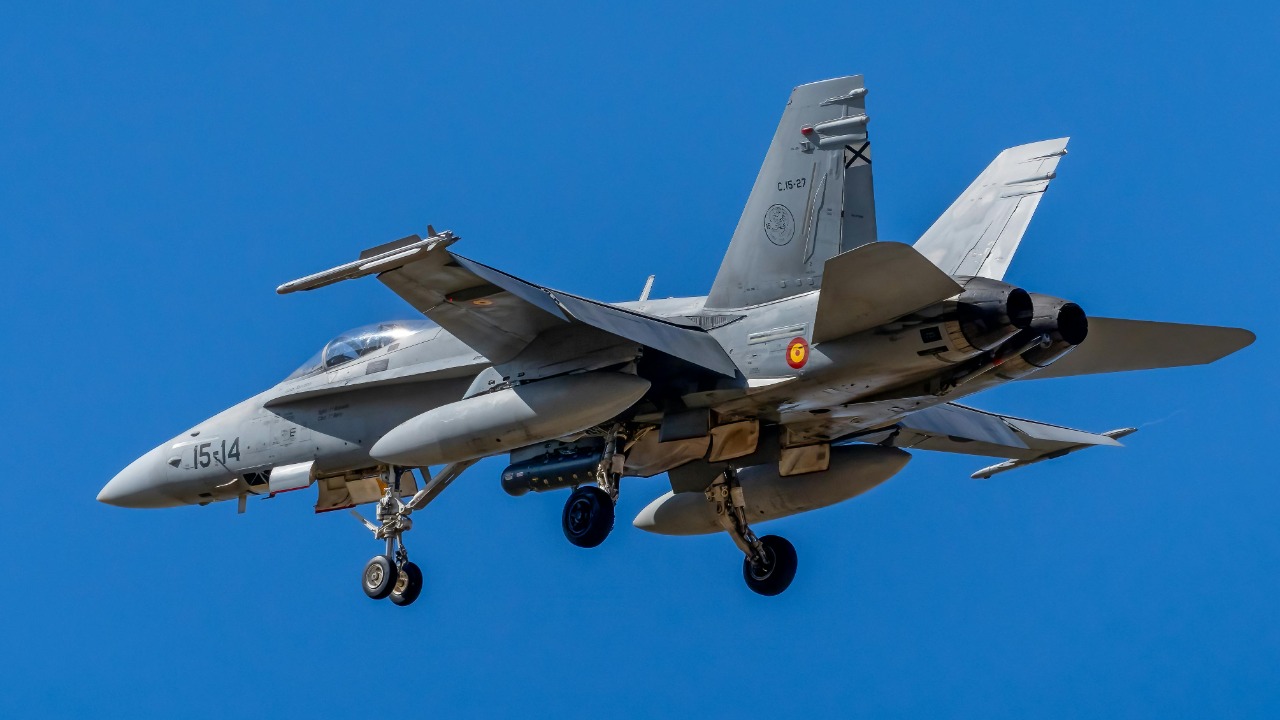
The F/A-18 family earned its combat reputation through decades of carrier operations and real-world missions. From a lightweight fighter derivative to a capable strike platform, the Hornet line was refined through sustained combat at sea and ashore. Its combat legacy is defined by adaptability, reliability, and a rare ability to remain tactically relevant as warfare has shifted around it.
That legacy began with the original Hornet and continues today with the Super Hornet and electronic attack variants that still launch from American carriers. Across multiple generations, the aircraft has replaced older types, anchored carrier air wings, and supported nearly every major U.S. operation of the past two generations. The result is a platform that is not only battle tested but consistently judged by operators as battle worthy.
From First Flight to Fleet Workhorse
The story of the Hornet’s combat pedigree starts with a design that was never meant to be a niche specialist. The F/A-18 evolved from the YF-17 to replace older U.S. carrier aircraft while complementing the F-14 in air-to-air roles. Its first flight on 18 November 1978 marked the transition from prototype to a multirole aircraft that would soon enter operational service and eventually take over from the F-14 Tomcat in the U.S. Navy. That early decision to fuse fighter and attack missions into a single airframe set the conditions for the Hornet’s long combat life.
From the outset, the aircraft was engineered as a carrier-capable multirole platform with advanced avionics, cockpit displays, and forgiving aerodynamics that made it suitable for both seasoned and younger pilots. The design’s flexibility enabled export in a carrier-ready configuration with folding wings and reinforced landing gear to countries including Australia, Canada, Finland, Kuwait, Malaysia, Spain, and Switzerland. Over time, this original Hornet earned a reputation for high performance and proven combat reliability across varied environments, a reputation that has kept it relevant in modern and future warfare scenarios as documented in detailed operational histories.
Legacy Hornets in Combat
By the early 1980s, the McDonnell Douglas F/A-18 had moved from test ranges to the front line, with the type deployed since 1983 and soon seeing combat in conflicts that defined the late Cold War and post–Cold War era. It played a visible role in the Gulf War, where its ability to carry both air-to-air missiles and precision-guided munitions on the same sortie allowed commanders to task it flexibly against Iraqi targets while still maintaining self-defense capability. The Hornet’s dual-role performance validated the strike fighter concept and established it as a central element of carrier air wings.
The aircraft’s technical performance underpinned that combat record. The F/A-18 has a top speed of Mach 1.8 (1,034 k, 1,190 m or 1,915 km/h at 40,000 ft or 12,190 m), and it can carry a wide variety of air-to-air and air-to-ground weapons from beyond-visual-range missiles to laser-guided bombs. That combination of speed, altitude performance, and payload made the Hornet suitable for missions ranging from fleet air defense to deep strike from an air base in Kuwait and from carriers at sea. Over time, the type’s availability, reliability, and maintainability were refined to the point that it became the nation’s first strike-fighter to fully integrate both missions, a role highlighted in official descriptions of the Hornet Strike Fighter.
Super Hornet and EA-18G: Extending the Line
As the original Hornets aged, the F/A-18E and F/A-18F Super Hornet emerged as larger, more capable evolutions of the design. The Boeing Super Hornet is an American supersonic twin-engine, carrier-capable, multirole fighter that now serves as a primary combat aircraft for the United States, Australia, and Kuwait, giving allied navies a common platform for strike and air defense. Within the U.S. fleet, The Super Hornet became the backbone of navy carrier aviation, while another key derivative, the EA-18G, took on the demanding electronic attack mission.
The Super Hornet’s combat record reflects that central role. U.S. defense officials authorized the type to launch bombing missions against Islamic State targets, where it struck a convoy and a mortar position, demonstrating its precision-strike capability in a complex airspace. More broadly, throughout their service, the F/A-18 and EA-18G family has supported nearly every major U.S. military conflict of the past 40 years, adapting to rapidly changing threat environments as documented in official assessments. That continuity of employment, from high-intensity state-on-state conflict to counterterrorism campaigns, underscores how the Super Hornet has extended and deepened the combat legacy of the original design.
Enduring Reputation and Future Relevance
Four decades after its introduction, the Hornet line remains central to naval aviation and to the way the United States projects power from the sea. Analysts have noted that for forty years the F/A-18 Hornet fighters have been central to the Navy’s aerial capabilities, regarded as some of the most versatile and reliable jets in the fleet. That reputation is echoed in broader aviation rankings that describe the Hornet, known for its versatility and carrier-based operations, as a primary multirole fighter for the United States and a critical asset in modern naval aviation. Even after the Navy retired its last legacy aircraft in Spring 2023, Hornet variants remain workhorses for carrier air wings, continuing to anchor a new generation of air dominance.