
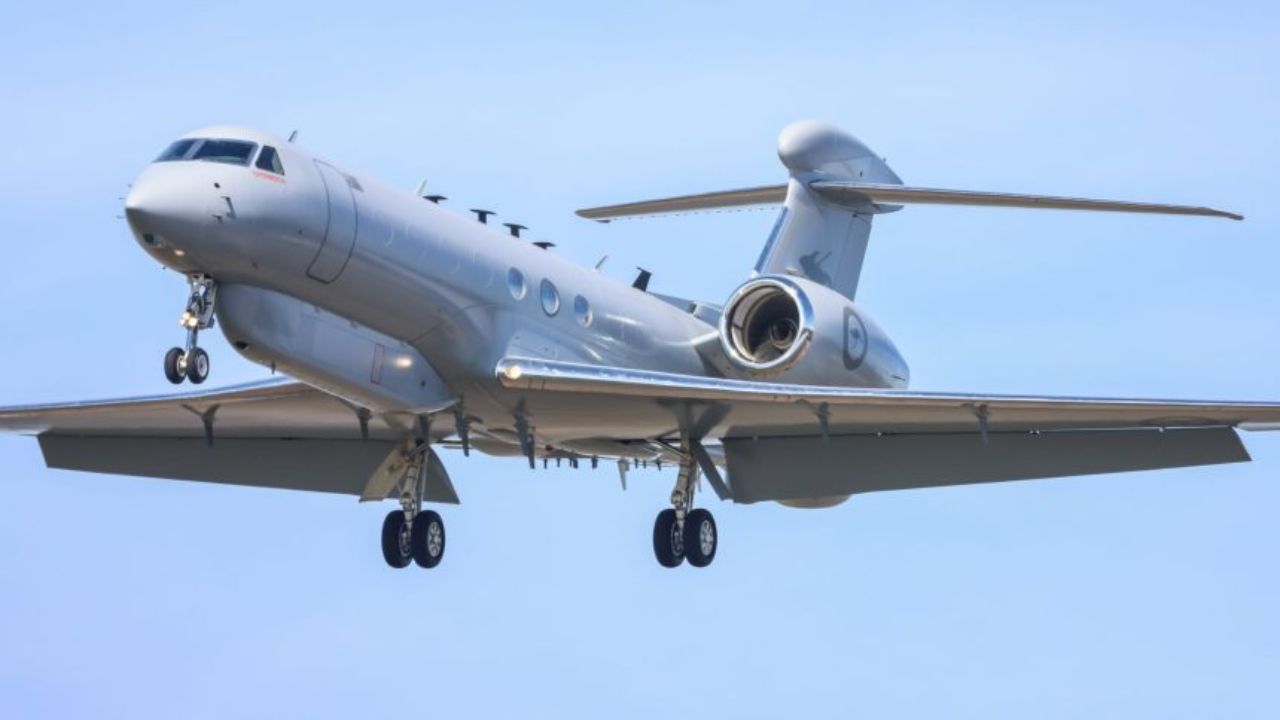
Australia’s first MC-55A Peregrine has arrived at a moment when electronic warfare and long-range sensing are reshaping how air forces deter conflict. The aircraft is being framed as a genuine step change, not only for the Royal Australian Air Force but for how the country understands and manages risk in a more contested region. By pairing a proven business jet platform with dense intelligence, surveillance and electronic attack systems, Canberra is signalling that information dominance is now a front-line capability in its own right.
The new jet is the first of four MC-55A Peregrine aircraft that will form a dedicated airborne Intelligence, Surveillance and Reconnaissance and electronic warfare fleet. It is intended to give commanders a clearer picture of activity across vast distances, while also helping shield other forces from hostile sensors and communications. In doing so, it marks a decisive shift from legacy arrangements toward a purpose-built system that is already being described inside government as a true game changer for national defence.
From contract to touchdown at RAAF Base Edinburgh
The journey from concept to operational arrival has been shaped by a deliberate effort to field a first-of-type capability that could integrate quickly with existing Australian and allied forces. Defence officials describe the MC-55A Peregrine as Australia’s inaugural airborne Intelligence, Surveillance, Reconnaissance and electronic warfare asset, a role that places it alongside other high-value surveillance and electronic warfare platforms in the national order of battle. In official material, the aircraft is presented as part of a broader network of Intelligence and electronic warfare assets that are being modernised in parallel.
The aircraft itself is based on a modified Gulfstream G550 airframe, a choice that reflects the need for long range, high altitude performance and the electrical power to support dense mission systems. Aviation enthusiasts tracked the specially configured Gulfstream as it made its way to South Australia, with images of the jet’s arrival circulating widely. The MC-55A Peregrine touched down at RAAF Base Edinburgh, South Australia, where RAAF Base Edinburgh is already established as a hub for long-range patrol and surveillance operations, underscoring how central the new platform will be to day-to-day defence activity.
What makes the MC-55A Peregrine different
Australian officials are keen to stress that the MC-55A Peregrine is not simply another sensor platform but a multi-role system dedicated to electronic warfare and ISR missions. Reporting on the aircraft’s arrival notes that it is dedicated to electronic warfare and ISR, replacing the capabilities of older types that were never designed from the outset for this role. The new jet is expected to detect, classify and geolocate a wide range of emitters, then feed that information into joint command systems so that threats can be tracked and, if necessary, targeted.
Canberra has described the MC-55A Peregrine as a first-of-type capability that strengthens Australia’s ability to monitor and respond to regional activity. Official statements emphasise that the Peregrine will operate alongside other airborne and surface systems, extending the reach of existing radars and patrol aircraft. The platform’s electronic warfare suite is also expected to support protection of national and coalition forces by helping to disrupt or deceive hostile sensors and communications, a role that becomes more important as potential adversaries field longer-range missiles and more sophisticated targeting networks.
Industrial partnerships and the path to four aircraft
The MC-55A Peregrine program is the product of a complex industrial and diplomatic effort that has involved the United States and major defence contractors. L3Harris Technologies has been central to integrating the mission systems onto the G550 platform, with the aircraft delivered through the United States Foreign Military Sales process. Another report notes that the MC-55A Peregrine is part of a near two and a half billion dollar investment, described as the most advanced in its class, highlighting the scale of the financial and technological commitment involved.
Australia has committed to a fleet of four aircraft, with the first now in country and the remaining jets to follow after completion of modification and testing. One analysis characterises the MC-55 as one of the country’s most powerful weapons, noting that Australia Just Took when the aircraft arrived at RAAF Base Edinburgh, South Australia. Another report on RELEASES notes that the United St has supported the program as part of a broader effort to strengthen the ability of national and coalition missions to share information and coordinate operations, reinforcing the aircraft’s role as a node in a wider allied network.
Operational impact and regional signal
The arrival of the MC-55A Peregrine at RAAF Base Edinburgh has immediate operational implications for how Australia monitors its approaches and supports partners. Aviation News coverage records that Aviation News described the aircraft as a tool to monitor regional security developments, with the platform expected to provide persistent coverage over maritime chokepoints and key air routes. Another report on Key Points highlights that the MC-55A Peregrine will support national and coalition missions, indicating that it will be tasked not only with national surveillance but also with contributing to shared situational awareness in combined operations.
Australian officials have framed the introduction of the MC-55A Peregrine as a significant step forward in strengthening the country’s ability to monitor and respond to threats, while also enhancing regional stability. One statement notes that Peregrine boosts Australia’s defence power by improving national security and enhancing regional stability, language that underscores the strategic messaging behind the program. Coverage of the aircraft’s first public appearance with No 10 Squadron describes how crews expect to detect threats earlier and locate them more precisely, while another account notes how Aviation enthusiasts followed the jet’s journey as a symbol of Australia’s growing Electronic Warfare (EW) capabilities. Together, these details explain why the first MC-55A Peregrine is being hailed as a genuine game changer for how Australia sees, understands and shapes its strategic environment.