
A single drivetrain component has put more than half of the U.S. Army’s Apache attack helicopters on the ground. On Oct. 2, 2026, the Army announced an immediate, temporary pause in flight operations for AH-64E Apaches equipped with Improved Drive System transmissions, to last while required inspections and corrective actions are completed.
The Army’s announcement gave no aircraft count and no end date. An Army official who was not named has since filled in both: about 400 of the Army’s roughly 700 Apaches are affected, and the grounding is expected to last for months.
The Army’s Oct. 2 release from U.S. Army Public Affairs ran under the title “Army Orders Temporary Grounding for AH-64E Apache Helicopters for Inspection Purposes.” Its text says the service “has directed an immediate, temporary pause in flight operations for AH-64E Apache helicopters equipped with Improved Drive System transmissions while required inspections and corrective actions are completed.” The action, it says, “follows ongoing Army technical and airworthiness assessments of the Improved Drive System transmission, including information developed through prior Safety of Flight actions, inspection results, maintenance reporting, and ongoing engineering analysis.” It closes with two lines:
“Safety remains the foremost priority. The Army will share further details when appropriate.”
How many aircraft, and for how long
The scale came out over the following days, through an official speaking without a name. Task & Purpose reported on Oct. 5 that an Army official said “about 400 Apache E-model helicopters will be kept out of the air during the pause,” and that it “could take months.” Military Times reported on Oct. 7 that an Army official said about 400 of the Army’s roughly 700 Apaches are affected, with aircraft from every active-duty and National Guard Apache unit included, and that the grounding is expected to be in place for months while the service conducts a global inspection.
According to Military Times, the official said an earlier safety-of-flight message calling for inspections of all AH-64E transmissions “triggered a decision point for Army senior leaders,” who chose to speed up inspections and repairs while trying to keep units ready. The official also said the Army expects to need a “rebalancing” of Apaches between squadrons to meet minimum capability requirements. None of these figures appear in the Army’s own release, and Combat Rated has not seen them in an on-the-record Army statement.
This is not the fleet’s first stand-down this year. Task & Purpose reported that the Army halted Apache flights in August for just over a week after a fatal crash outside Fort Hood, Texas. Military Times reported that the official said the Army quickly determined transmission issues did not cause that crash. Task & Purpose also reported, citing the Army’s September 2026 FlightFax safety publication, that at least four AH-64Es have had Class A mishaps since October 2025, and that one involved a “catastrophic transmission failure.” The causes of the four have not been made public.
What the Improved Drive System does
The Improved Drive System is one of the changes that separates the AH-64E from the AH-64D it followed. A Sept. 25, 2014 Army article by Capt. Carter Johnston listed the E-model’s early features as “more powerful engines, an upgraded transmission to accommodate the increase in power” and “new composite main rotor blades.” It quoted CW4 Richard Crabtree: “The improved drive system of the AH-64E provides the pilot with an exceptional power margin.” It said the E-model “is capable of carrying 2,500 pounds more than its predecessor, the AH-64D Model.”
Boeing, which builds the Apache, describes the same trade on its AH-64 Apache product page: “transmission upgrades support higher gross weights,” paired with more powerful T700 engines for hot and high conditions. Task & Purpose reported that a Boeing official said the company “is supporting the U.S. Army’s investigation to ensure the operational readiness and safety of any affected aircraft.”
The earlier Safety of Flight warning
The most detailed public account of the transmission problem came from Defense One, which reported on May 19, 2026 that an internal Army safety document from April said “some AH-64E [improved drive system] main transmissions can experience an internal failure.” Defense One reported that the document stated “The root cause is still under investigation” at that time.
The Army’s own wording still stops at “required inspections and corrective actions.” It has not said whether the inspections will lead to part replacements, modifications or a return to flight without changes, and it has said it “will share further details when appropriate.”
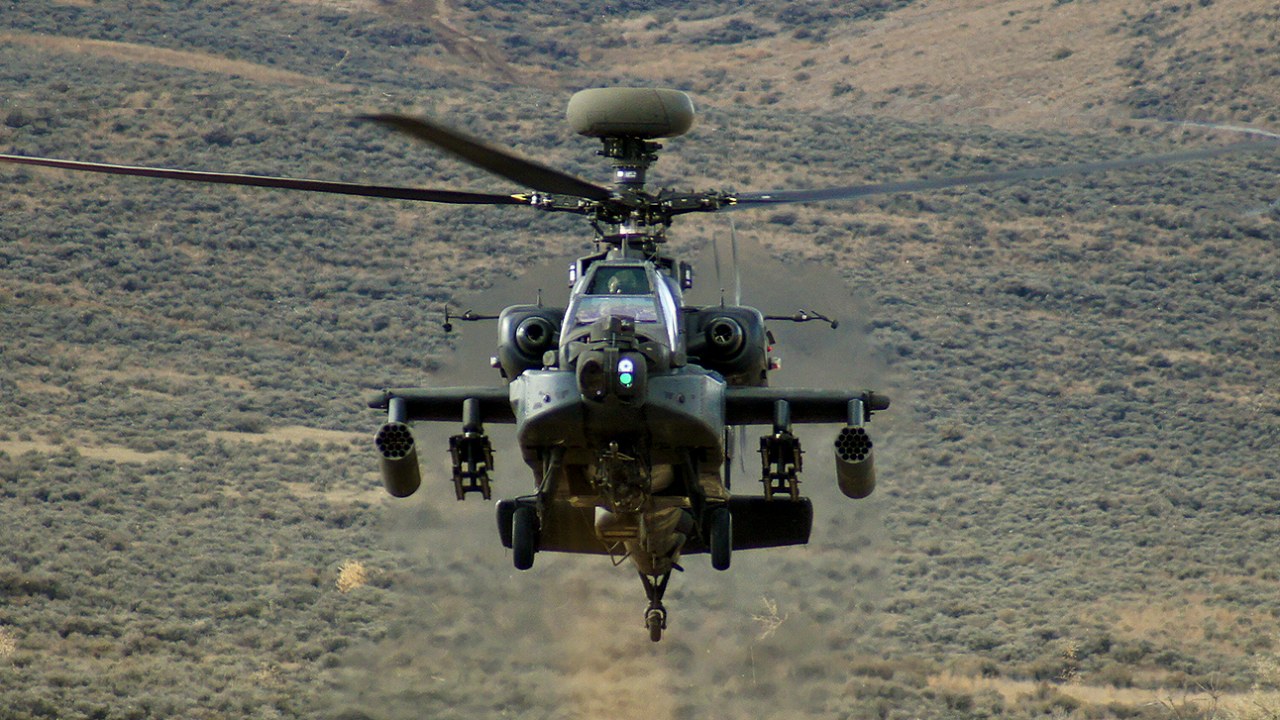
Top image: An AH-64E Apache rises from behind a hill during training at Yakima Training Center, Washington, in 2015. The photo predates the 2026 flight pause. Image Credit: U.S. Army photo by Capt. Jesse Paulsboe — Public domain / Wikimedia Commons
This article was produced with the assistance of AI and reviewed by Combat Rated editors prior to publication.