
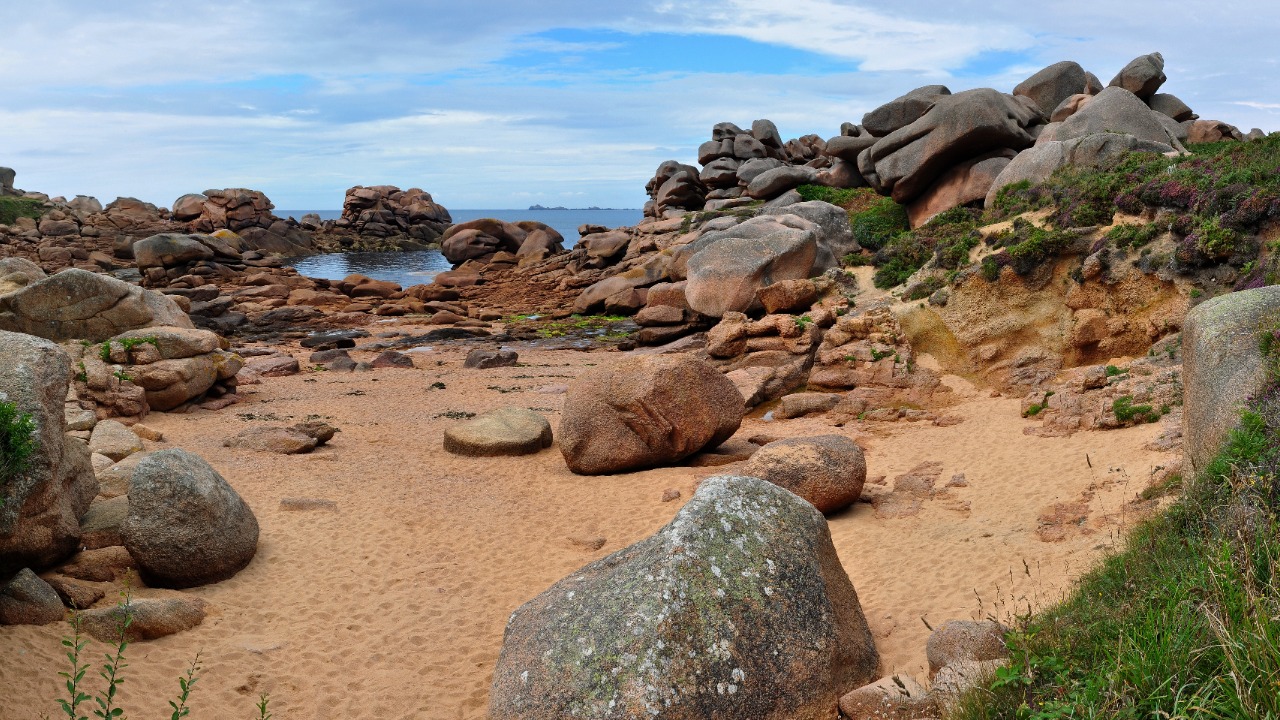
Pink granite boulders scattered across a dark Antarctic mountain range have led scientists to a colossal stone body hidden far below the ice. By tracing these out‑of‑place rocks back to their source, researchers have mapped a buried granite structure roughly 60 miles long that reshapes what is known about the continent’s deep past and its icy future.
The discovery beneath the West Antarctic Ice Sheet links a striking surface mystery to a vast underground feature that has been invisible for millions of years. It also offers a rare new anchor point for models that try to predict how quickly one of the planet’s most vulnerable ice regions might melt and raise global sea levels.
From stray pink boulders to a buried giant
The story begins with the pink granite boulders that sit like bright punctuation marks on the dark volcanic peaks of West Antarctica. These boulders do not match the surrounding rock, which is largely volcanic, so geologists suspected they had been carried from far away and dropped by moving ice. Field teams catalogued the scattered blocks and used their mineral fingerprints to show that they shared a common origin, even though they were now perched high on isolated ridges above the West Antarctic Ice Sheet, as described by the British Antarctic research program.
Those clues pointed toward a hidden source region buried under the ice, and gravity surveys provided the missing piece. Aircraft equipped with gravity sensors flew repeated lines over the Pine Island Glacier sector and detected a dense, coherent anomaly that matched what would be expected from a large granite body, according to airborne data summarized in recent geophysical work. When scientists combined the gravity signal with the mapped distribution of the pink boulders, they concluded that the rocks had been eroded from a single, enormous granite mass and then transported to the mountain peaks by flowing ice.
A 100 Km stone colossus beneath Pine Island Glacier
The hidden structure itself is vast, stretching roughly 100 Km beneath the ice in West Antarctica. Its footprint sits under the Pine Island Glacier, one of the fastest‑thinning outlets of the West Antarctic Ice Sheet and a major contributor to sea level rise. Researchers describe the feature as a giant granite body that formed deep in the crust and was later buried by younger rocks and then by ice, a configuration outlined in reports on the Pine Island Glacier region.
Airborne surveys show that the granite mass has a consistent gravity signature along its length, which supports the idea that it is a single, coherent body rather than a patchwork of smaller intrusions. One analysis notes that the anomaly extends for about 60 miles and aligns with the pattern of pink boulder deposits at the surface, reinforcing the link between the buried colossus and the scattered rocks described in Antarctic field reports. Another account of the airborne campaign emphasizes that the structure was identified by a plane and that it stretches 100 Km, highlighting how modern instruments can reveal features that are completely hidden from direct view, as detailed in coverage of the discovery flight.
Clues to Antarctica’s ancient tectonic past
The granite body is not only large, it is also ancient, and that age matters for understanding how Antarctica was assembled. Granite typically forms when magma cools slowly deep within the crust, often during major tectonic events such as continental collisions or the growth of mountain belts. The newly mapped mass beneath West Antarctica appears to be a relic of such an episode, preserved under younger volcanic rocks and ice, a scenario discussed in analyses of the ancient granite boulders.
By tying the pink boulders to this deep source, geologists gain a rare window into crust that would otherwise be unreachable. The mineral composition of the boulders, which differs sharply from the surrounding volcanic peaks, suggests that the granite formed in a very different tectonic setting from the younger rocks now exposed at the surface. Researchers argue that this contrast helps refine reconstructions of how West Antarctica evolved, including how crustal blocks were stitched together and later stretched, as noted in interpretations of the hidden giant. Those reconstructions feed into broader efforts to trace how the Antarctic continent once connected to other landmasses before the Southern Ocean opened.
Why a buried granite mass matters for future ice and seas
The discovery also has direct implications for how the West Antarctic Ice Sheet behaves today and how it might change in the future. The shape and composition of the bedrock beneath ice sheets influence how ice flows, where it sticks, and where it slides more easily toward the ocean. A large, relatively hard granite body can create ridges and basins at the base of the ice, affecting the pattern of fast‑moving ice streams that drain the interior, a relationship highlighted in studies that link subglacial geology to ice thickness and flow regimes.
Better knowledge of the buried granite colossus therefore feeds directly into climate models. When ice sheet simulations include more realistic maps of the bedrock, they can more accurately estimate how quickly glaciers like Pine Island Glacier might thin and retreat under future warming. One account of the airborne discovery notes that the 100 Km structure could offer unexpected help for climate research because it provides a fixed geological reference that improves estimates of past ice thickness and flow, which in turn sharpen projections of future sea level rise, as described in the report on how the feature could aid climate research. In that sense, the pink granite boulders on the surface are not just geological curiosities, they are signposts that connect Earth’s deep tectonic history to the urgent question of how fast the oceans will rise.