
A rescue basket that steers itself against the wind brought an injured hunter out of the Mount Jefferson Wilderness on Sept. 12, 2026. The Oregon Army National Guard HH-60M Black Hawk crew that flew the mission used a new self-stabilizing hoist device, called the Vita, to lift the hunter, who had broken an ankle about 10 miles from the nearest road. The Guard describes it as one of the first live operational uses of the technology in the country.
The device clips to the rescue basket and uses fans to counteract the wind and other forces that can set a basket spinning during a hoist. That removes the need for someone on the ground holding a tagline, the rope traditionally used to keep a hoisted load from rotating.
The Army published the account in a Sept. 14, 2026, article by Maj. Wayne Clyne. According to that report, the hunter’s companion used a satellite communication device to call for help, the Oregon Department of Emergency Management requested Guard support, and an HH-60M from Golf Company, 1st Battalion, 189th Aviation Regiment was sent. The crew found the pair by the signal they had improvised: orange-and-white clothing spinning on a pole.
How the Vita works on the hoist
The Army article says the litter attachment “uses an electric propulsion system to counteract spin, bringing a rotating basket under control within seconds,” and that the crew runs it from a wireless handheld controller. Staff Sgt. Michael Lam, who led the five-person crew with Chief Warrant Officer 3 Noelan Smith, said that with “this Vita that we attach to our rescue basket, we don’t have to have a tagline anymore,” and that it “stabilizes it up the whole time.”
Smith pointed to terrain where a tagline is not an option. “If it’s cliffside,” he said, “we don’t necessarily have the ability to have somebody on the ground.” The hunter was flown to a hospital and received treatment within a few hours of the rescue, the Army reported.
The maker, Vita Inclinata, announced in a Dec. 6, 2024, company release that its Vita Rescue System had completed U.S. Army airworthiness qualification and U.S. Air Force testing, including MIL-STD-810H environmental and MIL-STD-461 electromagnetic qualification. The company says the system works at speeds up to 80 knots and is waterproof to one meter for 30 minutes. Those are the manufacturer’s figures; the Oregon mission was a mountain hoist, not a test of those limits.
From Salem testing to an Army contract
Oregon’s Guard aviators have been working with the device for more than a year. The Sept. 14 Army article says testing began in June 2025, when Guard flight medics worked with Army researchers in Salem. A Jan. 22, 2026, Army article, also by Clyne, records that Oregon became the third Army unit to receive Vita Rescue System training on June 18, 2025.
That same January article describes a problem the Oregon crews found and fixed. Standard Black Hawk seat belts were too short to secure a litter basket once the Vita unit was attached, so Golf Company crews developed an extended strap, the SK-1189-V. After airworthiness certification by the U.S. Army Aeromedical Research Laboratory at Fort Rucker, Alabama, it became standard equipment for all Army MEDEVAC units, about six months after the problem was first identified.
The Army has since committed money to the device. Vita Inclinata said in a Jan. 30, 2026, company release that the U.S. Army Utility Helicopter Program Office awarded it a sole-source $45.6 million contract to supply Vita Rescue Systems. The release did not state how many units the contract covers.
Guard officials indicated the system may eventually be used beyond Oregon, according to the Sept. 14 Army report. For the Golf Company crew, the Mount Jefferson hoist now stands as an operational use of equipment the unit spent more than a year helping to field.
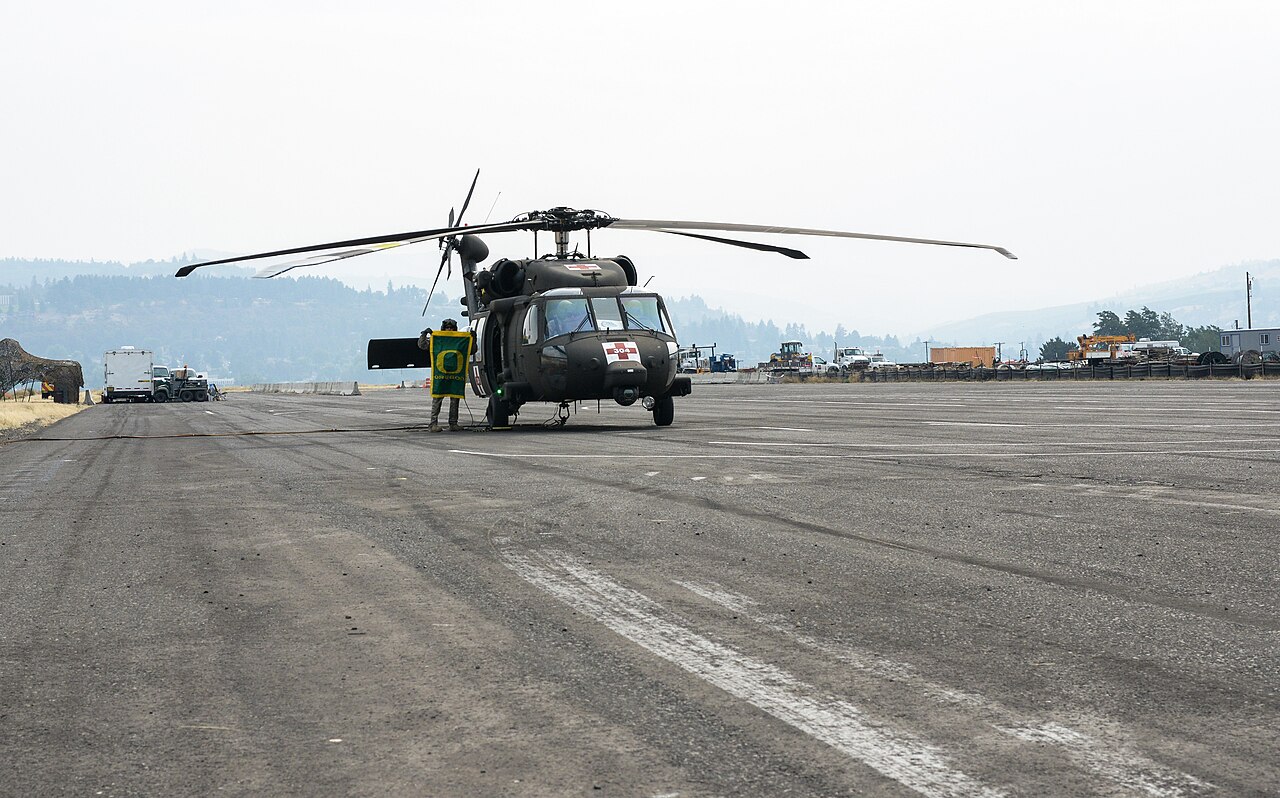
Top image: An Oregon Army National Guard HH-60M Black Hawk, 2013. Image Credit: Oregon Military Department — Public domain / Wikimedia Commons
This article was produced with the assistance of AI and reviewed by Combat Rated editors prior to publication.