
Hoses, valves, bladders and pumps are the parts of a base-camp shelter system most vulnerable to cracking and freezing when the temperature drops. Army and Navy engineers wrapped and insulated those components on a Triple Container, or TRICON, rigid-wall shelter system and then took it far below its design goal. In an Army laboratory’s extreme-cold test chamber, the upgraded system stayed operational down to minus 65 degrees Fahrenheit, against a target of minus 50 and a fielded-version limit of minus 15.
The work paired the Navy’s Naval Facilities Engineering and Expeditionary Warfare Center, known as NAVFAC EXWC, with the Army’s Cold Regions Research and Engineering Laboratory, or CRREL. The aim was a rapidly deployable shelter system that keeps working in far colder conditions than the version already in the field.
The results were reported Oct. 14, 2026, by Military Times, in a report by Claire Barrett carried on Defense News. It says the already fielded version “can operate in temperatures as low as -15 degrees Fahrenheit,” that the new configuration was meant to be “usable in temperatures as low as -50 degrees Fahrenheit,” and that testing showed the system “staying operational down to -65 degrees Fahrenheit.”
What a TRICON system does at a base camp
These are not cold-weather clothing or tents. The container-based systems are “used to provide kitchens, showers, laundries, and latrines at forward bases,” The Defense Post reported Oct. 5, 2026, in its own account of the project. Military Times summed up the benefit to personnel as “Toilets! Laundry! Showers!”
That plumbing is what the cold attacks. According to both reports, the engineers tested different combinations of thermal wrapping, insulation and other components, concentrating on the hoses, valves, bladders and pumps that are vulnerable to cracking and freezing.
Inside CRREL’s Extreme Cold Chamber
The testing took place in CRREL’s Extreme Cold Chamber, which Military Times describes as “a 288-square-foot cold room capable of reaching temperatures as low as -90 degrees Fahrenheit.” The Defense Post places the chamber in Hanover, N.H. CRREL is one of seven U.S. Army Engineer Research and Development Center laboratories, per Military Times.
Neither report gives a date for the chamber test. The result on record is a chamber result: the upgraded system ran at minus 65 degrees, 15 degrees colder than its goal and 50 degrees colder than the limit of the version already in service.
Why the engineers say it matters
Dr. Dan Tague, a research chemist at CRREL, tied the work to the people who use the facilities. “Our armed forces live and operate in extremely cold and difficult conditions,” he said, as quoted by Military Times, adding that “having these facilities operational is important for their physical and mental health” for troops serving in the Arctic and other high-north environments.
James Pilkington, a project manager in NAVFAC EXWC’s Expeditionary Technical Department, framed it in terms of reach. The system, he said in the Military Times report, “extends the operational range of base camps in terms of geographic locations and durations.” He added: “In turn [it] extend[s] force posture.”
Military Times described the gain the same way, saying the latest results provide “an expanded operational footprint for the U.S. military as a whole.” The minus-50 target itself traces to the Defense Department’s Arctic strategy, The Defense Post reported, a document that the outlet says “calls for more exercises with allies and investment in capabilities needed to operate in the region.”
The Military Times report gives no fielding timeline, production order or receiving unit for the upgraded configuration. The record so far is the chamber number: a shelter system built to work at minus 50 kept running at minus 65.
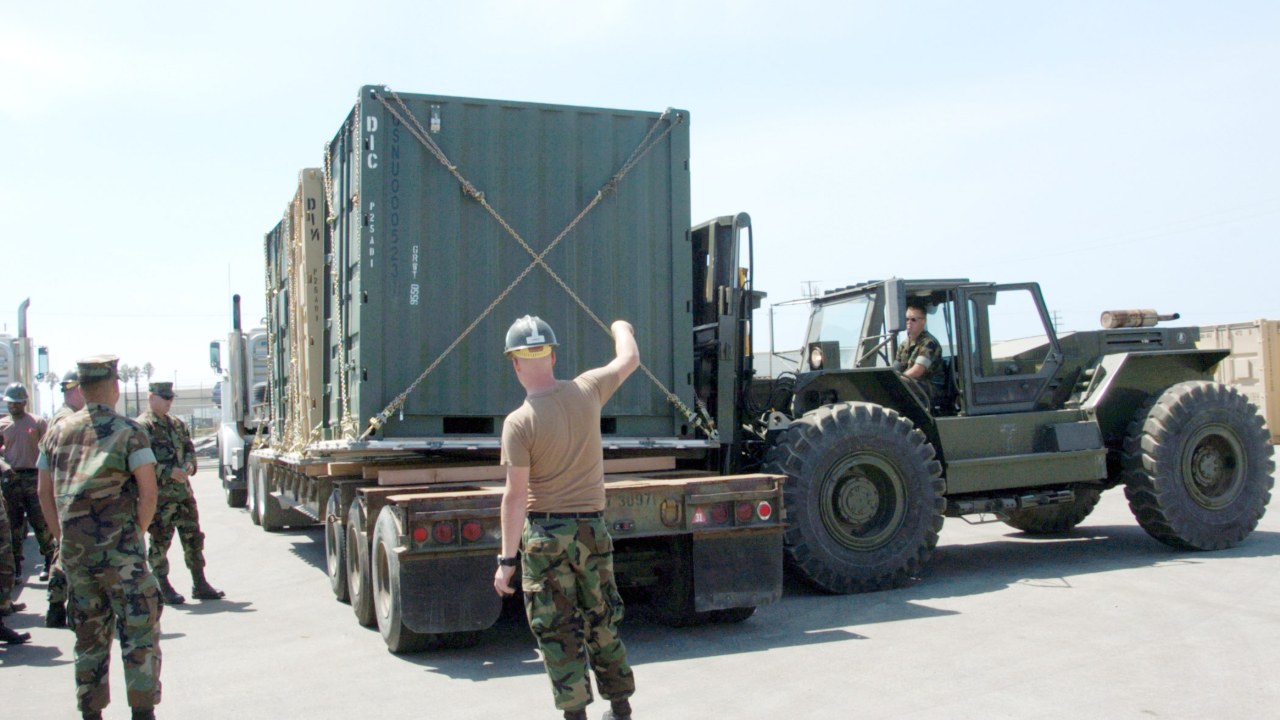
Top image: Seabees of NMCB-4 move TRICON containers at Port Hueneme, Calif., in 2006. The upgraded shelter system is not shown. Image Credit: MC2 Ronald Gutridge / U.S. Navy — Public domain / Wikimedia Commons