
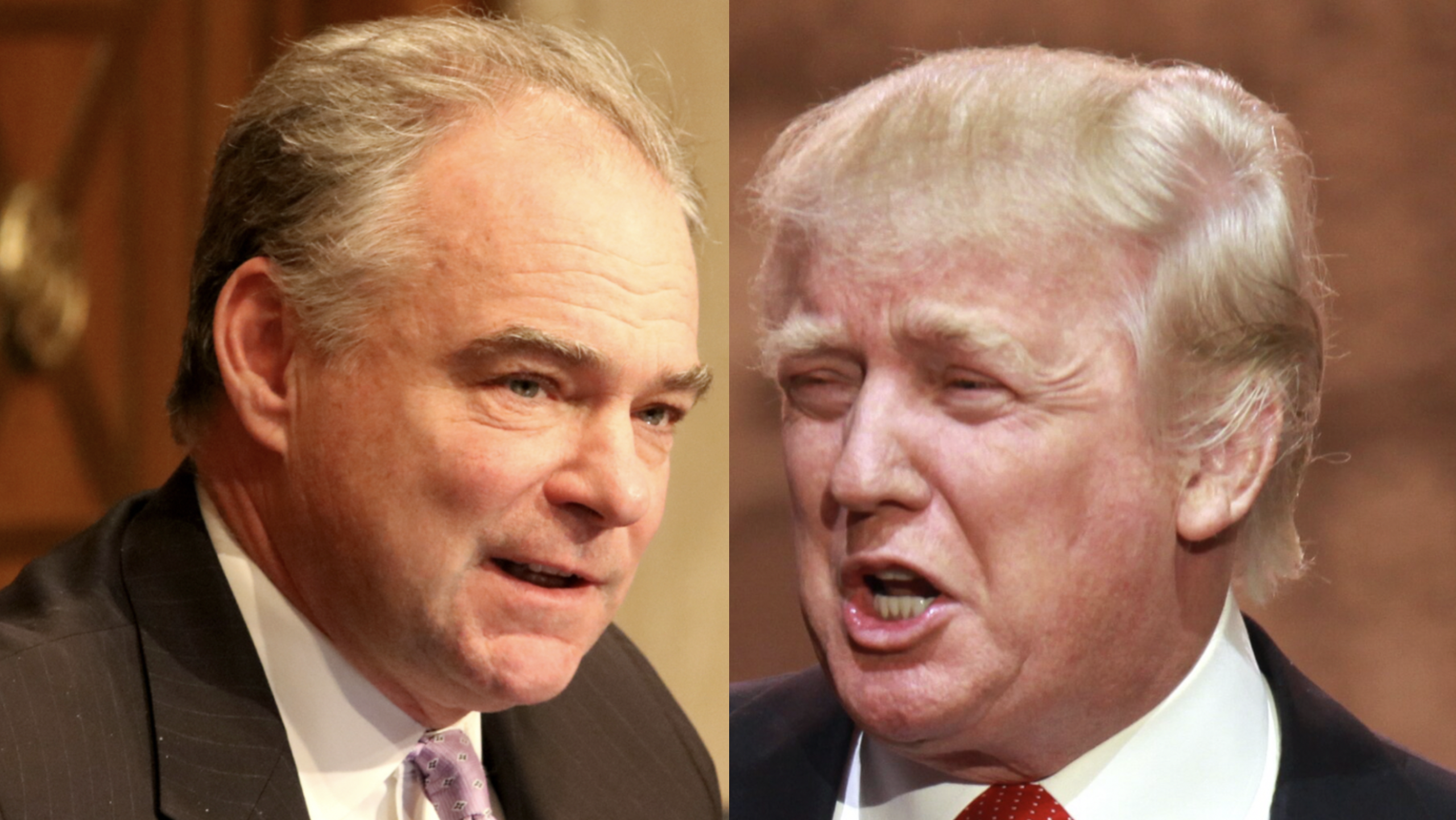
Virginia Democratic Sen. Tim Kaine responded forcefully Wednesday afternoon after the House of Representatives passed a war powers resolution designed to force an end to the Iran War, calling the vote clear evidence that the Trump-Vance administration is “focused on the wrong things” and pledging to press forward with his own Senate resolution in the coming days. Kaine, who has been the Senate’s most vocal and persistent champion of congressional war powers since the conflict began, framed the House action as further proof of a war that has grown deeply unpopular with the American public — and promised the fight is not over.
“It shouldn’t be surprising to the President and his national security team that this war is deeply unpopular — especially when the Trump-Vance Administration has offered no explanation to the American people about what our objectives are, whether we can achieve them through military force alone, what the legal rationale is, or what the financial and human costs and risks are for our country,” Kaine wrote in an X post at 4:53 p.m. on June 3rd. “Today’s House vote is more evidence that this Administration is focused on the wrong things. Americans have zero interest in being dragged into another prolonged war in the Middle East, and I’ll continue pushing my colleagues to end this unnecessary and costly war when my War Powers Resolution comes up for its next vote soon.”
House Passes Resolution 215-208
The House vote on Wednesday marked a significant milestone in the months-long congressional battle over the legality of the Iran War. Lawmakers approved the resolution 215-208, with four Republicans — Reps. Thomas Massie of Kentucky, Brian Fitzpatrick of Pennsylvania, Tom Barrett of Michigan, and Warren Davidson of Ohio — breaking with their party to join every Democrat in supporting the measure. The resolution, sponsored by Rep. Greg Meeks of New York, the senior Democrat on the House Foreign Affairs Committee, directs President Trump to remove all U.S. forces “from hostilities” with Tehran “unless explicitly authorized by a declaration of war or a specific congressional authorization for use of military force against Iran.”
The measure is designated as a “concurrent” resolution, meaning it requires approval from both chambers but does not go to the White House for the president’s signature or veto. That stands in contrast to the Senate’s version — a “joint” resolution — which, if passed, would go to Trump’s desk and, if signed, carry the full force of law. The White House has already dismissed the House measure as an “unconstitutional legislative veto” over executive authority, and the administration has argued the conflict effectively ended when Trump ordered a ceasefire in early April. “There are no present hostilities from which to remove U.S. Armed Forces,” the White House wrote in a formal statement of administrative policy opposing the Meeks bill. “The hostilities that began on February 28, 2026, have terminated with the ceasefire ordered by the President on April 7, 2026.”
The War Powers Debate: A Constitutional Battle
Wednesday’s vote was the fourth time House critics of the war had sought to end it through the war powers process. The conflict has drawn widespread public disapproval, and the War Powers Act of 1973 has become the legal backbone of the congressional push. That law empowers presidents to launch military operations without congressional approval for a specific window — 60 days, with the option to extend for another 30 — a period that closed in early May. With that deadline passed, an increasing number of lawmakers in both parties have demanded that Trump come to Congress for formal authorization to continue using military force against Tehran.
Behind Speaker Mike Johnson of Louisiana, most Republicans have argued that the conflict does not rise to the level of a war and therefore does not require congressional approval. GOP leaders have also warned that tying Trump’s hands mid-conflict would empower Iran’s Islamic regime at the expense of American security. But that wall of defense has shown increasing cracks as the conflict drags on and its economic toll mounts. Gas prices have been a particular flash point: the national average for a gallon stood at $4.26 on Wednesday, up from $3.14 a year ago, according to the American Automobile Association, driven in part by global trade disruptions stemming directly from the war.
Kaine’s Long Campaign Against the Iran War
Kaine’s response Wednesday was consistent with a position he has held since before a single shot was fired. The Virginia Democrat introduced a war powers resolution expressing concern about escalating Middle East violence before the conflict began, warning that it had “the potential to pull the U.S. into conflict” and calling for a mandatory congressional debate and vote before any U.S. military force was used against Iran. At the time, Kaine said, “It is not in our national security interest to get into a war with Iran unless that war is absolutely necessary to defend the United States. The American people have no interest in sending servicemembers to fight another forever war in the Middle East.”
After the Senate voted 53 to 47 to shut down his first war powers resolution in early March, Kaine was unambiguous in his assessment of the conflict. “This is a dumb war. I mean, have we really learned nothing?” he said, adding that he was “standing with a stop sign doing everything I can to stop my colleagues from embarking on yet another war in the Middle East.” He made clear that first failed vote would not be the end of his effort: “I want to assure everybody, this vote is the first step, not the last step, because there are other tools at our disposal to continue to raise the question about whether this war is worth it.”
Forcing Votes Week After Week
Kaine made good on that promise in dramatic fashion. He announced his intention to force a war powers vote every single week until one succeeded. “We’re going to bring this vote to end the war up every week until we succeed,” he said, calling the conflict both “illegal and stupid” and predicting that Republican opposition would erode week by week. That relentless pressure strategy slowly began paying dividends as the months wore on and public sentiment hardened against the conflict.
In mid-May, Kaine pointed directly to the war’s economic toll as what would ultimately force the issue. “We’re coming up on Memorial Day. A lot of people do a lot of driving, they’re going to be paying a lot for gas — a whole lot more than they paid last year, and they remember that,” he said. He added that the public’s lack of support for the war “is really hardening right now” and that pressure would be “what eventually gets us to pass the resolution.”
Senate Advances Its Own Resolution
The Senate took its own significant step on May 19th, advancing a War Powers Resolution led by Kaine alongside Senate Democratic Leader Chuck Schumer and eight other Democratic senators, including Adam Schiff of California, Cory Booker of New Jersey, Tammy Duckworth of Illinois, and others. The advance came after Sen. Bill Cassidy of Louisiana flipped his vote to yes just days after Trump had helped defeat him in Louisiana’s Republican primary — a pivotal development that gave the resolution the votes it needed to move forward for the first time.
“President Trump’s deeply unpopular war of choice in Iran has imposed a tremendous cost on the American people — including deaths and injuries of our servicemembers and soaring gas prices,” Kaine said after that Senate vote. “For several weeks, my colleagues and I have been forcing votes in the Senate to ensure we have a real debate about whether it’s in our national interest to continue this war. I’m grateful that today, enough of my colleagues stood up for the Constitution and listened to their constituents. This sends a strong message to President Trump, Vice President Vance, Secretary Hegseth, Secretary Rubio, and the rest of the Cabinet that the American people aren’t interested in more war in the Middle East.”
The Broader Political Picture
Wednesday’s House vote did not occur in isolation. In a separate action, the House also advanced Ukraine aid legislation that had been forced to the floor through an obscure procedural move known as a discharge petition, which required 218 signatures to compel a vote on legislation opposed by Republican leadership. The dual votes underscored a growing willingness among some House Republicans to break ranks with Trump on major foreign policy and military matters as the midterm election season takes shape. Independents, in particular, have soured significantly on the Iran conflict as it has stretched past three months — a warning sign for Republicans in competitive districts heading into November.
The economic dimension of the war has given Democrats their sharpest political weapon. House Minority Leader Hakeem Jeffries of New York framed it bluntly on Tuesday, telling reporters, “Donald Trump’s reckless and costly war of choice has cost everyday Americans hundreds, if not thousands of dollars more in increased costs, particularly as it relates to gas prices. This war — this reckless and costly war of choice — needs to end today.” Democrats have used that framing to tie the conflict to two campaign pledges Trump made on the trail: a promise to avoid foreign military entanglements, and a commitment to cut costs for working-class Americans.
What Comes Next
The Senate’s war powers resolution — the joint version that would carry the force of law — still awaits a final vote, though the timing remains unclear. It is widely expected that Trump would veto the measure if it reached his desk. Kaine’s own Senate resolution is also set for another vote in the near term, as he indicated in his Wednesday post. The concurrent House resolution now heads to the Senate, though its legal force remains a matter of dispute even among those who support it. Rep. Jared Huffman of California captured the sentiment of war opponents after Wednesday’s vote: “We’re inching closer to having both chambers of Congress declare this an illegal war. That’s huge. It’s just becoming more and more untenable, what he has done.”
For Kaine, Wednesday’s House action was the latest validation of a months-long argument he has made from the Senate floor, in classified briefings, and on television: that the United States went to war without a legal foundation, without a clear strategy, and without the consent of the American people’s representatives in Congress. As he wrote after one of his earliest failed votes: “The Framers of our Constitution gave Congress the power to declare war because they believed that the decision to send our nation’s men and women in uniform into harm’s way was too big for any one person.” With his next Senate vote approaching, Kaine has shown no signs of stopping.