

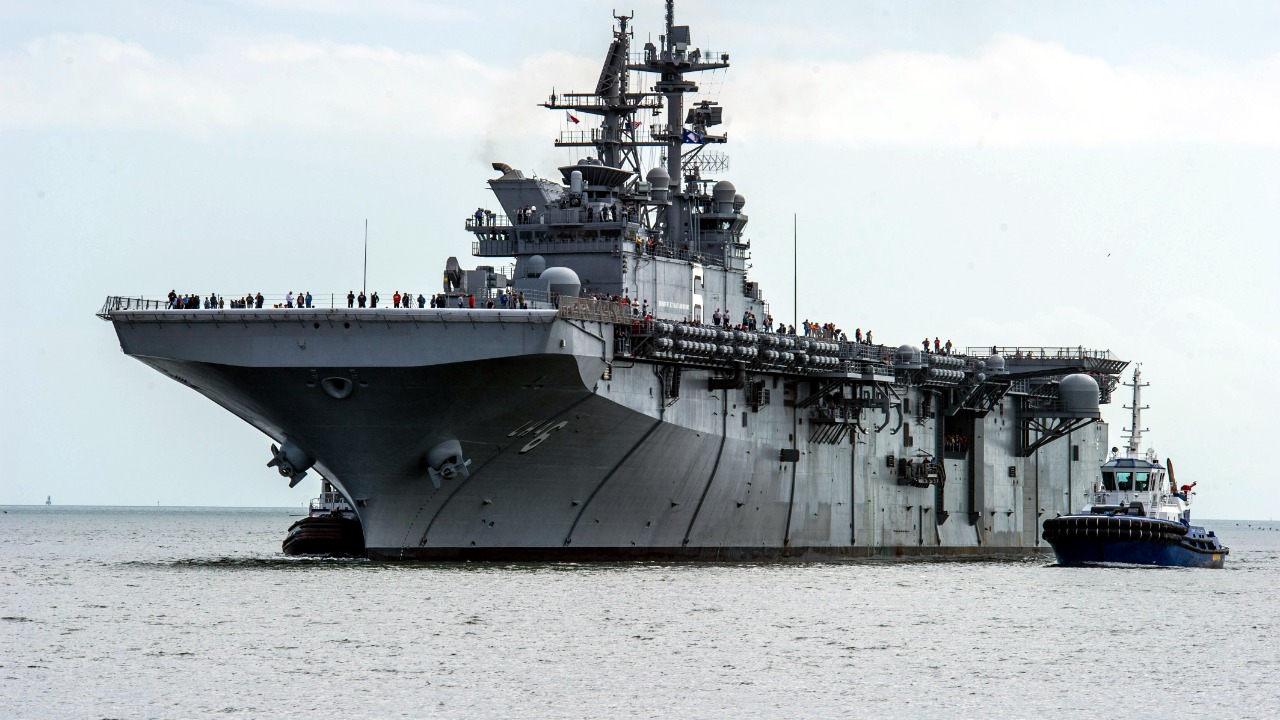
From a distance, America-class amphibious assault ships look like compact aircraft carriers, flat-topped silhouettes riding the horizon. Up close, they reveal a different purpose: these “big deck” warships are engineered to move an entire Marine air-ground task force from sea to shore, turning open water into a mobile launchpad for combat or crisis response. Their design fuses aviation, landing craft, and command-and-control into a single hull that can quietly loiter offshore, then unleash aircraft and armored vehicles in a tightly choreographed surge.
In practice, that means an America-class ship can host advanced jets, tiltrotors, helicopters, and landing craft, then push Marines ashore without relying on ports or airfields. The same capabilities that enable a major amphibious assault also allow rapid humanitarian relief, evacuation operations, or deterrent patrols, giving U.S. commanders a flexible way to project power from the sea.
From Wasp-class roots to aviation-focused “big decks”
The America-class story starts with a proven template: the Wasp-class LHD amphibious assault ships that defined the modern “large deck” amphibious concept for the U.S. Navy. The new America-class LHA ships are described as a variant of that extremely successful Wasp-class LHD design, but they are optimized to carry more aircraft and support more intense flight operations. Where the Wasp-class balanced a sizable well deck with aviation facilities, the earliest America hulls, including USS America (LHA-6), lean into their role as aviation flagships, trading some traditional amphibious capacity for expanded hangar and maintenance space.
That shift reflects how the Marine Corps fights. Modern amphibious warships are built to support the Marine Corps tenets of Operational Maneuver From the Sea and Ship to Objective Maneuver, concepts that prioritize speed, reach, and bypassing defended beaches. Official guidance notes that amphibious warships are designed to deliver Marines directly to objectives inland, not just to the waterline, and to underpin what is described as the most capable amphibious force in the world. The America-class, with its enlarged aviation facilities and ability to host a powerful Marine air combat element, is the physical expression of that doctrine.
How aviation turns America-class ships into sea-based airfields
The most visible way these ships “launch war from the sea” is through their flight decks. The America-class is built around a full-length flight deck and large hangar that can support a mix of F-35B Joint Strike Fighters, MV-22 Ospreys, CH-53K King Stallions, and attack helicopters such as the AH-1Z Viper, giving a single hull the ability to provide air superiority, close air support, and rapid troop lift. The builder notes that The America-class LHA ships are specifically configured to support the F-35B Joint Strike Fighter, which demands reinforced deck spots, advanced maintenance spaces, and robust aviation fuel and ordnance handling systems.
Those aviation upgrades are not cosmetic. Manufactured by Huntington Ingalls Industries, the America-class is described as a Large Deck Amphibious platform whose objective includes providing forward presence and supporting the most advanced Marine Corps aircraft. In operational terms, that means an embarked Marine Expeditionary Unit can launch F-35B sorties for strike and reconnaissance, spin up MV-22s for vertical assault, and cycle heavy-lift helicopters to move artillery and vehicles, all without touching a land base. The ship’s aviation complex effectively becomes a floating airfield that can reposition hundreds of miles in a day.
Well decks, LCACs, and the mechanics of storming a shore
While the earliest America hulls emphasized aviation, the class is evolving to restore and refine traditional amphibious capabilities. Later “Flight I” ships, such as USS Bougainville, incorporate a well deck that can be flooded to launch landing craft and amphibious vehicles from the stern. The broader category of America-class amphibious assault ship design is described as balancing aviation capacity with larger amphibious warfare well decks, a combination that lets commanders tailor each deployment toward either air-heavy or landing craft–heavy operations.
Inside that well deck, the workhorses are specialized landing craft. Amphibious warfare ships have steadily integrated new technology, and one of the most recent innovations is the LCAC (Landing Craft Air Cushioned), a large hovercraft that rides on a cushion of air to move cargo and troops from ship to shore. Official descriptions of amphibious assault ships emphasize that AMPHIBIOUS ASSAULT (LHA/LHD) ships use air cushion landing craft, conventional landing craft, and helicopters to move Marines and their gear, integrating LCACs with an embarked Marine air wing to deliver a synchronized assault.
LCACs and the ship-to-shore bridge
The Landing Craft Air Cushion is the critical bridge between the America-class hull and the beach. The official description notes that The Landing Craft Air Cushion (LCAC) is a class of air-cushioned landing craft used by the United States Navy and the Marine Corps to move weapons systems, equipment, cargo, and personnel from ship to shore and across the beach. Because LCACs ride above the water on a cushion of air, they can cross surf zones, sandbars, and mudflats that would stop traditional displacement hulls, letting America-class ships stand far offshore while still delivering tanks, trucks, and heavy engineering gear directly onto unimproved coastline.
In an assault, that capability is decisive. LCACs can surge out of the well deck in waves, each one carrying armored vehicles or large loads of supplies, while helicopters and tiltrotors lift infantry and reconnaissance teams over the horizon. Together, they turn the America-class into a hub for what planners call “ship-to-shore movement,” a carefully timed sequence that puts Marines, vehicles, and logistics ashore in the right order. The result is a force that can appear on a hostile coastline with little warning, or pivot just as quickly to deliver food, water, and medical teams after a natural disaster.
Sea-based command posts and sustained power projection
Beyond aircraft and landing craft, America-class ships function as floating headquarters and hospitals. Modern U.S. Navy amphibious assault ships are described as the cornerstone of the amphibious ready group, projecting power and maintaining presence while supporting operations from the sea. Official fact files explain that Modern U.S. Navy Amphibious Assault Ships have supported combat operations in places such as Iraq and Afghanistan, even when those campaigns were landlocked, by serving as sea-based staging areas for Marines and their aircraft. That same architecture, with extensive command-and-control suites and medical facilities, allows an America-class hull to coordinate joint operations or act as a regional crisis hub.
At the doctrinal level, these ships are built to support the Marine Corps’ Operational Maneuver From the Sea and Ship to Objective Maneuver concepts, which rely on sea basing to keep forces mobile and less vulnerable to attacks on fixed infrastructure. The official description of Amphibious warships underscores that they are designed to support these tenets by carrying Marines, their aircraft, and their equipment in a single, integrated package. For the America-class, that means not only launching the first wave of aircraft and LCACs, but also sustaining operations for weeks, with the ship’s logistics, medical, and command spaces all geared toward keeping a Marine air-ground task force in the fight while it remains anchored to the sea rather than a vulnerable land base.