
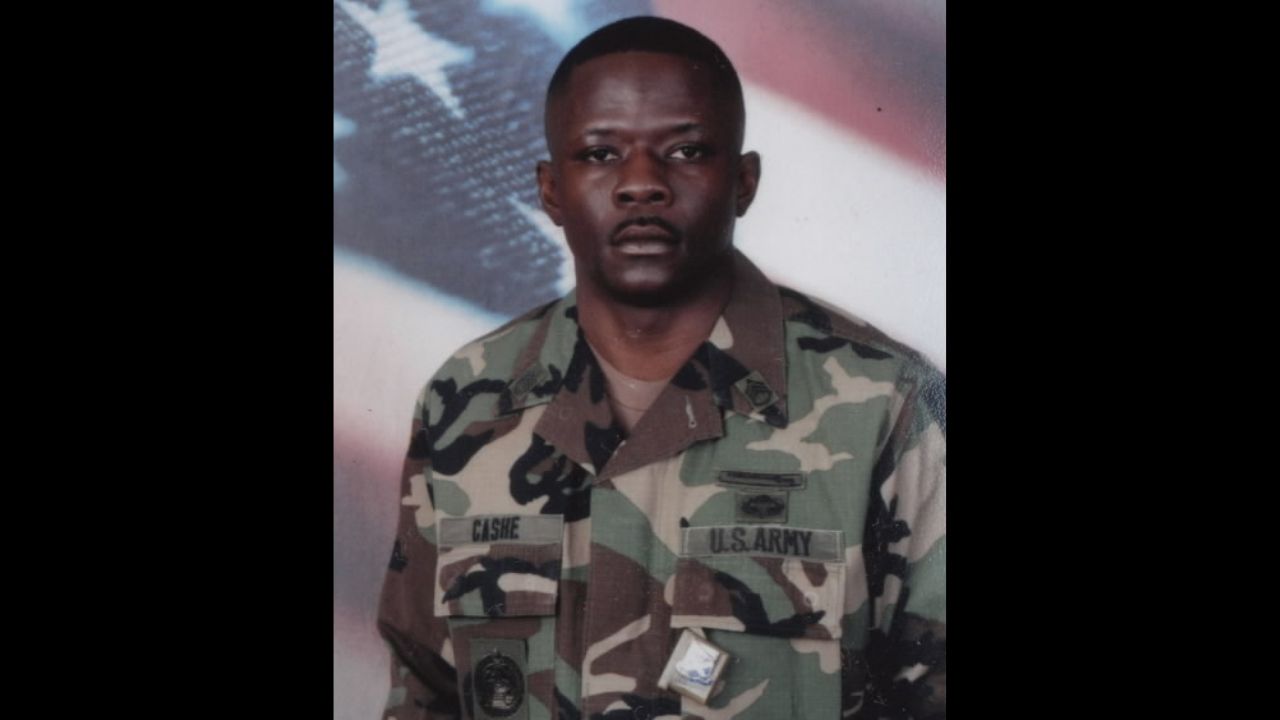
Armor is supposed to buy time: time to react, to fight, to get out. On Oct. 17, 2005, near Samarra, Iraq, that bargain collapsed for a U.S. Army Bradley crew when a roadside blast turned their vehicle into a burning trap. That failure set the stage for Sgt. 1st Class Alwyn C. Cashe’s final, repeated decision to go back inside anyway. The U.S. Army Medal of Honor profile describes Cashe—the platoon sergeant in command of the lead vehicle on a nighttime mounted patrol—moving into danger as flames and fuel engulfed the compartment and soldiers fought to escape.
Cashe’s actions are sometimes summarized as a single rescue, but the accounts emphasize repetition: he kept returning to the vehicle after seeing what it had become. An Army.mil article quotes a witness saying he went back “again and again.” Feature reporting has also put a number to those entries, describing him re-entering the burning Bradley three times. What follows in the story is both immediate and delayed—people pulled free in the moment, and catastrophic burn injuries that would claim Cashe’s life weeks later at the military’s premier burn-care facility in San Antonio.
M2A2/M2A3 Bradley Fighting Vehicle (BFV) — Cashe’s lead vehicle on the patrol (near Samarra, Iraq)
The Bradley at the center of the incident is described across sources as an M2A2/M2A3 Bradley Fighting Vehicle, the lead vehicle in Cashe’s platoon on that nighttime patrol near Samarra. The U.S. Army Medal of Honor profile places him in command as platoon sergeant when the vehicle was hit and caught fire. The hook is the hard contradiction the event exposes: a heavily armored infantry fighting vehicle can still become deadly once a post-blast fire takes hold inside a confined troop compartment.
Because retellings vary on technical cause—ASOM notes differences such as whether the fire is framed as a “fuel cell” issue or a “fuel leak”—Combat Rated should not over-specify the mechanism. What remains consistent in the U.S. Army profile and other semi-official writeups (including VA News, ASOM, and the Association of the United States Army) is the outcome: the Bradley burned, soldiers were trapped, and Cashe chose to go into the flames to get them out.
Improvised Explosive Device (IED) / roadside bomb strike (Oct. 17, 2005)
Multiple official and semi-official accounts describe the initiating event as an IED/roadside bomb strike on Oct. 17, 2005, which disabled the Bradley and sparked the fire. The Army’s Medal of Honor page anchors the incident in a nighttime mounted patrol, the kind of movement that IED networks in Iraq targeted. In practical terms, the blast didn’t just stop a vehicle—it created a rescue problem inside an armored space that was rapidly becoming unlivable.
Some accounts also mention small-arms fire or an ambush during the incident, but it is important not to blur the sequence. The IED is described as the trigger. The burning vehicle is the immediate environment Cashe ran into, not away from, as personnel struggled to escape.
The specific action claim in the headline — “walked back into the burning Bradley three times”
The key detail—Cashe re-entering the burning Bradley three times—needs careful handling because the most official summaries often avoid a precise count. Task & Purpose explicitly states “three times,” while the Army.mil witness quote “again and again” supports repeated entries without numbering them. Read together, those accounts describe the same core reality: this was not a one-and-done dash into danger.
Task & Purpose also describes him acting while his uniform was fuel-soaked and on fire, emphasizing that the risk and pain were already in progress when he chose to return. That repetition is what makes the moment legible as a series of decisions rather than a reflex: he went back after learning firsthand how lethal the conditions were inside the vehicle.
Casualty/rescue specifics — number of personnel saved/extracted
How many people Cashe saved is central to the scale of the rescue, and the numbers vary depending on how the story is framed. Wikipedia states he saved six fellow soldiers. A U.S. Army article, by contrast, describes him as attempting the rescue of seven soldiers and an Iraqi interpreter—language that can capture the broader group at risk and the full scope of what he tried to do around the burning vehicle.
Rather than forcing those figures into a single definitive tally, the most accurate approach is to present them as they appear in the accounts: Cashe repeatedly entered the burning Bradley to pull out trapped personnel, with one widely cited summary crediting him with saving six (per Wikipedia) while Army reporting emphasizes a larger rescue effort involving seven soldiers and an Iraqi interpreter.
Burn injuries + evacuation chain — DoD Burn Center / Brooke Army Medical Center (BAMC), San Antonio
The fire left Cashe with catastrophic burns, and the fight did not end when he was out of the vehicle. Sources commonly cite burns over roughly 72% of his body (Wikipedia), while an older Army.mil feature mentions more than 80%; that difference should be treated as a conflict rather than glossed over. What is consistent is the end point of the evacuation and treatment chain: he entered the military burn-care system and ultimately died at Brooke Army Medical Center (BAMC) in San Antonio, part of the Department of Defense’s burn-care capability.
This is what gives the story its full weight. The rescue happened in seconds and minutes, but severe burns make survival a prolonged medical battle. In Cashe’s case, the injuries were survivable long enough to reach specialized care—yet still fatal.
Timeline anchor — death date and “weeks later”
The timeline is clear: wounded on Oct. 17, 2005, Cashe died on Nov. 8, 2005—roughly three weeks later. That spacing matters because it shows what “survived the blast” can mean in practice: a service member can live through the initiating strike and still succumb to the secondary effects days or weeks afterward. The Army Medal of Honor profile, ASOM, and other writeups cited in the context anchor that arc from battlefield action to stateside hospital death.
For Combat Rated readers, the larger takeaway is not only that Cashe’s actions were extraordinary, but that the incident captures a brutal dynamic of the Iraq War. An IED didn’t have to be described as penetrating armor to produce catastrophic casualties; it only had to start a fire that trapped people inside a confined vehicle. Cashe’s repeated entries into that space—described as “three times” by Task & Purpose and as “again and again” by an Army.mil witness account—helped others live long enough to get out, even as it set the terms for his own death weeks later at BAMC.