
When a faint, fast-moving speck labeled 3I/ATLAS first appeared in survey data earlier this year, it took only hours for social media to promote it from obscure comet candidate to supposed alien craft. The object’s interstellar origin, unusual speed and outsider status in the solar system made it an irresistible canvas for speculation. Yet as astronomers have gathered data, the picture that has emerged is far less sensational and far more scientifically revealing.
NASA and other research teams now describe 3I/ATLAS as a textbook example of an interstellar comet, an icy fragment from another star system that happens to be passing through ours. Its path, color, activity and behavior match what physics predicts for a natural object, not a guided vehicle, and the agency has gone out of its way to spell out why the alien rumors do not hold up under scrutiny.
How 3I/ATLAS crashed into the public imagination
The story of 3I/ATLAS began on July 1, 2025, when the object was first identified by the NASA-funded ATLAS telescope in Chile. Astronomers quickly realized that its orbit could not be explained by the gravity of the Sun and planets alone, which meant it was not bound to our solar system and had to be arriving from interstellar space. That instantly placed it in a very small club: according to NASA’s own Comet 3I/ATLAS Facts and FAQS, it is only the third known object to pass through our solar system from beyond, after earlier interstellar visitors that were detected in the previous decade.
That rarity helped turn a technical discovery into a cultural moment. As NASA’s planetary defense team noted, the object was quickly confirmed as an interstellar comet and given the formal designation Comet 3I/ATLAS, with “3I” marking it as the third interstellar object and “ATLAS” honoring the survey that spotted it. Within a day of its announcement, however, the same qualities that excited scientists, especially its high velocity and unbound trajectory, were being recast online as evidence of an artificial probe, even though the initial orbital calculations already showed a natural, gravity-driven path.
NASA’s case for an interstellar comet, not a craft
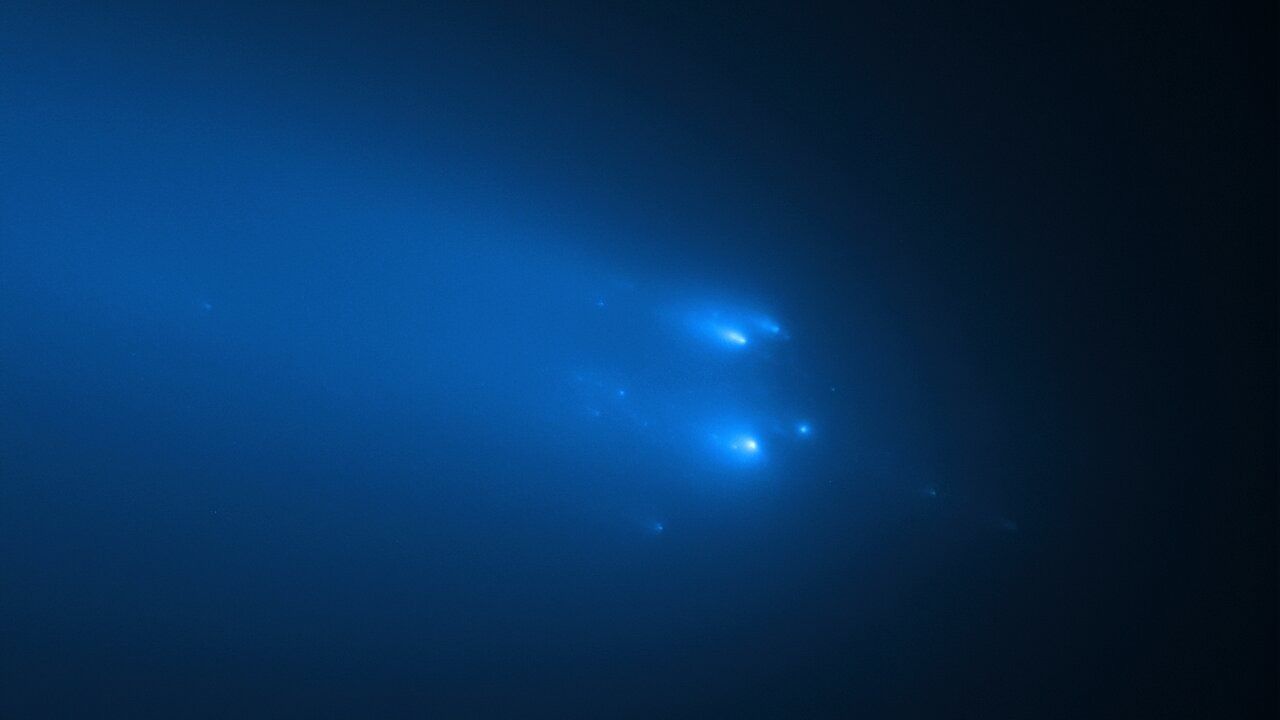
From the start, NASA scientists have emphasized that 3I/ATLAS behaves exactly like a comet and not at all like a controlled spacecraft. In its official FAQ on 3I/ATLAS, the agency points out that the object’s characteristics, color, speed and direction are all consistent with what astronomers expect from a comet. As it approached the Sun in October 2025, it developed a diffuse coma and tail produced by sunlight heating its icy surface, a hallmark of natural outgassing that matches standard comet physics rather than any kind of propulsion system.
Equally important is the way 3I/ATLAS moves through space. NASA’s FAQ explains that observations of the comet’s trajectory show it follows a hyperbolic path that cannot be closed into an ellipse by the Sun’s gravity, which is how scientists determined that it did not originate in our solar system. That same trajectory is smooth and predictable, with no sudden course changes that would hint at active steering. A detailed breakdown in a November analysis of why 3I/ATLAS is not “aliens” stresses that its motion is fully explained by gravity and the gentle push of outgassing, in line with comets seen closer to home and with models of icy bodies that formed in the outer regions of another star system.
Debunking the “alien spaceship” narrative

Despite that scientific clarity, rumors that 3I/ATLAS might be an alien spacecraft have persisted, amplified by social media posts and speculative videos. One particularly viral idea recycled claims that any interstellar visitor must be artificial, a narrative that previously attached itself to other objects. In response, NASA leaders have directly rejected the extraterrestrial conspiracy, with officials quoted in a December report on where 3I/ATLAS is now saying there is no evidence it is anything other than a comet. A separate November explainer titled “Comet 3I/ATLAS is not ‘aliens’. Here’s the science to prove it” underscores that there are no anomalous signals, no engineered structures and no unexplained accelerations in the data.
NASA’s communications have tried to get ahead of the speculation cycle. A short video released in late November, framed as a response to claims that 3I/ATLAS is an alien object, walks through the July 2025 discovery and the subsequent observations that confirmed its cometary nature. The clip, referenced in a November summary, highlights that the object’s brightness variations, tail formation and spectral fingerprints all match frozen volatiles, not metal or manufactured materials. When Discover magazine later revisited the early frenzy in a December feature on saying goodbye to 3I/ATLAS, it noted that speculation about an alien spacecraft had spread quickly after the first detection, but that the growing body of data steadily reinforced the mundane, if still remarkable, conclusion that this is a natural interstellar comet.
What the trajectory and distance really tell us
Part of what fueled the alien narrative was the perception that 3I/ATLAS was on a dangerously close or targeted path toward Earth. The actual numbers tell a different story. When NASA and its partners modeled the orbit earlier in the year, they concluded that the comet posed no threat to Earth and would remain at a distance of at least 1.6 astronomical units, which is farther than the distance from the Sun to our planet. Later refinements showed that at its closest point to Earth, 3I/ATLAS would pass within 1.8 astronomical units, or about 168 million miles, a comfortable distance that rules out any collision scenario.
The shape of the orbit is just as revealing. A December overview of how 3I/ATLAS is moving away notes that less than 24 hours after its initial detection, NASA confirmed that the speeding blur of light was an interstellar object, sometimes described as an “alien asteroid” in the sense that it comes from another star system, not in the sense of being artificial. Its hyperbolic trajectory means it entered the solar system from the Milky Way’s “frontier” region and will eventually leave again, never to return. That one-time flyby is exactly what celestial mechanics predicts for a small body that has drifted in from deep space and been deflected by the Sun’s gravity, and it leaves no room for the kind of looping, targeted maneuvers that a spacecraft would need to match Earth’s orbit.
What scientists are learning from an interstellar visitor
While the public debate has focused on whether 3I/ATLAS is a ship, researchers have been more interested in what it can reveal about the building blocks of other planetary systems. In late October, scientists described how the comet’s material offers a glimpse of the “initial primordial material” from which it formed, based on observations with powerful tools such as the Hubble Space Telescope and the James Webb Space Telescope’s Near-Infrared Spectrograph. A detailed report on 3I/ATLAS near the Sun explains that by splitting the comet’s light into its component wavelengths, researchers can identify ices and minerals that condensed around another star billions of years ago, then compare them with the ingredients found in comets that formed in our own outer solar system.
Those comparisons are already yielding surprises. A November update on newly released images of 3I/ATLAS notes that scientists currently think the comet is anywhere from a couple of thousand feet to a couple of miles in diameter, a size range that makes it large enough to survive its passage near the Sun but small enough to be strongly affected by heating and outgassing. Another October analysis of why the comet has scientists excited highlights findings related to nickel and other elements that hint at how and where in its original system the object formed. Together, these measurements turn 3I/ATLAS into a kind of time capsule from another star’s protoplanetary disk, offering a rare chance to test theories about how common our own solar system’s chemistry might be in the galaxy.
Why the grounded explanation matters
For NASA, pushing back on alien rumors is not just about image management, it is about protecting public understanding of how science works. The agency’s official FAQ on Comet 3I/ATLAS devotes space to explaining how astronomers determine that an object did not originate in our solar system, walking through the role of trajectory measurements and gravitational modeling. By laying out the logic step by step, from the initial detection by ATLAS in Chile to the confirmation of a hyperbolic orbit and the assessment of its physical properties, NASA is effectively inviting the public to follow the same chain of reasoning that scientists use, rather than relying on mystery or authority.
That transparency also helps reframe the story. A November feature on four key things NASA revealed about 3I/ATLAS points out that the comet offers a rare chance to study material forged around another star, not a threat or a harbinger. A December reflection on saying goodbye to the interstellar visitor notes that as 3I/ATLAS speeds back into deep space, it leaves behind a trove of data that will help researchers understand processes seen closer to home, from comet formation to planetary system evolution. In that light, the grounded explanation is not a letdown but a reminder that the universe is already full of wonders, even when they are not piloted by anyone at all.