
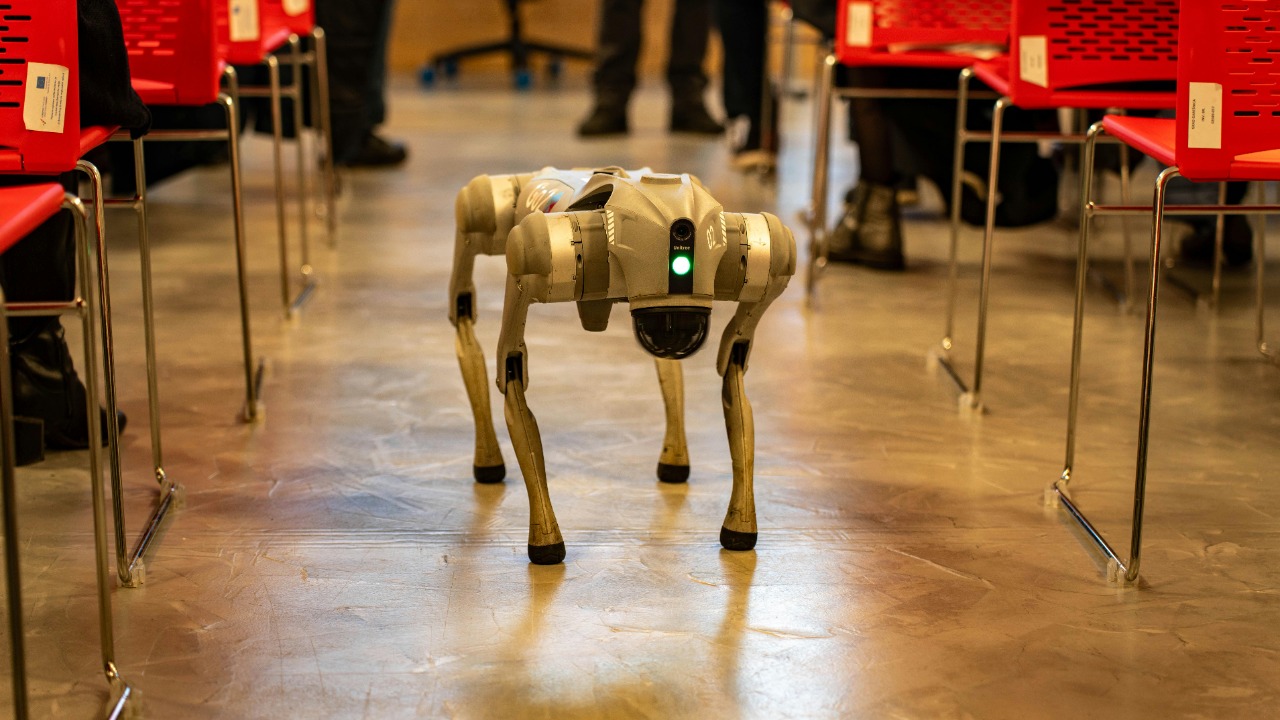
On a frozen test track, a four legged robot now sprints, skids and recovers on glare ice without a single joystick nudge. The machine leans into slips, catches itself on one leg, then powers forward as if it has spent a lifetime on winter roads. What looks like instinct is in fact the product of intensive AI training that lets a robot dog master brutal, slick terrain with no human in the loop.
I see this shift as more than a flashy demo. It signals a new phase in robotics in which learning systems, not hand coded rules, decide how machines move through the world, from icy slopes to soft mud and tangled roots. The result is a generation of robot dogs that behave less like remote controlled tools and more like autonomous field partners.
The new breed of autonomous robot dog
The most striking change in this new generation is the move away from pre scripted gaits toward self directed motion. A four legged platform nicknamed Clarence, developed by Researchers at the University of, learns to walk in about nine hours of practice instead of relying on painstaking manual tuning. Rather than follow a fixed script, Clarence adjusts each step in real time, which is exactly the kind of adaptation a robot needs when a rock shifts underfoot or a patch of ice gives way.
That same philosophy now extends to commercial style platforms. The Go2 Pro AI quadruped, sold as a high end product, packages similar learning based balance into a chassis that can patrol warehouses or research sites. Listings for that robot dog highlight its AI enhanced navigation and show how a consumer can order the same class of machine that only labs once had, using standard shopping tools.
How AI training replaces human micromanagement
The core breakthrough is that these robots are not given a detailed map of how to move. Luna, described as a Machine with no explicit rules for walking, learns by trial and error, testing movements and keeping what works while discarding what fails. In reports on Machine learning, Luna gradually figures out how to stand, walk and turn without any engineer scripting each joint angle.
Developers behind Luna Intuell describe this as a new learning paradigm that lets a robot dog improve like a person, not like a programmed appliance. In a presentation on Revolution in robotics, they argue that such systems unlock robots that can adapt to surprises instead of freezing when conditions deviate from a plan. A separate video on Luna Intuell shows Luna exploring its environment, bumping into obstacles, then adjusting its behavior, which is exactly the kind of self correction that lets a robot stay upright on slick ground without a human operator stepping in.
From ice and mud to tangled roots
What makes these machines compelling is not just that they move, but that they keep moving when the ground turns hostile. They, the team behind Clarence, tested that robot dog on uneven rocks, tangled roots, woodchips and loose timber, and it walked through each area by remembering which motions had worked before. Instead of following a pre drawn path, Clarence uses its experience to choose each new foothold, as described in coverage of how They guided it step by step through wild terrain.
Soft ground poses a different challenge, and here a Samsung backed quadruped from the Korea Advanced Institute of Science and Technology shows how AI can read the ground itself. The research team behind that Samsung project trained a robot dog to sense how much its feet sink into soft terrain and adjust its gait to maintain balance. Reports on the same Backed Robot Dog effort describe how the quadruped uses AI to decide how to move on sand, mud or snow, which are exactly the surfaces that defeat many traditional machines.
Wheels, legs and commercial spin offs
Not every robot dog that thrives on slick ground relies only on legs. A hybrid platform known as Lynx, from Chinese company deep robotics, uses a wheeled leg design to dance on ice, leap over obstacles and glide through snow. Video of Lynx shows the robot spinning and sliding in a controlled way, using wheels for speed and legs for stability, a combination that suits icy roads and rough trails.
That same hybrid idea underpins a platform described as a robotic dog that uses AI to climb steps and speed down mountains. Reports on Robotic Dog Uses explain how the wheeled leg design combines the speed of wheels with the agility of legs and is suited to industrial inspection and rescue work, with a three hour battery life that keeps it in the field. A related summary of how that robot can Climb Steps and handle steep slopes shows how AI planning lets it pick routes that keep traction even when gravity and loose gravel conspire against it.
Commercial offerings are racing to catch up with these research platforms. The Go2 Pro AI quadruped is marketed as a ready to deploy robot dog with advanced navigation, and its Go2 Pro listing highlights its AI capabilities. A separate entry for the same quadruped shows how it is positioned for tasks like patrol and inspection, while broader tools such as Google’s Shopping Graph organize Product data so buyers can compare these robots as easily as they would a laptop.
From lab curiosity to off leash worker
For years, the most famous robot dog was a tethered showpiece that engineers guided through rehearsed routines. That image is changing fast. A report on how a major industrial quadruped has been made smarter and taken off leash describes how While the robotic dog still unsettles some viewers, engineers see its ability to roam broken terrain on its own, like a real dog, as a milestone. That same shift toward autonomy is visible in Luna, which a video on AI powered robotics portrays as learning to live in a human environment rather than just execute commands.
Even the flashier demonstrations now serve a serious purpose. A wheeled wonder robot dog that shows off complex dance moves on tough terrain is not just performing for cameras. Coverage of that Wheeled platform, identified as Lynx, emphasizes how those spins and slides demonstrate control on ice and rough ground. A related summary of the same Wheeled wonder notes that the robot combines the agility of legs with the stability of wheels, while a separate clip of off road performance shows it taking on snow and rough trails.
Behind the spectacle, the same learning principles keep surfacing. A detailed feature on how a four legged robot now walks like a living creature explains that A four legged machine can master new moves in nine hours by refining its own behavior. Another section on how it remembers what worked before notes that Clarence uses memory to choose each step. When I watch Luna learning without a detailed map in reports on Luna, or see a hybrid platform Speed Down Mountains, I am struck by how quickly the field has moved from remote control to genuine autonomy. Even consumer facing coverage of a robot dog that adapts to terrain and a technical note on how a quadruped uses AI to navigate soft ground point to the same destination. Robot dogs are learning to keep their footing on ice, mud and rubble without waiting for a human to tell them what to do.