
The Space Development Agency’s Tranche 1 Transport Layer now has a third manufacturer’s hardware in orbit. Twenty-one data transport satellites built by Northrop Grumman left Space Launch Complex 4 East at Vandenberg Space Force Base, Calif., aboard a SpaceX Falcon 9 on Oct. 10, 2026, bringing the number of Tranche 1 space vehicles on orbit to 84.
The launch completed the fourth orbital plane of Tranche 1 Transport satellites. It came five days late: an attempt on Oct. 5 ended when the rocket’s automated systems halted the countdown just before liftoff.
Those figures come from the release issued Oct. 10, 2026 by the U.S. Space Force Portfolio Acquisition Executive for Missile Warning and Tracking and SDA, which announced “the successful launch of the fourth orbital plane of Tranche 1 (T1) Transport satellites.” The release says Falcon 9’s automated systems “safely halted the initial countdown just before liftoff” on Oct. 5. GP Sandhoo, SDA’s director and the Space Force’s PAE for Missile Warning and Tracking, framed the milestone around the supplier base:
“This launch marks the delivery of satellites built by the third of four vendors selected to field Tranche 1 of the proliferated LEO architecture.”
“SDA’s model emphasizes regular industry competition and vendor diversity,” Sandhoo said in the same release.
Liftoff at 12:39 a.m. and the Oct. 5 abort
Spaceflight Now’s launch report put liftoff early Saturday, Oct. 10, at 12:39 a.m. PDT (0739 UTC). It said the Oct. 5 attempt was stopped by an automatic abort with 58 seconds left, with SpaceX citing “some off-nominal data on Stage Two,” and that the launch then slipped a day at a time for troubleshooting and range deconfliction. The first-stage booster landed at Landing Zone 4 about seven and a half minutes after liftoff, per the same report.
The outlet lists the earlier Tranche 1 Transport Layer launches as Sept. 10, 2025; Oct. 15, 2025; and July 16, 2026. The Oct. 10 flight was the fourth in that series. Earlier flights carried other manufacturers’ hardware; Air & Space Forces Magazine reported on Oct. 15, 2025 that the 21 satellites on that month’s launch were “built by Lockheed Martin.”
SDA’s release credits Space Systems Command with launch support. It says the missions are bought through the National Security Space Launch program and overseen by SSC’s System Delta 80 and the Space Force PAE for Space Access.
What the Transport Layer is meant to carry
The job is data, not sensing. SDA’s Oct. 10 release describes the satellites as providing secure, low-latency, beyond-line-of-sight data transport that supports tracking of advanced missile threats. The planned services it lists are persistent regional tactical data links, enhanced missile tracking and warning, beyond-line-of-sight targeting, and “user connectivity enabled by both tactical optical and Ka-Band links.”
The agency’s Transport Layer overview page adds that the constellation will be linked by optical inter-satellite links and will be able to integrate with Link-16 and the Integrated Broadcast System. That same page describes the full Transport Layer, across tranches, as “varying in size from 300 to more than 500 satellites,” and lists the Tranche 0 demonstration layer at 20 space vehicles.
Tested versus promised
What the Oct. 10 launch established is delivery: 21 more Tranche 1 vehicles in orbit, from a third manufacturer, on a Falcon 9 that flew after a five-day slip. The release does not report on-orbit checkout results for the new batch.
The warfighting payoff is still a schedule. “Tranche 1 will provide initial warfighting capability beginning in 2027,” the release says. Until then, SDA says, the Tranche 1 launch campaign “will continue until the full constellation is delivered on orbit.”
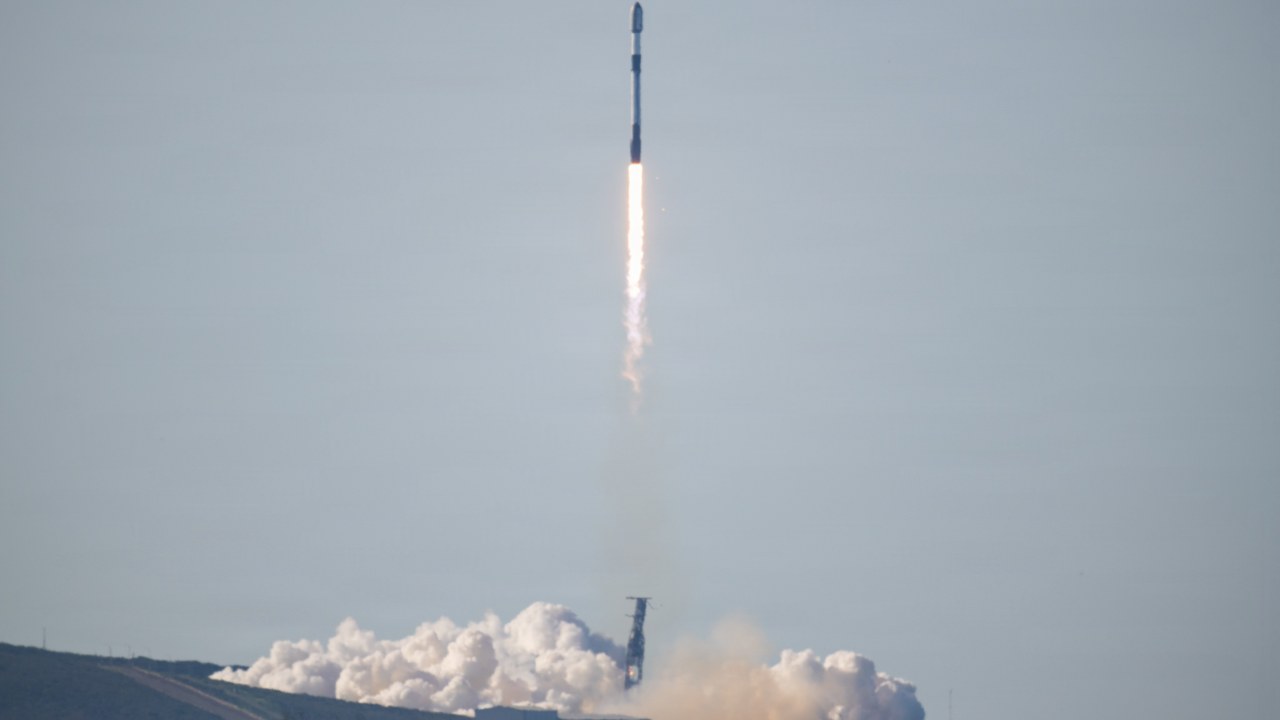
Top image: A Falcon 9 lifts off from Vandenberg Space Force Base, California, on a Starlink mission on Jan. 29, 2026. It is not the Tranche 1 launch. Image Credit: U.S. Space Force photo by 2nd Lt. Andrew Taller — Public domain / Wikimedia Commons
This article was produced with the assistance of AI and reviewed by Combat Rated editors prior to publication.