
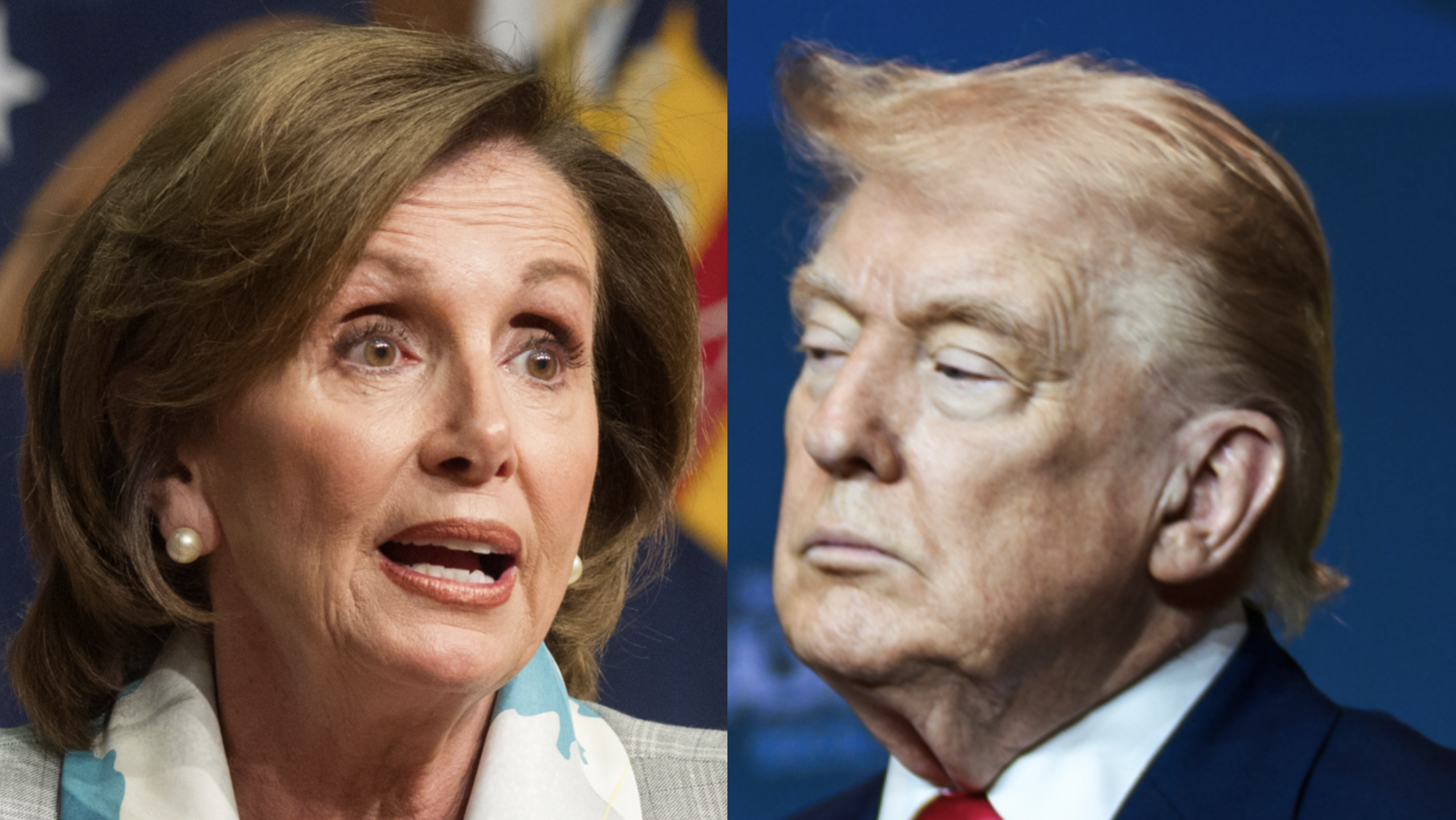
Representative Nancy Pelosi, D-Calif., the House Speaker Emerita, on Thursday accused President Donald Trump of pulling the United States back into renewed hostilities with Iran, arguing that the administration’s decision to resume strikes came after Trump “failed to secure a lasting peace” and in defiance of a congressional vote directing him to end the conflict. Pelosi made the accusation in a post on X published at 6:16 p.m. on July 9, 2026, as fresh fighting broke out in the Strait of Hormuz and gasoline prices ticked upward for the first time in weeks.
The full text of Pelosi’s post reads: “Having failed to secure a lasting peace or achieve his stated objectives, President Trump has once again dragged America back into a dangerous and illegal war with Iran. By ignoring the vote of the Congress to stop this war, the President has doubled down on endangering American servicemembers, driving up costs at the pump, and forcing working families to foot the bill for this unnecessary war of choice.”
Renewed Strikes Follow Attacks on Shipping
Pelosi’s statement came a day after U.S. forces launched a new round of strikes on Iranian targets and reimposed sanctions on Iranian oil sales, a response to attacks on commercial vessels transiting the Strait of Hormuz. The renewed fighting has unfolded even as Iran holds funeral observances for Supreme Leader Ali Khamenei, who died earlier in the conflict, with his burial taking place in the early hours of July 10 in Iran. The escalation has cast doubt on the durability of the ceasefire and memorandum of understanding that had been negotiated between Washington and Tehran, mediated in part by Qatar and Pakistan, to end hostilities and reopen the strait in exchange for eased sanctions.
The war traces back to February 28, 2026, when U.S. and Israeli forces carried out the initial strikes on Iran that opened the conflict. The Trump administration submitted a report to Congress on March 2, 2026, under the War Powers Resolution, and the fighting has continued intermittently in the months since, through a ceasefire, a memorandum of understanding, and now a renewed round of hostilities.
A Pattern of Congressional Rebukes
Pelosi’s Thursday post is the latest in a series of public statements she has issued challenging the administration’s handling of the war, and it follows a broader effort by lawmakers in both parties to constrain the president’s ability to continue military action without congressional authorization. On April 16, 2026, ahead of a House vote on a war powers resolution, Pelosi delivered floor remarks arguing that Article One of the Constitution vests the power to declare war exclusively in Congress.
That effort culminated on June 3, 2026, when the House passed a war powers resolution, H.Con.Res. 86, by a vote of 215 to 208, with four Republicans — Reps. Thomas Massie of Kentucky, Brian Fitzpatrick of Pennsylvania, Tom Barrett of Michigan and Warren Davidson of Ohio — joining Democrats in support. The resolution directs the president to remove U.S. Armed Forces from hostilities against Iran unless Congress has explicitly declared war or authorized the use of military force, with an exception preserved for forces needed to defend against an imminent attack.
The Senate followed on June 23, 2026, passing its own version of the resolution by a vote of 50 to 48, with Republican Sens. Bill Cassidy of Louisiana, Susan Collins of Maine, Rand Paul of Kentucky and Lisa Murkowski of Alaska crossing party lines to support it. It marked the first time both chambers of Congress had passed a resolution directing a president to withdraw armed forces from a conflict under the War Powers Resolution of 1973. Because the measure is a concurrent resolution, it does not require the president’s signature and does not carry the force of law.
Pelosi’s Broader Record on the Conflict
Pelosi’s Thursday post extends a position she has staked out publicly since the earliest days of the war. On May 8, 2026, marking eight years since Trump withdrew the United States from the Joint Comprehensive Plan of Action, Pelosi issued a statement arguing that the president had “cost American lives by engulfing the region in the very conflict that serious diplomacy was meant to prevent.”
Earlier in the conflict, after Trump issued public threats regarding Iran, Pelosi issued a statement describing the president’s “instability” as “more clear and dangerous than ever” and calling on the Cabinet or Congress to act. That statement remains published through Pelosi’s press office. Pelosi has also spoken publicly about the memorandum of understanding reached last month between the U.S. and Iran to end hostilities, describing the terms as a “real gift to the Iranians” during remarks at the opening of the Obama Presidential Center in Chicago, and citing the deal’s costs in both dollars and American lives.
The Administration’s Position
The White House has defended the renewed strikes as a direct response to Iranian violations of the memorandum of understanding and to attacks on commercial shipping in the Strait of Hormuz. Trump has separately said that if Iran violated the terms of the agreement, the United States would “go right back to dropping bombs right smack in the middle of their head.” Following the House’s passage of the war powers resolution in June, Trump criticized the vote publicly, characterizing the Republicans who joined Democrats in support as having made his position in negotiations “more difficult,” while maintaining that a resolution to the conflict would be reached. Trump has also acknowledged in recent public remarks that he considers himself a target of Iranian retaliation stemming from the broader conflict, telling reporters this week that he is “on every list” of Iranian assassination targets.
Defense Secretary Pete Hegseth has continued to coordinate on the administration’s regional posture amid the renewed hostilities, and Trump met with NATO leaders in Ankara, Turkey, this week, where the security situation in the Strait of Hormuz was among the topics discussed with alliance members.
Gas Prices Climb as Conflict Reignites
Pelosi’s statement that the war is “driving up costs at the pump” arrived alongside new data showing gasoline prices rising for the first time in weeks. According to AAA, the national average price for a gallon of regular gasoline rose 5 cents overnight to $3.846 on July 9, 2026, up from $3.838 a week earlier, as the future of the U.S.-Iran ceasefire remained uncertain. Prices remain below the spring peak of $4.56 recorded on May 21, but AAA noted that crude oil prices, trading in the $70-per-barrel range, could climb further “if volatility lingers along the Strait of Hormuz.”
AAA’s data also showed gasoline demand falling last week, from 9.13 million barrels per day to 8.84 million, alongside a decline in total domestic gasoline supply from 214 million barrels to 212.1 million. West Texas Intermediate crude settled at $73.52 a barrel on Wednesday, up $3.08 on the day, while U.S. crude oil inventories stood roughly 6% below the five-year average for this time of year, according to the Energy Information Administration.
What Comes Next
With both chambers of Congress having passed non-binding resolutions calling for an end to hostilities, and with the administration defending its renewed strikes as necessary enforcement of the U.S.-Iran memorandum of understanding, the conflict’s trajectory remains unsettled. Pelosi’s Thursday post signals that congressional Democrats intend to keep pressing the war’s economic and human costs as a political flashpoint, even as the administration and regional mediators, including Qatar and Pakistan, continue efforts aimed at restoring the ceasefire.