
Roughly $2.2 billion in private munitions manufacturing is headed for Pine Bluff Arsenal in southeast Arkansas. Hanwha Defense USA will put its Advanced Manufacturing Campus on underused Army land at the installation, where it plans to make propellant charges and base bleed units for 155mm artillery. The company says the project will create up to 400 jobs.
The deal runs through an Army Enhanced Use Lease, a tool that lets the service lease property it is not fully using to a private partner in exchange for a return. The first physical step is modest: an administrative headquarters for the campus, which the Army describes as the opening phase of a planned long-term industrial partnership.
The Army announced the headquarters in a Sept. 21, 2026, release from U.S. Army Public Affairs, which said it followed a competitive lease solicitation awarded to Hanwha Defense USA. In that release, Michael Coulter, chief executive officer of Hanwha Defense USA, said the company “plans to invest around $2.2 billion in our new Advanced Manufacturing Campus,” and the Army put the expected employment at approximately 400 jobs in Arkansas.
Jordan Gillis, Assistant Secretary of the Army for Installations, Energy and Environment, said in the same release that “the eventual lease will create revenue for the Army, bring in new jobs for the local community, and enhance our organic industrial base.”
Propellant charges and base bleed units for 155mm guns
The campus will manufacture 155mm propellant charges and base bleed units, according to the Army release, which said the work will establish advanced domestic munitions production and support increased U.S. production capacity. The Army’s January announcement, covered below, had described the plant’s output more broadly.
A base bleed unit is a small motor fitted to the rear of an artillery projectile to stretch its range. A Picatinny Arsenal article published Nov. 19, 2015, described the base bleed motor as one that “gets some extended range over a normal round and burns right out of gun,” and listed the XM1128 base bleed round with a maximum range of 30 kilometers.
Hanwha’s own press release dated Sept. 22, 2026, names the same two product lines. In it, Coulter said Hanwha “remains committed to supporting the American defense industrial base by bringing our manufacturing strength to the U.S. and creating up to 400 jobs in Arkansas.” The company’s release did not give a construction or first-production date.
An arsenal built around energetics
Pine Bluff Arsenal was picked, the Army said, for its established infrastructure, specialized chemical and industrial expertise, and location near key defense logistics routes. The installation has been working with hazardous chemistry for 85 years. In a May 5, 2026, article, arsenal commander Col. Matthew C. Mason traced its history from World War II production of incendiary munitions through Cold War chemical and biological weapons work to the elimination of its chemical weapons stockpile, completed in 2010.
Mason’s article lists the arsenal’s current lines as smoke and pyrotechnics, chemical and biological defense, and energetics, propellants and munitions subassemblies. It also names the Hanwha lease as an ongoing effort and notes that the Pine Bluff commander oversees a multistate enterprise that includes the Holston and Radford Army Ammunition Plants.
From $1.3 billion to $2.2 billion
The project has grown since the Army first announced it. A Jan. 28, 2026, Army release said Hanwha Defense USA planned a $1.3 billion investment and expected about 200 skilled jobs, with the plant making essential ingredients for explosives and propellants that support 155mm artillery shells and other munitions. At that point the Enhanced Use Lease was still pending final negotiations.
Eight months later, the Army’s September figures stand at roughly $2.2 billion and approximately 400 jobs, and the product list is specific: propellant charges and base bleed units. Brent G. Ingraham, Assistant Secretary of the Army for Acquisition, Logistics and Technology, called the arrangement in January “a model that the Army will use to further strengthen and build a modern commercial industrial base.”
What exists on the ground today is the administrative headquarters. Neither the Army nor Hanwha has published a construction start date or a production date, and the Army’s own language refers to “the eventual lease,” meaning the long-term lease for the full campus is still ahead.
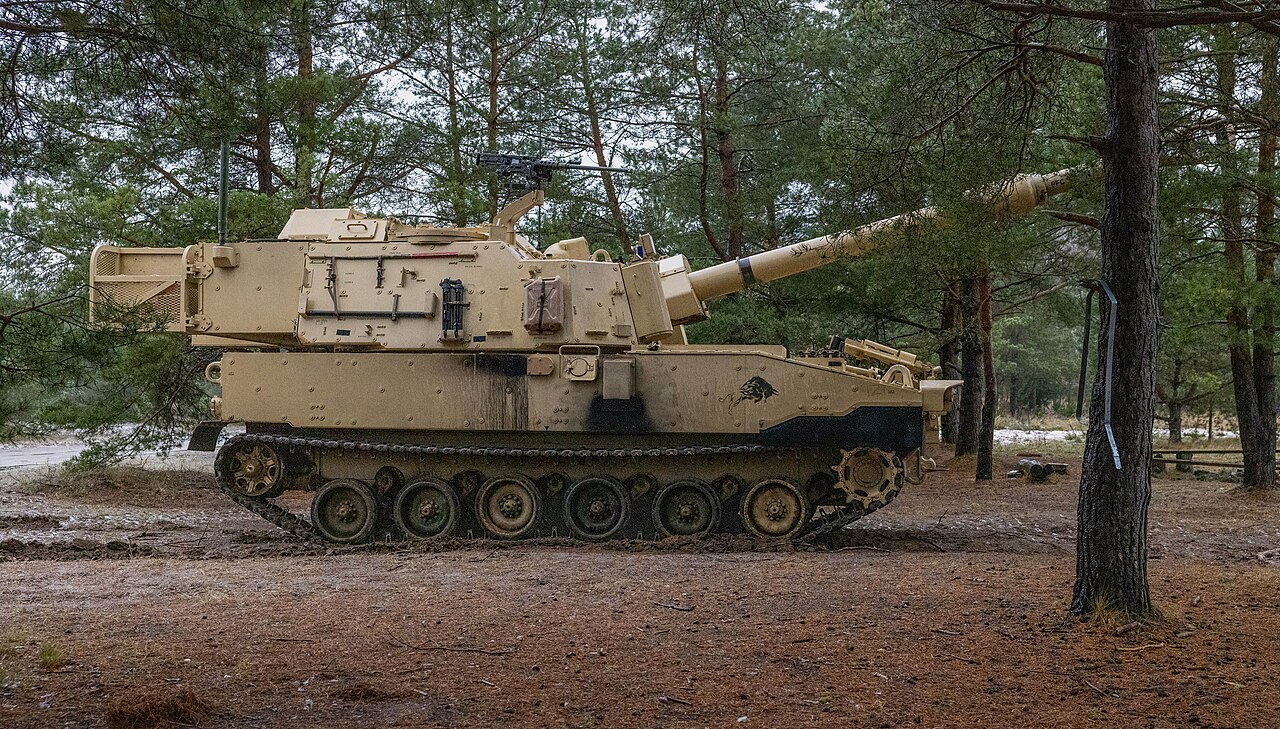
Top image: Soldiers of the 2nd Battalion, 82nd Field Artillery Regiment set up a firing position with an M109A7 Paladin self-propelled howitzer. Image Credit: U.S. Army photo by Pfc. Gabriel Martinez — Public domain / Wikimedia Commons
This article was produced with the assistance of AI and reviewed by Combat Rated editors prior to publication.