
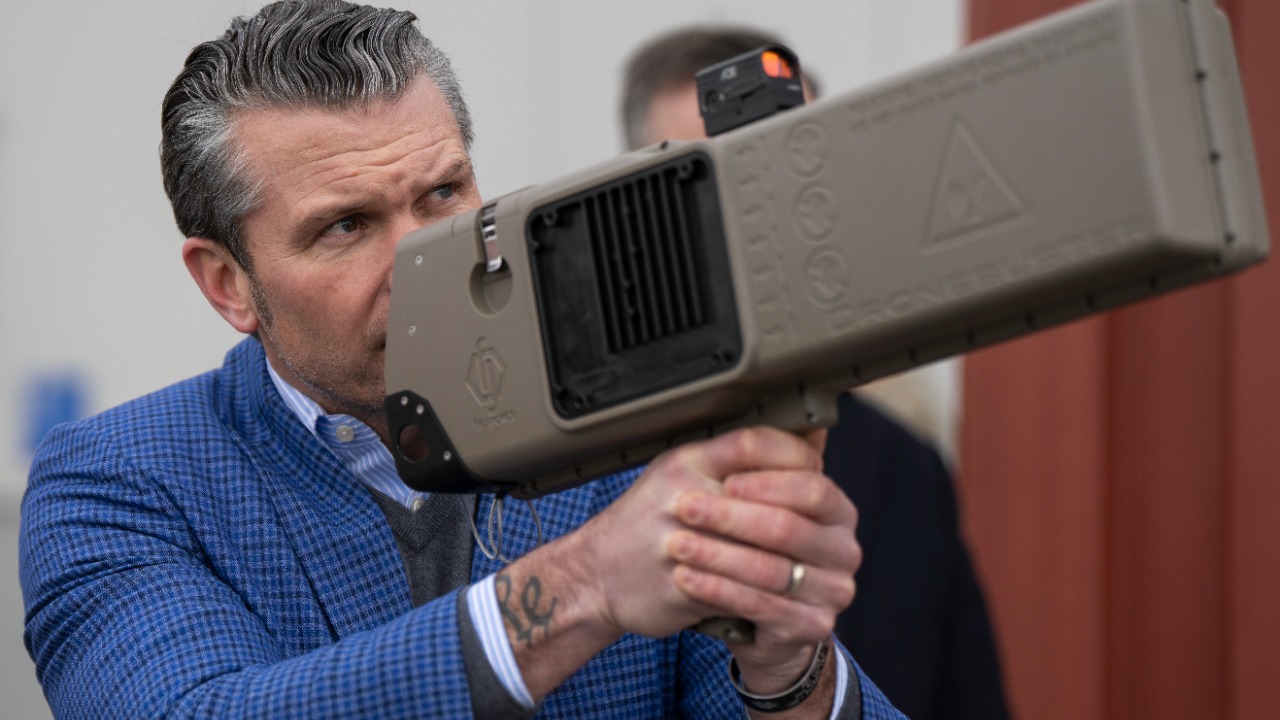
America’s military bases are facing a new kind of low‑cost, hard‑to‑trace threat from small drones, and the Pentagon is no longer willing to let commanders wait on distant approvals before acting. In a sweeping policy shift, installation leaders are being given clearer authority and new tools to detect, track, and, if necessary, disable unmanned aircraft that stray into sensitive airspace. The move is designed to close dangerous gaps in responsibility that left some of the country’s most critical sites exposed to cheap quadcopters and improvised aerial weapons.
The new guidance elevates base commanders from passive observers to primary decision makers in counter‑drone operations, backed by a centralized task force and a growing suite of “low‑collateral” interceptors. It also reflects a broader recognition that drones can threaten runways, fuel farms, ammunition depots, and even nearby communities long before they cross a fence line.
The new rules: more authority, faster decisions
The Pentagon has updated its counter‑drone playbook so that installation commanders can now respond to suspicious aircraft as threats develop, instead of waiting for them to breach a perimeter. Under the revised guidance, installation commanders are explicitly empowered to assess the risk posed by drones in nearby airspace and to take protective action when they judge that risk to be credible. The Pentagon wants those leaders to issue site‑specific operating procedures that spell out how security forces, air traffic control, and local law enforcement will coordinate when a drone appears.
Officials describe this as a deliberate shift away from a narrow focus on what happens “inside the wire.” New guidance highlighted by Drones and On Base makes clear that commanders are expected to act before drones breach an installation perimeter, not after. The Pentagon has also stressed that new guidance is meant to be flexible enough to cover everything from a hobbyist’s misdirected quadcopter to a coordinated swarm probing a nuclear weapons storage site.
From “fence line” thinking to layered defense
Senior leaders now openly acknowledge that the old model, which treated the fence line as the start of the problem, no longer fits the threat. Brigadier General Matt Ross, director of JIATF‑401, has stated that “Countering drones does not start and stop at the fence line,” underscoring a push for layered surveillance that extends into surrounding communities and approaches. That philosophy is embedded in the new rules, which allow commanders to expand the range at which they can detect and, in some cases, disrupt drones that are on a trajectory toward sensitive assets, according to guidance signed by Defense Secretary Pete.
The Pentagon wants those defenses to rely on tools that can neutralize drones without endangering people on the ground or nearby aircraft. Officials have said they want low‑collateral interceptors at all U.S. military installations, a category that can include radio‑frequency jammers, precision projectiles, and systems that capture drones using nets. Brigadier General Matt Ross has also highlighted options that use artificial intelligence to track small unmanned aircraft and predict their flight paths, giving base security teams more time to decide whether to engage.
Fixing confusion after watchdog and wargame warnings
The policy overhaul did not emerge in a vacuum. It follows a blunt warning from the Pentagon’s own inspector general that unclear rules left commanders unsure of their authority to act against drones, a problem captured in a report that said Pentagon Watchdog Warns Drone Rules Leave US Bases Exposed. That assessment, echoed by Rojoef Manuel’s coverage of how leaders were left uncertain about their authority, painted a picture of bases where security teams watched drones loiter overhead while lawyers debated who could pull the trigger on a jammer. The inspector general’s findings also matched a series of wargames run by the Army Joint Counter Small Unmanned Aerial organization, which found that adversaries were already exploiting similar seams overseas and could do the same in the U.S.
In response, the Pentagon has tried to strip away layers of bureaucracy and clarify who is in charge. The department has publicly stated that Base commanders are getting more power to directly respond to threats from drones flying over military installations, including in the airspace above their installations. A related review of counter‑drone incidents between September 2023 and found that many near‑misses involved hesitation over legal authorities rather than a lack of technology. That history is one reason the Pentagon is now stressing that commanders have both the responsibility and the legal cover to act when they see a drone behaving suspiciously.
JIATF‑401 and the emerging counter‑drone ecosystem
At the center of the new approach is Joint Interagency Task Force 401, which has been charged with turning policy into practical guidance for the field. The Pentagon’s Joint Interagency Task Force 401 announced a new counter‑unmanned aerial systems playbook on Monday that lays out how bases should detect, identify, and, if necessary, defeat drones before they enter an installation’s perimeter. Under that framework, JIATF‑401 was given expanded authority over the development, procurement, and coordination of counter‑drone capabilities, reporting directly to senior Pentagon leaders on the state of defenses at military facilities. The Pentagon has said that Joint Interagency Task Force 401’s document is designed to help installation commanders and local partners protect the most vital assets against threats from drones.
Gen Matt Ross, who leads JIATF 401, has argued that Technology is evolving fast and that UAS defenses at home must adapt just as quickly. The Pentagon has framed the broader initiative as part of a campaign in which the Pentagon Expands U.S. Base Commanders’ Authority to Counter Drone Threats, with this SOFX Report and Pentagon Expands Base Commanders Authority detailing how those changes are being implemented. The Pentagon has also emphasized through Pentagon Expands Base Commanders Authority Counter Drone Threats that this is not a one‑time adjustment but part of an ongoing effort to keep pace with rapidly evolving drone threats, a point reinforced when Pentagon Expands Base Authority Counter Rising Drone Threats Following Inspector General Warning earlier this week.