
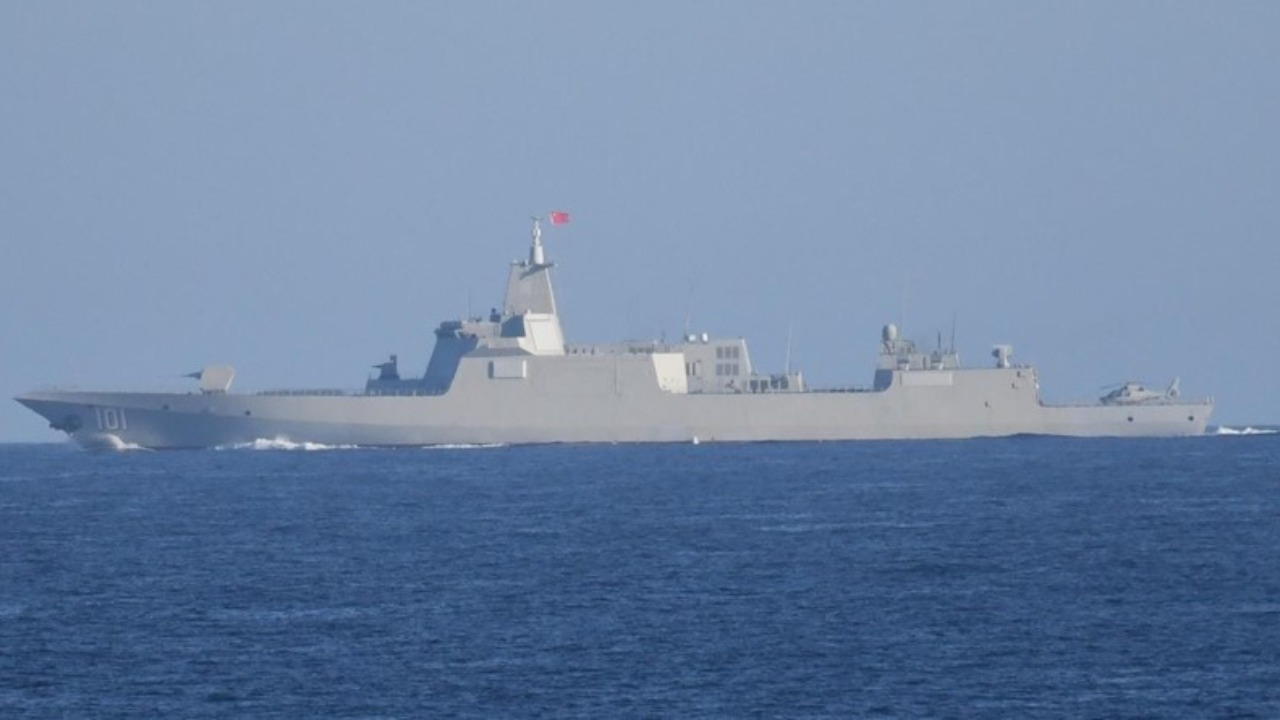
A rare glimpse into China’s electronic warfare playbook has emerged from the waters around Taiwan, where an 11,000 ton warship used powerful jamming systems to disrupt foreign military aircraft. The incident, captured by state television, underscores how Beijing is pairing heavy surface combatants with sophisticated sensors to challenge surveillance flights near the island it claims as its own.
The footage, centered on the destroyer Yanan, highlights a shift from simple radio warnings to active interference with radar and communications as foreign jets approach contested airspace. It also comes at a moment when the Taiwan Strait is already crowded with Chinese, American, and allied forces, raising fresh questions about the risks of escalation in one of the world’s most sensitive flashpoints.
Electronic warfare on the Yanan: how China used jamming at sea
Chinese state television presented Yanan as a frontline platform for electronic warfare, showing crew members tracking foreign aircraft and then activating jamming systems to interfere with their sensors. According to the broadcast, the 11,000 ton destroyer used what it described as “electronic countermeasures” to warn off jets operating near the island, with the interference reportedly forcing the aircraft to adjust course and altitude. The footage framed the episode as a routine patrol by the Chinese crew. Still, the decision to publicize the engagement suggests a deliberate signal about the capabilities now riding on these ships.
State coverage stressed that the Yanan did not fire kinetic weapons, instead relying on jamming missiles and other emitters to project power without crossing the line into open combat. The description of “electronic countermeasures” matches earlier references to the destroyer’s role in tracking and disrupting foreign aircraft near Taiwan, with the State narrative emphasizing control and restraint. A separate account of the same patrol noted that the Yanan destroyer repeatedly adjusted its own posture as the foreign jets maneuvered, portraying a cat-and-mouse contest in which the ship’s electronic suite was central to shaping the air picture.
Type 055 muscle: why an 11,000 ton hull matters near Taiwan
The Yanan is part of the Type 055 family, a class of large surface combatants that Western militaries classify as cruisers rather than simple destroyers. Public data on the Type 055 notes that NATO and OSD refer to the design as the Renhai class, reflecting its size, vertical launch capacity, and extensive radar arrays. With a displacement in the 11,000 ton range, these ships carry long-range missiles, advanced phased array radars, and a dense suite of electronic support measures, making them ideal platforms for the kind of jamming and tracking that the Yanan displayed near Taiwan.
Chinese state footage and follow-up analysis stressed that Yanan’s electronic warfare systems are integrated with its broader combat management network, allowing the crew to shift from passive monitoring to active interference in seconds. One report described how the China crew used jamming to force foreign aircraft to repeatedly alter their flight paths, suggesting that the destroyer’s emissions were strong enough to disrupt targeting or navigation systems. Another account of the same episode highlighted the Yanan destroyer by name, describing how Yanan used jamming missiles as part of a layered response that combined radio warnings, tracking, and electronic attack.
A crowded strait: foreign jets, U.S. warships, and blockade drills
The Yanan’s jamming episode did not occur in isolation, but against a backdrop of rising military activity around Taiwan. The island sits at the center of a strategic corridor that links the East China Sea to the South China Sea, and its status is contested by Beijing and defended in practice by its own forces and by outside partners. Basic reference material on Taiwan underscores how central the island has become to regional security, global semiconductor supply chains, and the balance of power between China and the United States.
Earlier this year, the United States sent a destroyer and an auxiliary vessel through the Taiwan Strait in what it described as a routine transit. An account of that passage noted that the UPDATED U.S. Destroyer and Survey Vessel Conduct First Taiwan Strait Transit of 2026, with Aaron and Matthew Lariosa detailing how the mission was framed as a freedom of navigation operation. The same reporting recorded that on Friday, China launched 25 sorties of fighters, support aircraft, and unmanned aerial vehicles over the Taiwan Strait in response, underscoring how quickly naval movements can trigger air activity.
China has also been rehearsing more expansive scenarios that go beyond single-ship or single-day encounters. A recent update on PRC activity noted that Jan propaganda emphasized the blockade aspects of large-scale exercises, suggesting that Beijing is practicing how to combine air, naval, and missile forces to encircle the island and test Taiwanese sovereignty and self-defense. Separate coverage from TAIPEI, Taiwan described how China’s People Liberation Army staged a second day of large-scale drills around the island on Tuesday, presenting the maneuvers as a test of blockade capabilities against territory that Beijing claims as part of its sovereign domain. In that context, the Yanan’s electronic warfare display looks less like a one-off and more like a live rehearsal of how a Renhai-class ship might help enforce a future cordon.
Escalation risks and the future of electronic brinkmanship
The use of high-power jamming against foreign jets raises difficult questions about escalation, especially when those aircraft belong to major powers that also field advanced electronic warfare tools. Analysts have warned that aggressive interference with radar or communications can be misread as preparation for a missile shot, prompting rapid countermeasures in crowded airspace. The detailed accounts of how the PLA Navy crew on Yanan used jamming to shape foreign flight paths, and how Navy operators coordinated those actions with tracking radars, illustrate how quickly such encounters can move from routine shadowing to active contestation of the electromagnetic spectrum.