
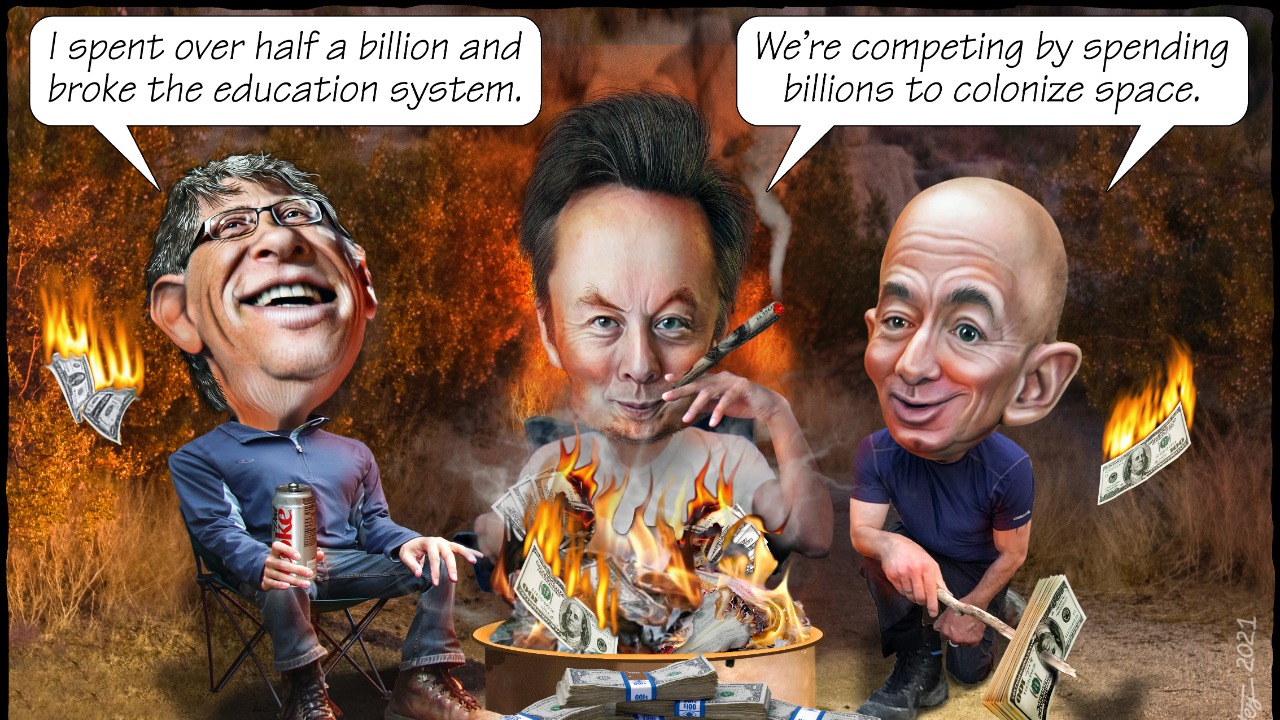
The global billionaire class has entered a phase of almost surreal expansion, with fortunes compounding at a pace that outstrips both economic growth and wage gains. At the very top, a small cohort of tech and finance titans now commands sums that would once have been considered impossible for any individual, while their collective influence over markets, politics, and public debate grows just as quickly. These fortunes are reshaping the balance of power, presenting challenges for democratic institutions.
Record-shattering fortunes and a swelling billionaire class
Across the world, billionaire wealth has surged to levels that would have sounded like science fiction a decade ago. Anti-poverty researchers report that $18.3 trillion is now held by this tiny elite, a figure echoed in social posts noting that Billionaires are seeking power “for their own gain” even as poverty reduction slows. Wealth managers report that global billionaire wealth reached nearly $16 trillion in 2025, approaching $18 trillion. At the same time, researchers tracking the richest 500 individuals say their fortunes alone swelled by $2.2 trillion in a single year, a windfall that Oxfam argues could lift 3.8 billion people out of poverty if it were redistributed.
The number of individuals joining this club is rising just as sharply. Data from Swiss investment bank UBS shows that as of early April there were 2,919 billionaires around the world, controlling $15.8 trillion in assets, while a separate summary of the same research notes that Their combined net worth of about $15.8 trillion rose roughly 13 percent in a year. Another breakdown of the same trend notes that these billionaires added 287 new members in a single year and that inheritances and a 25 percent jump in certain asset classes were key drivers of the surge, a pattern echoed in a separate analysis that describes how New research from Swiss bank UBS finds inherited wealth is increasingly central to billionaire status.
AI, markets, and the making of “super-billionaires”
The composition of this elite is changing as fast as the totals. Analysts report that nearly 70% of new billionaire fortunes are linked to AI, biotech, and other frontier technologies. A separate assessment of billionaire power notes that Soaring valuations of artificial intelligence companies have delivered further windfall gains to investors who were already among the richest people on the planet. The global wealth leaderboard compiled by crypto and finance commentators now shows technology founders dominating the top slots, with a January snapshot observing that the richest names have entered “uncharted territory” as they added hundreds of billions of dollars to their fortunes, a trend captured in a post on the global wealth leaderboard.
Individual stories illustrate how extreme these gains have become. Elon Musk has seen his net worth officially touch a record $726.3 billion, making him the world’s richest person since May 2024 according to that social media post, while earlier tallies from business magazines noted that, According to Forbes, he became the first person to reach $300 billion in 2021 and $400 billion in Decem of that year, before his wealth briefly hit $700 billion later that month. A separate breakdown of post election winners shows how market moves feed this dynamic: Tesla shares rose nearly 30 percent in a single week, pushing the company’s value above $1 trillion and adding $41 billion to Musk’s fortune. At the same time, Oracle co founder Larry Ellison has, according to one widely shared post, overtaken Musk to become the world’s richest person, while a separate wealth index notes that the increase in his holdings lifted his total net worth to $383.2 billion according to the Bloomberg Billionaires Index, a figure that underlines how volatile and contested these rankings can be.
Inheritance, dynasties, and the next generation of ultra-rich
Beneath the tech fortunes lies a significant trend of dynastic wealth. Analysts of the global rich note that the world now has more billionaires than ever before and that their combined wealth has hit a record high, with one detailed breakdown explaining that in 2025 the global billionaire club expanded across sectors from genetics to energy and infrastructure, and that the sums their children will inherit over the next 15 years will reshape ownership patterns, a trend highlighted in a report on how much Dec era fortunes will cascade to heirs. Another summary of the same phenomenon stresses that the world now has more billionaires than ever before, with their combined wealth hitting a record high this year and inheritance, rather than entrepreneurial “hustle,” driving a growing share of new entries into the club, a point reinforced by the Made of money analysis.
Experts warn that inherited wealth may entrench inequality across generations. The UBS research cited earlier, which found 2,919 billionaires controlling $15.8 trillion, also underscores how family offices and private banks are engineering ever more sophisticated structures to preserve these fortunes, a pattern that 2025 commentary describes as a “boom” in dynastic wealth rather than a meritocratic rise. A separate overview of the billionaire boom notes that these billionaires have a combined net worth of about $15.8 trillion, and that inheritances are a major driver of surging net worth alongside market gains, reinforcing the sense that the next generation of ultra rich will start life on a very different footing from everyone else.