
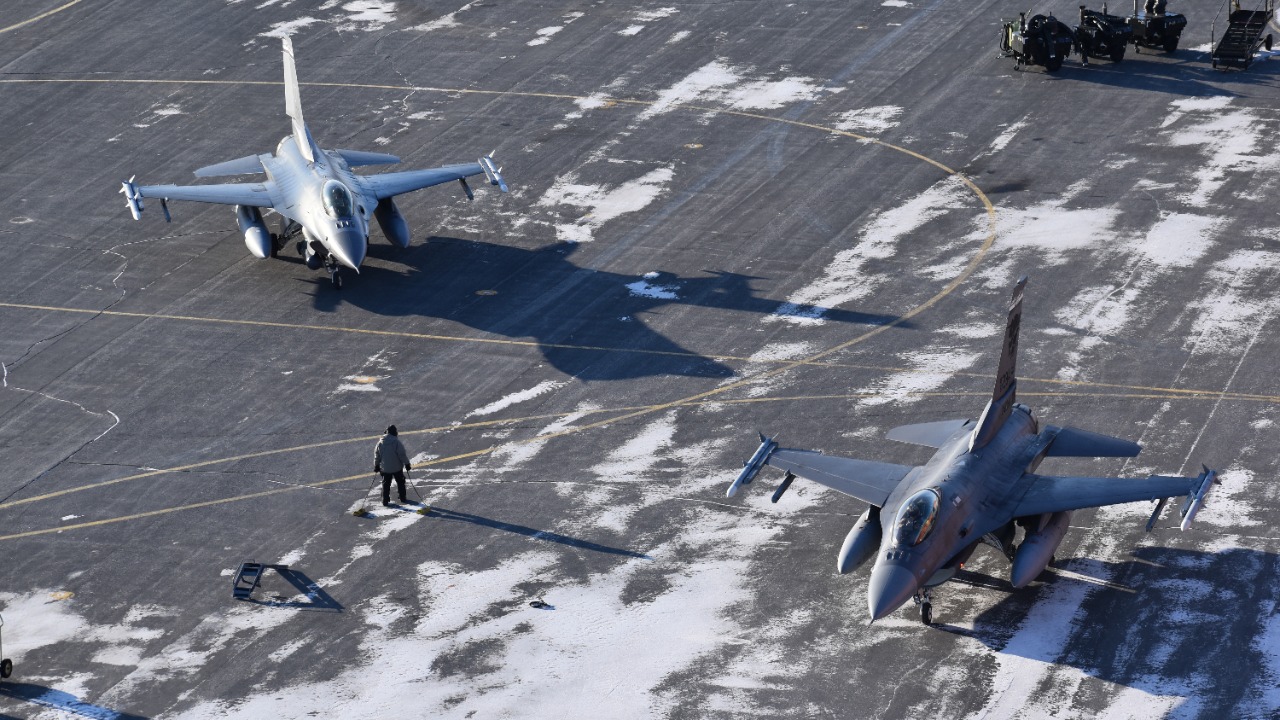
A North American Aerospace Defence Command jet is heading to Greenland just as President Donald Trump intensifies his demand for sweeping control over the Arctic. The timing has fused a routine military deployment with a charged political campaign to acquire the vast island and reshape the balance of power at the top of the world.
What NORAD describes as long-planned activity has become a symbol in a larger confrontation between Washington, European allies, and local leaders over who will decide Greenland’s future. At stake are not only military bases and radar sites but also shipping lanes, critical minerals, and the rules that will govern a rapidly warming Arctic.
NORAD’s “routine” mission meets a political storm
North American Aerospace Defence Command has confirmed that its aircraft will soon arrive at Pituffik Space Base in Greenland for what it calls long-planned and routine activities. Officials describe the deployment as part of regular defense and space surveillance operations that support the United States national security and protect the Arctic island’s critical infrastructure. The mission involves NORAD aircraft staging out of the remote base near the top of the world, a site that has long served as a key node in early warning networks and satellite tracking.
Under normal circumstances, such a rotation would draw little attention beyond defense circles. This time, however, the flight has landed in the middle of a political storm created by President Donald Trump’s renewed push to acquire Greenland for the United States. As NORAD stresses that its aircraft are heading to the island for scheduled activities, the political context has shifted, with the same presence now read by some allies as a signal of Washington’s determination to entrench its position.
Trump’s case for owning Greenland and the wider Arctic
President Donald Trump has in recent days ratcheted up a pressure campaign to acquire Greenland, framing the Arctic island and semi-autonomous territory as central to the United States power. He has argued that control of the island would secure a dominant position over emerging Arctic shipping routes, expand access to natural resources, and give Washington a strategic platform between North America and Europe. In his telling, the United States is falling behind rivals that are investing heavily in polar capabilities, and only outright ownership of Greenland can guarantee long term security.
Trump’s argument goes beyond the island itself and extends to what he casts as total control of the Arctic. He has linked his demand for ownership of Greenland to a broader vision in which the United States dictates access to key sea lanes and infrastructure across the polar region. In a separate communication, he referred again to his controversial demand that Washington take ownership of the territory, underscoring that the push is not a passing remark but a sustained policy objective. For supporters, this is a hard-headed recognition of the Arctic’s strategic value. For critics, it is a destabilizing attempt to rewrite long-standing arrangements without the consent of the people who live there.
Allied pushback, Nobel resentment, and the risk of escalation
Trump’s Greenland campaign has collided with European allies who insist that the island’s status is not Washington’s to decide. Greenland is part of the Kingdom of Denmark, and Danish leaders have rejected the idea that it can be treated as a commodity. Several European NATO allies have instead sent troops to Greenland for military exercises under Denmark’s Operation Arctic Endurance, a move designed to show that the alliance is committed to the island’s defense within existing legal frameworks. Those drills, which involve several European NATO partners, underline that Copenhagen and its allies see the Arctic as a shared security space, not a prize to be seized.
The diplomatic friction has been sharpened by Trump’s anger over the Nobel Peace Prize. The Norwegian Nobel Committee annoyed him by awarding the 2025 Peace Prize to Machado, not Trump, a decision he has now linked to his Greenland stance. In a pointed message, he tied his threat over the island to what he sees as a snub by the committee, which he cannot directly influence but which Norway hosts. According to reporting on his letter, he suggested that if Norway controls who gets the prize, then Washington will reconsider how it treats Norwegian interests, including in the Arctic. The Nobel dispute, captured in accounts that note how the NOBEL COMMITTEE GAVE PEACE PRIZE to Machado, has thus spilled into a concrete policy clash over territory and security.
NATO’s Arctic vision and the uncertain road ahead
While Trump talks about American control, NATO’s leadership has tried to frame Arctic security as a shared transatlantic interest. The alliance’s chief has met with Danish and Greenlandic officials to discuss how to manage rising tensions, stressing that cooperation with United States allies is essential but warning that tariff threats are not the way to resolve disagreements. That message reflects concern that economic pressure and unilateral rhetoric could fracture the unity that underpins collective defense. It also acknowledges that Greenlandic leaders themselves must have a say in decisions about their land and resources, rather than being treated as bystanders in a contest between larger powers.
For now, NORAD’s presence at Pituffik Space Base remains officially described as routine, and the aircraft heading to Greenland for long-planned activities are carrying out missions that predate the latest political flare-up. Yet the convergence of that deployment with Trump’s escalating rhetoric has turned a standard rotation into a litmus test for how the Arctic will be governed. European allies are signaling through Operation Arctic Endurance and diplomatic outreach that they see the region as a space for cooperation and shared rules. Trump is signaling that he is prepared to link everything from Nobel honors to trade measures to his demand for control. Between those positions lies an uncertain road, one that will determine whether the Arctic becomes a zone of managed competition or a new front in a widening geopolitical confrontation.