
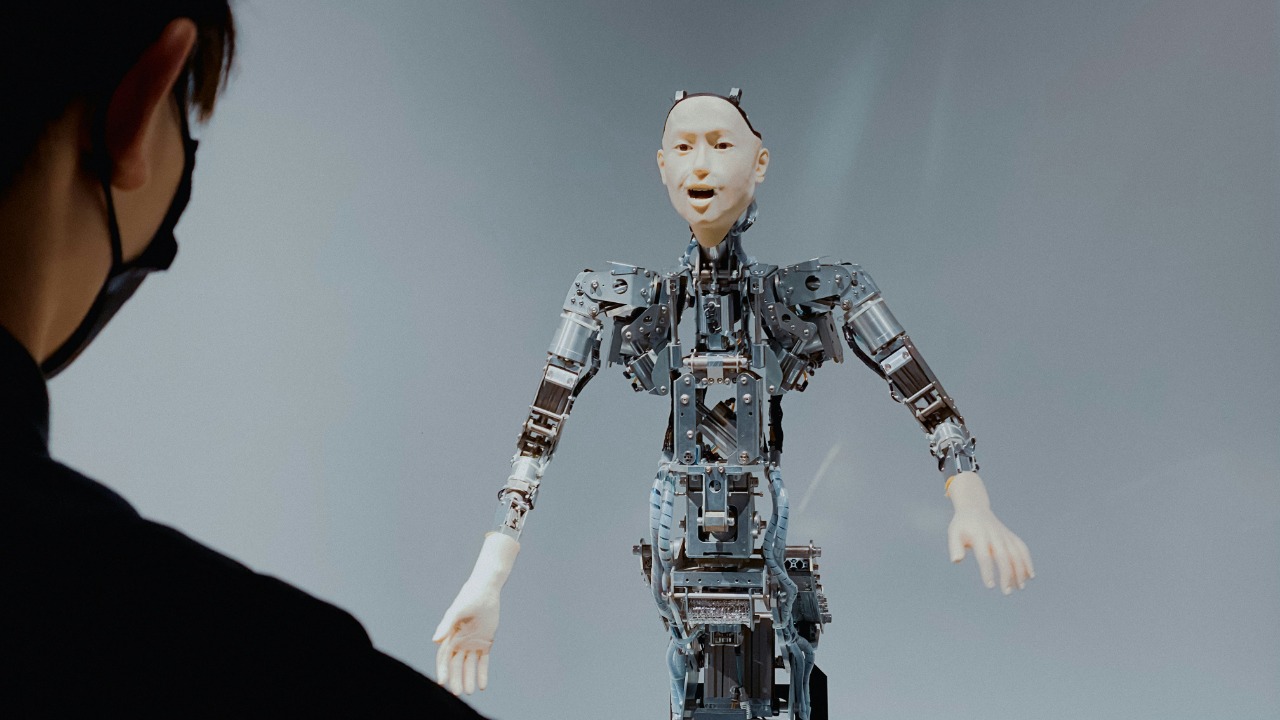
Humanoid faces are crossing a line that once belonged only to actors and mirrors. The latest generation of robots can lock eyes, move their lips in sync with speech, and even anticipate your next smile so quickly that the copy arrives almost before your own expression finishes forming.
The result is a new kind of encounter, one where a machine’s face feels uncannily alive and the boundary between tool and social presence starts to blur. I see that tension most clearly in the robots now debuting at trade shows and in labs, where engineers are racing to perfect both the mechanics of expression and the algorithms that drive them.
From showroom stunt to “new era” of humanlike robotics
The clearest public glimpse of this shift arrived on the floor of CES 2026, where a company called Realbotix rolled out a humanoid head that moved with unsettling nuance. In clips shared from the event, the robot’s lips track speech with tight synchronization while its brows and cheeks cycle through micro expressions that feel less like a demo and more like a performance. Commentators framed the moment as a sign that we might have just crossed into a new era of humanlike robotics, and that framing captures how quickly the aesthetics of these machines have leapt forward.
One viral reel shows the CES crowd clustering around the Realbotix display as the robot cycles through smiles, frowns, and side glances, its skin and musculature tuned for realism rather than cartoon charm. The post tags the clip with “Humanlike,” “Technology,” and “Innovation,” and it features the handle of Jan alongside a prompt to “Follow,” a reminder that these robots are being marketed as social media ready personalities as much as engineering feats. In the same stream of footage, another segment highlights how, at CES, Realbotix leaned on facial detail to signal where robotics is headed, using the showroom as a stage for a future in which humanlike machines are expected to hold eye contact and emote on cue.
The inverse model that lets a robot lip-sync like a pop star
Behind the spectacle sits a quieter revolution in control systems. Engineers have been refining what they call inverse models, algorithms that translate a target expression or sound into the exact motor commands needed to move dozens of tiny actuators in a robot’s face. A recent upgrade to one such inverse model now generates those motor commands 5× faster than before, which is what allows a humanoid robot to keep its lips locked to audio in real time instead of lagging a beat behind.
In tests with more than 45 human participants, the system proved quick enough to support natural back and forth interaction, not just preprogrammed monologues. I see that as a turning point, because once a robot can match the timing of human speech and expression, the remaining gap is less about mechanics and more about social design. The same research notes that the upgraded model frees up processing power for other tasks like listening and planning, which hints at robots that can watch your face, understand your words, and respond with synchronized expressions in a single fluid loop.
Predicting your smile 839 milliseconds before it happens
Speed alone is not the most unsettling part of this story. In a separate line of work, researchers built an anthropomorphic facial robot that does not just copy expressions, it predicts them. By training on human motion patterns, the system can forecast a person’s smile 839 milliseconds in advance and start animating the robot’s own face concurrently, so that by the time your grin peaks, the machine is already there with you.
The team behind this project routed the motor commands to a platform called Emo, a head specifically designed for fine grained mimicry. They described how they transmitted the commands efficiently so that future versions could layer in speaking and listening without sacrificing responsiveness. In a follow up report, the same anthropomorphic facial robot is described as predicting human smiles 839 ms ahead of time and using that forecast to synchronize its own grin, a result that was detailed in Science Robotics. I read that as a move from reactive machines to anticipatory companions, ones that try to meet your emotion before you fully show it.
From Ameca to “man-made horror”: the creep factor grows
Long before CES crowds met Realbotix, another platform had already hinted at how eerie real time mimicry can feel. The Ameca robot, described as a British humanoid system, was shown copying a researcher’s facial expressions in real time using only a phone camera as input. In the footage, The Ameca widens its eyes, raises its brows, and mirrors surprise with a precision that makes the human on the other side of the lens look like the puppet, not the puppeteer. That demo set an early benchmark for what “real time” actually means when a robot is tracking your face frame by frame.
Since then, the visuals have only grown more intense. A Chinese robotics company showed off a head form that blinks, twitches, and nods almost exactly like a human, its skin stretching and folding with each motion. Another viral clip, amplified in part because Stephen Colbert weighed in, focused on a China based company’s humanoid face that looked like a Westworld extra or an Elven character dubbed ELF V1, and the reaction ranged from awe to discomfort. In one widely shared tabloid account, a Creepy robot with an eerily realistic head left onlookers terrified, prompting one person to label it “Man made horror,” a phrase that captures how quickly admiration can flip to fear when a machine’s face gets too close to our own.
Live skin, gaming tie-ins, and the road to robot doctors
Engineers are not stopping at silicone and servos. In one experiment that went viral under the tag #FPBeyondBizarre, a group of researchers took the idea of realism further by adding living tissue to a robot’s face. The project, described with the phrase Scientists Put Live every passing day, involved growing skin and attaching it with a gel so the robot could form more organic looking smiles. The clip asked viewers whether the result was creepy or not, and the split reaction underscored how adding biological material to machines raises new ethical and emotional stakes, even as it improves the fidelity of expressions.
At the same time, companies are weaving these faces into broader consumer ecosystems. One showcase of a new AI robot at CES highlighted an Ailer platform that pairs an AI system with a media bar and deep PlayStation integration, turning charging time into gaming time while the robot’s face provides a focal point for interaction. In social clips, the same wave of humanoid tech is framed with questions about whether robots might replace doctors soon, with Jan again appearing as a tagged presence in the conversation. I see those juxtapositions as a preview of where this is heading: expressive heads that serve as companions, customer service agents, or even clinical assistants, their ability to copy your face in milliseconds used to build trust, gather data, and keep you engaged, whether you find them comforting or deeply uncanny.