
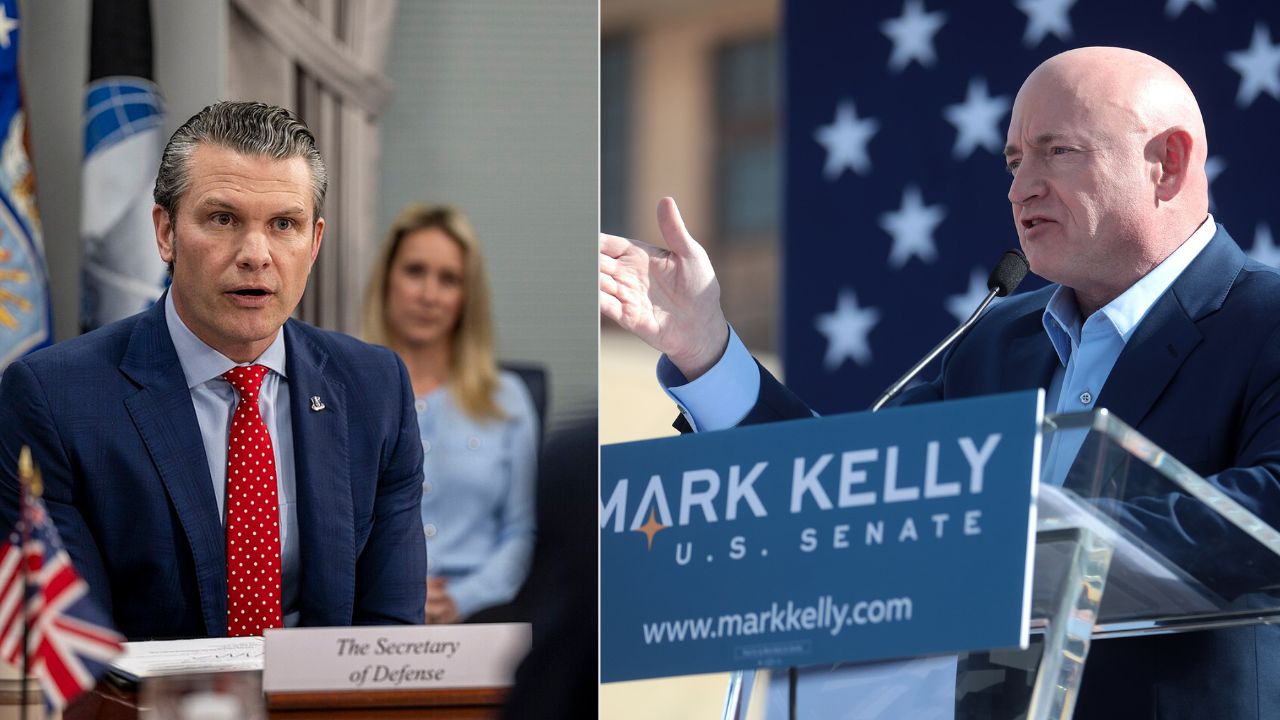
Sen. Mark Kelly has turned a simmering clash with the Pentagon into a direct legal confrontation, filing suit against Defense Secretary Pete Hegseth after the military moved to punish him over a video about “illegal orders.” At stake is not only Kelly’s rank and pension as a retired Navy captain but also the boundary between civilian oversight and military discipline when elected officials speak to troops about the law.
The case now pits a sitting senator and former astronaut against the Trump administration’s defense leadership, with Kelly arguing that the penalties send a chilling signal to anyone in uniform who might question unlawful commands. I see this as a test of how far the government can go in policing speech that urges service members to follow the Constitution first.
The video that sparked a Pentagon crackdown
The dispute traces back to a video in which Kelly and other Democrats spoke directly to service members about their duty to refuse unlawful commands, including any order to interfere in elections or seize foreign territory. In that message, Kelly, an Arizona Democrat, warned troops against obeying any directive to defy election results or to take control of Greenland, framing such scenarios as examples of “illegal orders” that would violate their oath. I read that as a pointed but legally grounded reminder that uniformed personnel swear allegiance to the Constitution, not to any individual commander in chief.
Defense Secretary Pete Hegseth responded by opening a formal case against Kelly, accusing him of undermining good order and discipline and of using his retired status to influence active duty personnel. According to the Pentagon’s own account, the investigation began after concerns that the video could encourage troops to question presidential authority in a crisis, and officials cited a federal statute that lets retired officers be recalled and punished for misconduct. The Pentagon’s letter of censure, as described in multiple reports, treated Kelly’s appearance as a breach of norms that separate partisan politics from the chain of command, even though the senator insists he was explaining settled law on unlawful orders.
From censure to lawsuit over rank and pension
Kelly’s lawsuit, filed in federal court earlier this week, seeks to block Hegseth from cutting his retirement rank and pension or enforcing the censure. In his complaint, Kelly argues that the threatened demotion from captain to a lower grade would be an unprecedented use of disciplinary tools against a member of Congress for core legislative and oversight work. One filing notes that the Pentagon’s own letter cites activities that Kelly’s lawyers describe as “quintessential legislative and oversight acts,” a phrase that underscores his claim that the speech at issue is inseparable from his Senate duties.
The suit names both the Pentagon and Hegseth personally, and it asks the court to declare the censure and any rank reduction unlawful. Kelly’s lawyers contend that Hegseth’s actions violate the Speech or Debate Clause by punishing comments that stem from legislative acts, and they stress that the senator has continued to serve on defense and national security matters while this fight unfolds. I find it striking that the complaint also highlights the number 48, pointing to the 48 words in a key passage of the censure letter as evidence that the government is dissecting his remarks line by line to build a case against protected speech.
Free speech, “disfavored” views, and the Trump factor
At the heart of Kelly’s argument is a First Amendment claim that the Trump administration is targeting him for “disfavored political speech.” In the lawsuit, Kelly asserts that the government is punishing him not for any breach of classified information or operational security but for telling troops they must reject illegal orders, a message he frames as both constitutionally protected and operationally essential. One filing explicitly states that the administration violated his First Amendment rights by singling out his criticism of hypothetical abuses of power.
Kelly has been blunt in public, telling supporters in a video message that “Donald Trump and Pete Heg” are “abusing their authority” by trying to make an example of him. In that same clip, he accuses Pete Hegsth and “Donald Trump and Pete Heg” of using the machinery of military justice to send a warning to anyone who might question their directives. I read that as a deliberate effort to widen the frame, casting his case as a stand against broader attempts to blur the line between partisan loyalty and lawful command, rather than as a personal grievance over retirement pay.
Why the Kelly–Hegseth clash matters beyond one senator
Kelly has said repeatedly that the lawsuit is “much bigger than me,” and the legal filings back that up by stressing the potential impact on every retired officer who later enters public life. If the Pentagon can censure and demote a senator for a video about unlawful orders, the argument goes, then any retired general or admiral who criticizes a president’s conduct could face similar retaliation. In one account of the complaint, Kelly’s team warns that Hegseth’s approach would let future administrations weaponize recall authority to police speech that challenges their legitimacy, a prospect that should worry both parties.
Legal analysts have also questioned the strength of the Pentagon’s case, with one commentator writing that the Defense Department’s theory of jurisdiction over Kelly is weaker than it first appears. A detailed critique notes that the law on retired officers is murky and that using it to punish a sitting senator for a short video about unlawful orders risks turning a narrow disciplinary tool into a broad political weapon. That analysis, which appears in a piece by Fred Kaplan, argues that the message to troops about refusing illegal commands in places like Venezuela was clear and lawful, even if it irritated the White House.
Inside the legal strategy and what comes next
Kelly’s legal team has built a multi‑pronged strategy that blends constitutional claims with military law arguments. One section of the complaint, described in detail by lawyers close to the case, asserts that Hegseth’s censure violates due process because Kelly was not given a fair chance to contest the allegations before the punishment was imposed. Another section leans on the Speech or Debate Clause, arguing that the video and related comments are inseparable from his oversight role on defense issues, and therefore immune from executive branch retaliation. I see that as an attempt to force the court to treat the case not as a routine personnel dispute but as a separation‑of‑powers clash.
The broader institutional stakes are visible in how other outlets describe the Pentagon’s posture. One report notes that The Pentagon opened its investigation of Kelly after internal complaints that his video could undermine discipline, while another account emphasizes that Kelly filed his lawsuit on a Monday to halt what he calls a campaign against “disfavored speech.” Coverage of the case also notes that the complaint targets DOD and Sec Hegseth as overstepping their authority, that one detailed story by By Dare reports Kelly is challenging efforts to reduce his military retirement rank, and that another account in The Washington Post frames the suit as a direct challenge to Hegseth’s handling of due process. Even the instruction to Create a free profile to read one detailed account hints at the intense public interest surrounding the case. As the litigation moves forward, I expect the courts to confront not only the narrow question of Kelly’s rank but also the larger issue of how far any administration, including that of President Trump, can go in disciplining elected critics who speak to troops about the law.