
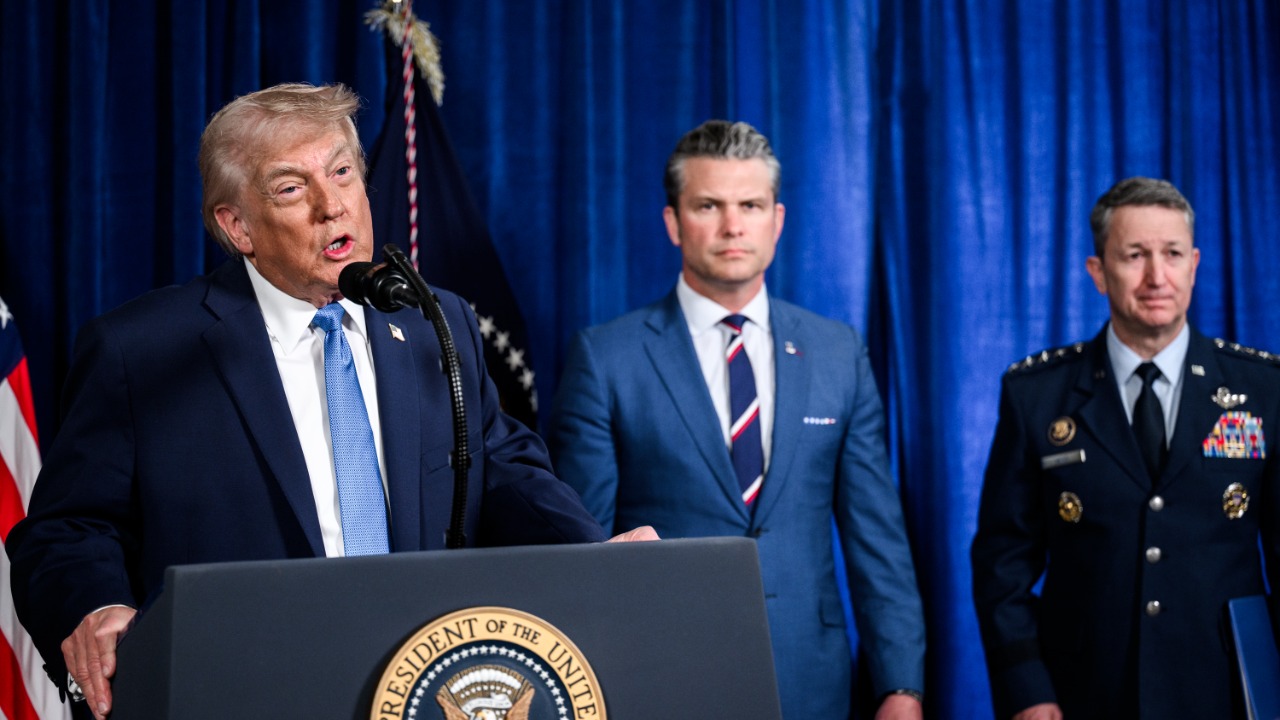
President Donald Trump is asking Congress to sign off on a historic surge in Pentagon funding, insisting that only a 50% jump in the defense budget will deliver what he calls a “dream military” capable of deterring every potential adversary. The proposal would lift planned 2027 spending to $1.5 trillion, a level that would reshape not only U.S. force structure but also the country’s broader economic and political priorities. I see in this demand not just a budget fight, but a test of how far Washington is prepared to go in redefining national security around raw military capacity.
The scale of Trump’s $1.5 trillion ambition
At the heart of the president’s push is a simple, staggering figure: a defense budget of $1.5 trillion in the 2027 fiscal year, which he has framed as the minimum needed to keep the United States safe in what he describes as “very troubled and dangerous times.” In public remarks, Trump has argued that the move would ensure national safety and security by guaranteeing that the U.S. military can outmatch any potential adversary, a case he has tied directly to a proposed increase in US military spending. Jan briefings from the administration describe the plan as a direct response to what Trump calls a deteriorating global security environment, from great power competition to regional flashpoints that he says demand overwhelming American strength.
The headline number also represents a dramatic break with the current trajectory of Pentagon funding. Trump and his aides have pointed to the roughly $901 billion already provisioned for 2026 as the baseline, casting the requested 2027 jump as a more than 50% leap that would take the United States to a $1.5 trillion war budget in a single year. In one account of the plan, the president is quoted calling for US military spending to rise more than 50% to $1.5 trillion, a scale of increase that modern budget history simply does not contain. I read that as a deliberate attempt to shock the political system into accepting that the old incremental approach to defense spending is, in Trump’s view, no longer sufficient.
Inside the “dream military” Trump says America needs
Trump has wrapped the numbers in a vivid promise: a “dream military” that he says would be rebuilt from top to bottom, from nuclear forces and missile defenses to cyber capabilities and conventional power projection. In Jan remarks reported by multiple outlets, President Trump described the $1.5 trillion request as the price of creating a force that can dominate every domain, including space and emerging technologies, and he has linked that vision directly to his call for a $1.5T defense budget for a $1.5 trillion “dream military.” I interpret this framing as an attempt to turn an abstract budget line into something emotionally resonant for his political base, a promise of unmatched strength rather than a spreadsheet exercise.
Behind the rhetoric, the administration has begun sketching out how such a force might be structured. Reporting on Trump Seeking Military Funding for 2027 indicates that President Donald Trump wants to use the extra money to accelerate procurement of future military equipment, modernize aging platforms, and expand readiness for sustained operations. In parallel, a Jan analysis of why Trump wants to give the Pentagon a 50% boost to its roughly $1 trillion budget underscores his argument that the United States is behind on its reinvestment cycle and must absorb “sticker shock” now to avoid strategic vulnerability later. I see a consistent throughline here: Trump is betting that voters will accept unprecedented spending if it is framed as catching up after years of underinvestment.
Paying for a 50% jump: tariffs, markets and Americans at home
Any proposal of this magnitude inevitably raises the question of how to pay for it, and Trump has been unusually explicit in pointing to trade policy as the answer. In Jan comments highlighted in one defense-focused report, he argued that if it were not for the “tremendous numbers” being produced by Tariffs from other Countries, the United States would already be facing more than $38 trillion in debt, a claim he uses to justify funding the $1.5 trillion request through continued tariff revenue rather than new taxes or deep domestic cuts. That argument is captured in detail in coverage of his call for $1.5T in defense in 2027, where Jan statements about Tariffs and Countries are central to the fiscal case. I read this as Trump doubling down on his long-standing belief that trade penalties can be converted directly into strategic investment at home.
Financial markets are already gaming out the implications. One analysis of Defense ETFs in 2026 notes that President Donald Trump’s plan to seek a sharp increase in Pentagon funding could deliver the biggest single-year jump in defense outlays since at least 1988, a prospect that has turned sector funds into a proxy bet on his Spending Push and Other Key Tailwinds. At the same time, another account of Trump’s demand to increase the military’s budget by 50% to a stunning level reports that President Donald Trump has floated the idea of a “substantial dividend” for lower-income Americans, suggesting that ordinary Jan Americans would share in the gains from a defense-driven boom. That promise, described in coverage of how he wants to increase the military’s budget by 50% to a stunning sum, and linked to the $901 billion provisioned for 2026 in 2026 funding, is a reminder that Trump is trying to sell this not only as a security upgrade but as a populist economic package.
Warfighters, contractors and the new rules of the defense economy
Trump’s pitch is not just about more money, it is about who controls and benefits from that money. In a Jan social media post amplified by cnbctv, President Donald Trump said he “will not permit” defense companies to issue dividends or buy back stock while they are receiving funds tied to the 50% budget increase, a stance captured in a viral clip that drew 268 comments and framed his demand as putting warfighters ahead of Wall Street. That message is echoed in reporting that Defense contractor executives’ salaries, stock options and other forms of compensation “are far too high,” with Trump insisting that his $1.5T defense budget protects warfighters, not Wall. I see this as a deliberate attempt to inoculate the plan against criticism that it is a giveaway to large contractors.
The policy architecture behind that rhetoric is already taking shape. The White House has released a Jan Fact Sheet titled “President Donald Trump Prioritizes the Warfighter in Defense Contracting,” which outlines how Trump Prioritizes the Warfighter in Defense Contracting by tightening oversight and using contract enforcement mechanisms to shift priorities away from executive pay and toward frontline needs. Separate legal analysis notes that The White House has issued an executive order that aims to accelerate defense procurement and enhance the defense industrial base by shifting contractor priorities, a move detailed in a Jan advisory on how defense contractors face new scrutiny under the Trump administration. In parallel, What, On January, President Trump signed an Executive Order titled “Prioritizing the Warfighter in Defense Contractin,” which directs agencies to accelerate production of critical defense weapons, systems and supplies, a step laid out in detail in guidance on the Executive Order to Prioritize and Accelerate Production of Critical Defense Weapons, Systems and Supplies. When I put these pieces together, I see a coherent strategy: use the promise of a 50% budget surge to justify rewriting the rules of the defense economy in favor of Jan warfighters and against entrenched corporate interests.