
The F-35 has long been sold as a stealthy sensor hub, but its critics have questioned whether it truly dominates in air-to-air combat. With the integration of the ramjet-powered Meteor missile, that balance is shifting, turning the jet into a platform that can threaten enemy aircraft far beyond visual range while staying hidden. The combination of low observability, advanced sensors and a European-designed weapon with a large “no escape zone” is reshaping how allied air forces plan to fight for control of the skies.
What is emerging is not just another weapons upgrade, but a coordinated effort across Europe and the United States to give the F-35A and F-35B a long-range punch that matches or exceeds rival systems. As integration milestones stack up, the program is moving from lab work and captive carry to a phase where Meteor-equipped F-35s will be central to Western air power planning for the next decade.
The Meteor–F-35 pairing reaches critical test milestones
The most important shift in recent months is that the Meteor missile is no longer a paper capability for the F-35A, but a system that has been physically mounted, shaken and cleared through key safety gates. During ground vibration testing, Meteor is mounted in the internal weapons bay of the F-35A, then subjected to a range of frequencies to ensure the missile and aircraft structures behave predictably under stress. That work is essential before pilots can safely carry and fire the weapon, and it confirms that the stealth jet can host the European-designed missile without compromising its low observable profile or flight envelope.
Engineers have not treated this as a routine fit check. At Edwards Air Force Base, the partners carried out a series of ground integration trials that combined vibration testing with internal bay checks to validate safe carriage and release. The trials were conducted at Edwards Air Force Base (AFB) in California, where the F-35 test community has long experience wringing out new weapons. According to program officials, the data from these events shows that the F-35A can stow and deploy Meteor from its internal bay in a way that preserves both safety margins and stealth, clearing the path to flight tests.
European leadership and funding behind the integration push
The drive to arm the F-35A with Meteor is being led and funded from Europe, reflecting both industrial interests and strategic urgency. Italy has taken a central role, with Italy sponsoring integration of the ramjet-powered weapon on the F-35A so its own fleet can exploit the missile’s reach. That sponsorship is not just about national pride, it ensures Italian and other European pilots can rely on a homegrown beyond-visual-range missile rather than depending solely on U.S. weapons, and it keeps European industry embedded in the F-35 ecosystem.
The United Kingdom has already moved ahead on the short takeoff and vertical landing variant, with the F-35B now flying operationally relevant test sorties carrying Meteor. Earlier work laid the financial foundation for this, when in 2019, Lockheed Martin received initial funding to begin integration of the missile on the F-35 family. That investment has matured into flight activity in which the fighters carry a maximum of four Meteors internally, a configuration that, as later testing has shown, preserves the aircraft’s stealth characteristics while giving it a heavy internal air-to-air loadout.
From ground tests to a “no escape zone” in the air
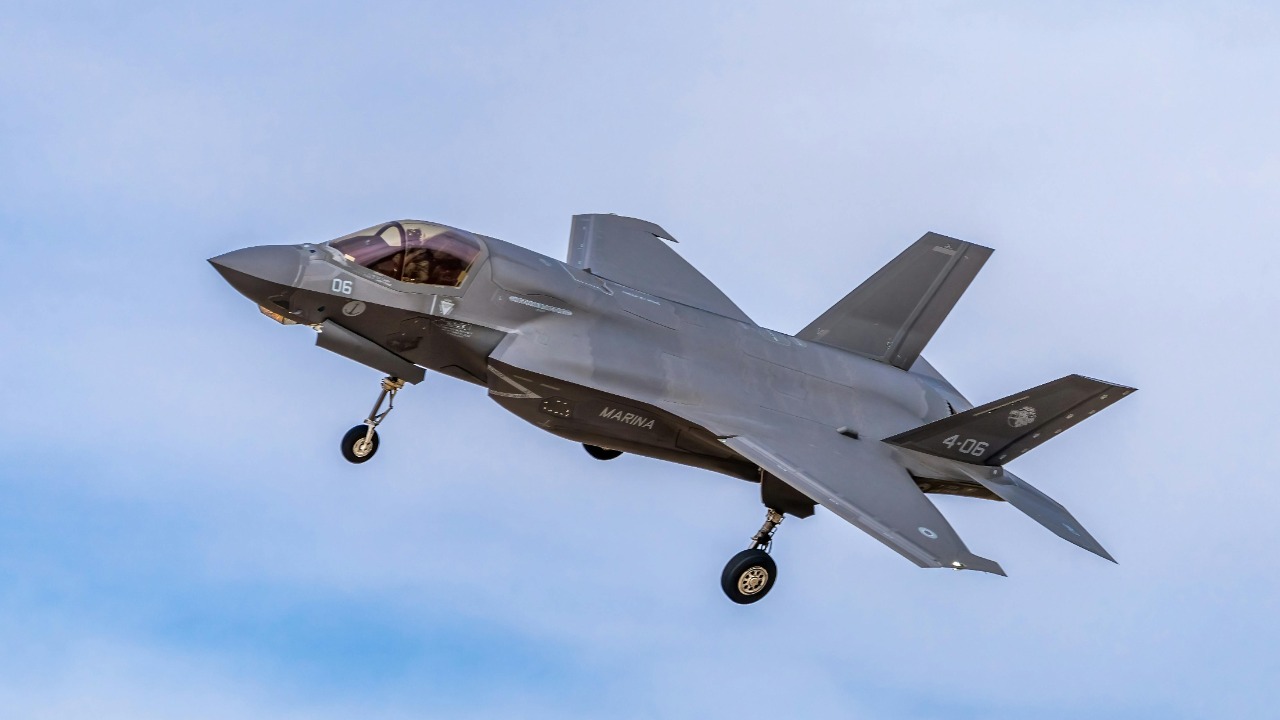
With the basic mechanical and structural work validated, the integration effort is now focused on proving that Meteor can be safely carried and released in the dynamic environment of flight. Program officials describe how Meteor nears completion of ground-based integration tests on the F-35A, with engineers meticulously evaluating data to confirm that the missile can be safely stowed and deployed from the internal bay. Once those final checks are complete, the program can move into captive carry and live-fire events that demonstrate how the missile behaves when launched at high speed and altitude from a stealth platform.
The payoff for this careful sequencing is a weapon that dramatically extends the F-35’s engagement envelope. Meteor’s ramjet sustainer and active radar seeker give it a reputation in Europe as a missile with a large “no escape zone,” meaning targets that fall within that envelope have little realistic chance of outrunning or outmaneuvering it. Analysts note that integrating METEOR on the F-35A is expected to give the US and Europe a major boost in modern Western air power, since the jet’s sensors can detect and track threats at long range and then hand off engagements to a missile designed to chase down maneuvering fighters deep into their own territory.
How Meteor changes the F-35’s air-to-air reputation
For years, the F-35’s critics have argued that its air-to-air punch lagged behind its stealth and sensor suite, particularly when compared with rival platforms armed with very long-range missiles. That narrative is already being challenged by the new integration work, with one assessment noting that the F-35 can currently carry up to four long range air-to-air missiles internally and that adding Meteor will significantly improve its ability to engage enemy aircraft before they can respond. In practical terms, this means an F-35 patrol can remain in a low observable configuration while still holding multiple adversaries at risk far beyond visual range.
European governments see this as more than a marginal upgrade. Program leaders have described how the introduction of the Meteor missile to the F-35A represents a game-changing tactical upgrade that is expected to help allied forces maintain air superiority for the foreseeable future. That assessment reflects not only the missile’s performance, but also the fact that it is being integrated across fleets in North America, Western Europe and Oceania, where North America, Western Europe and Oceania operate large numbers of F-35A aircraft and anti-aircraft assets that will benefit from a common long-range air-to-air weapon.
Strategic context: Europe’s answer to rival long-range missiles
The decision to prioritize Meteor on the F-35 is also a response to the broader missile landscape, particularly the rise of long-range systems fielded by potential adversaries. European officials have been explicit that the missile was developed by European nations to counter advanced threats, and that it has already proven its reliability in earlier trials. Reporting on the program highlights how the missile, developed by European nations, has already proven its reliability and offers a large ‘no escape zone’ for enemy aircraft, a capability that directly addresses concerns about rival systems such as the PL-15.
That strategic framing explains why European governments have pushed to keep the integration schedule tight. Program timelines show that the schedule for adding the European-produced missile to the US-produced stealth fighter is designed to bring the F-35A into frontline service with Meteor before the end of the decade. As that happens, the jet will no longer be seen primarily as a stealthy strike aircraft that can defend itself, but as a central node in an air defense network that can quietly patrol contested airspace and launch long-range intercepts without ever appearing on an adversary’s radar.
Industrial and export implications for the wider fighter market
The integration effort is also reshaping the industrial and export dynamics around the F-35 and competing platforms. Lockheed Martin and its partners have been keen to show that the jet can work seamlessly with European weapons, and recent reporting notes that Lockheed Martin Tests Meteor BVRAAM Integration on F-35A following carriage tests onboard a range of aircraft, including other platforms such as KAAN and KIZILELMA. That cross-platform compatibility makes Meteor more attractive to countries that operate mixed fleets, since they can buy a single missile type for multiple fighters.
At the same time, the integration work has been closely watched in Europe, where the program is seen as a test of how well the F-35 can accommodate non-U.S. weapons. In Belfast, program officials have emphasized that engineers meticulously evaluated the data from the pivotal ground tests to ensure the European Meteor could be integrated without compromising the aircraft’s design. That message is aimed not only at current operators, but also at potential buyers who want the flexibility to mix U.S. and European weapons on their future fleets.