
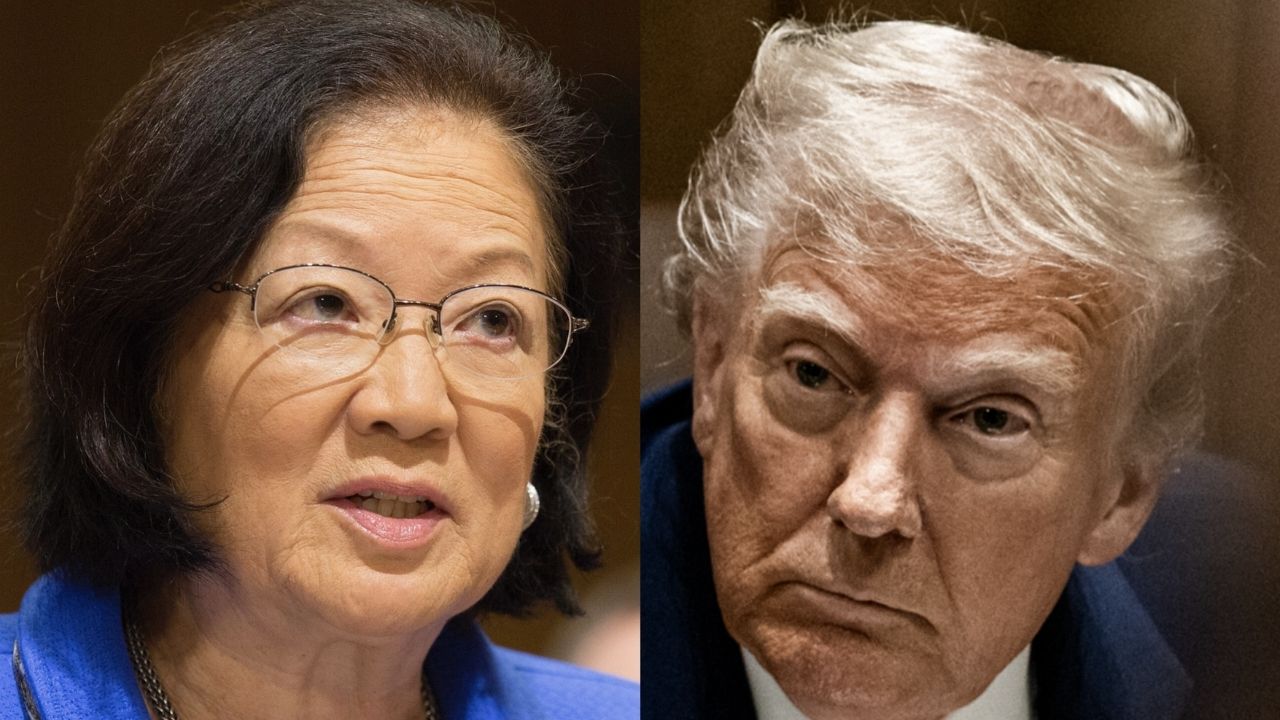
U.S. Senator Mazie Hirono is renewing her criticism of President Donald Trump’s war against Iran and his sweeping tariff policies, arguing that both are contributing to rising costs for American families and businesses. In a November 14 statement, the Hawaii Democrat accused the administration of pursuing policies that are placing additional financial pressure on consumers, declaring that Americans cannot allow the pattern to continue. Her remarks build on months of opposition to the Iran military campaign, repeated warnings about its economic consequences and legislative efforts to challenge Trump’s tariffs, including measures specifically intended to protect small businesses from higher import costs.
Hirono opened her statement with a direct accusation against the administration: “Prices are skyrocketing because of Trump’s illegal war and his destructive tariffs.” The senator is connecting two major areas of Trump’s economic and foreign policy agenda, arguing that military escalation overseas and trade restrictions are both contributing to the financial pressures experienced by Americans. Her reference to the war as illegal also reflects her longstanding constitutional objection to Trump’s decision to initiate military operations against Iran without congressional authorization.
Full post:
Prices are skyrocketing because of Trump’s illegal war and his destructive tariffs.
We have to stop the bleeding. We cannot and will not let this pattern continue.
Her criticism of the Iran campaign dates back to its beginning. On February 28, 2026, following Trump’s announcement of U.S. military strikes against Iran, Hirono issued a statement arguing that the president had exceeded his constitutional authority. “The President’s unilateral decision to strike Iran for purposes of regime change is a clear violation of the Constitution, which gives Congress, not the President, the sole power to declare war,” she said. She also warned that the administration had not articulated a clear strategy for what would happen next and expressed concern that American servicemembers and personnel in the region were being placed at risk.
Hirono’s initial response established two central objections that have remained consistent in her subsequent statements: the constitutional authority to initiate military action and the absence of a clearly articulated strategy for the conflict. As a senior member of the Senate Armed Services Committee, her criticism also carries particular significance because the committee oversees major defense policy decisions, military readiness and the resources committed to American military operations. She called for Congress to immediately consider Senator Tim Kaine’s War Powers Resolution to reassert legislative authority over the conflict.
On March 4, Hirono voted to advance Kaine’s War Powers Resolution, which sought to block Trump from using additional military force against Iran without congressional authorization. Following the vote, she criticized the administration for continuing the military campaign without presenting a clear plan for what would happen after the initial operations. She also highlighted the deaths of six American servicemembers at that point in the conflict and argued that the president was diverting military resources, attention and assets away from other national priorities. Her statement accused Senate Republicans of failing to defend Congress’s constitutional authority over decisions involving war.
Hirono’s March position is important to understanding her November 14 remarks because she has consistently connected the military campaign to both national security and domestic economic consequences. Rather than limiting her objections to the legal authority for the initial strikes, she has also challenged the financial burden of the conflict and the potential consequences for military readiness. Her argument is that the United States cannot indefinitely redirect military resources toward another overseas war without accounting for the costs to American taxpayers and the country’s other defense requirements.
Hirono’s April 30 questioning of Defense Secretary Pete Hegseth provided another example of her focus on the economic consequences. During a Senate Armed Services Committee hearing, she raised questions about the financial costs of the war and the administration’s handling of the Strait of Hormuz. She cited the deaths of 13 American servicemembers, more than 400 wounded personnel and more than $25 billion in taxpayer spending at that stage of the conflict. She also argued that the closure of the Strait of Hormuz was contributing directly to unaffordable prices facing Americans. Her questioning connected the military campaign to disruptions in a critical international shipping route and the resulting pressure on energy markets.
The economic significance of the Strait of Hormuz is central to Hirono’s argument. The waterway is one of the world’s most important energy transportation routes, carrying substantial volumes of internationally traded oil and petroleum products. Disruptions to shipping through the strait can affect global supply expectations, energy markets, transportation expenses and the cost of goods that depend on fuel. The Iran conflict has therefore created economic consequences extending beyond the direct cost of military operations, particularly for American consumers exposed to changes in gasoline and other energy prices.
The Pentagon’s October estimate also provides additional context for Hirono’s criticism. The military’s reported $47.1 billion cost through October 16 represents a substantial increase from the figures she cited during her April questioning. The estimate includes operational expenditures, replacement munitions and lost equipment. It does not represent the entire economic cost of the conflict, including all indirect effects associated with energy-market disruptions and higher transportation expenses. Hirono’s repeated emphasis on military spending reflects her argument that the administration must account for both the immediate defense budget and the broader financial consequences of the war.
Her November 14 statement also specifically identifies Trump’s tariffs as another source of rising consumer and business costs. Hirono has repeatedly argued that the administration’s trade policies place the financial burden of import duties on American businesses and consumers rather than simply forcing foreign governments to pay. On May 6, 2025, she joined Senate Democratic Leader Chuck Schumer and Senator Ed Markey in introducing the Small Business Liberation Act. The proposed legislation was designed to exempt more than 34 million American small businesses from the administration’s broad global tariffs. In announcing the measure, Hirono said the tariffs were creating uncertainty and driving up prices for small businesses, entrepreneurs and their customers.
Hirono continued challenging the tariff policy in 2026. On February 20, following a Supreme Court ruling against Trump’s global tariffs, she said the measures had “wreaked havoc on small businesses and driven up costs for consumers, while doing nothing to help the U.S. economy.” She also argued that the tariffs had been used as a political instrument against international partners rather than as an effective economic policy. The ruling provided an important development in the legal dispute surrounding the administration’s tariff authority, although the broader policy debate over import duties and alternative tariff authorities remained unresolved.
Federal economic statistics provide additional context for Hirono’s warning about household expenses. The Bureau of Labor Statistics reported that the Consumer Price Index increased 0.4% in October 2026 after rising 0.6% in September. Food prices increased 0.5% in October, while food purchased for home consumption rose 0.4%. The energy index increased 0.7% during the month, following a 5.2% increase in September. Gasoline prices increased 1% in October on a seasonally adjusted basis, following a 9.1% increase in September. These figures document continued increases in several major household expense categories, although the monthly statistics do not independently establish that the Iran war or tariffs caused every price increase.
The longer-term gasoline figures also demonstrate the scale of the energy-price pressures facing consumers. The Bureau of Labor Statistics reported that gasoline prices were 34.2% higher in September 2026 than they had been in September 2025. Fuel oil prices increased 74.2% over the same period, while overall consumer prices rose 3.7%. Food-at-home prices increased 1.8% year over year in September. The figures illustrate the uneven impact of inflation across household spending categories, with energy costs experiencing particularly substantial increases. Hirono’s argument is that the administration’s decisions surrounding Iran and international trade are adding to an economic environment in which families are already confronting higher expenses.
Hirono’s opposition to the war has also extended into defense authorization legislation. In June 2026, after the Senate Armed Services Committee advanced its draft of the Fiscal Year 2027 National Defense Authorization Act, she said she could not support advancing a measure that would allow for as much as a 40% year-over-year increase in Department of Defense spending while the administration continued what she described as an illegal war in Iran without a clear plan or endpoint. Her position demonstrates that her criticism is not limited to public statements about gasoline prices or the cost of living. She has also challenged the relationship between the administration’s military spending requests, congressional oversight and the ongoing conflict.
Hirono’s latest statement brings these arguments together in two short sentences: “We have to stop the bleeding. We cannot and will not let this pattern continue.” The first sentence reflects her call to address the financial pressures she associates with the administration’s foreign and trade policies. The second is a broader political commitment to continue challenging those policies rather than accepting them as unavoidable consequences of the president’s agenda. Her November 14 remarks reinforce a position she has advanced through Senate votes, committee questioning, legislation and public statements throughout the Iran conflict: that military decisions must remain subject to congressional authority and that the economic consequences of government policy must be considered alongside its national security objectives.