
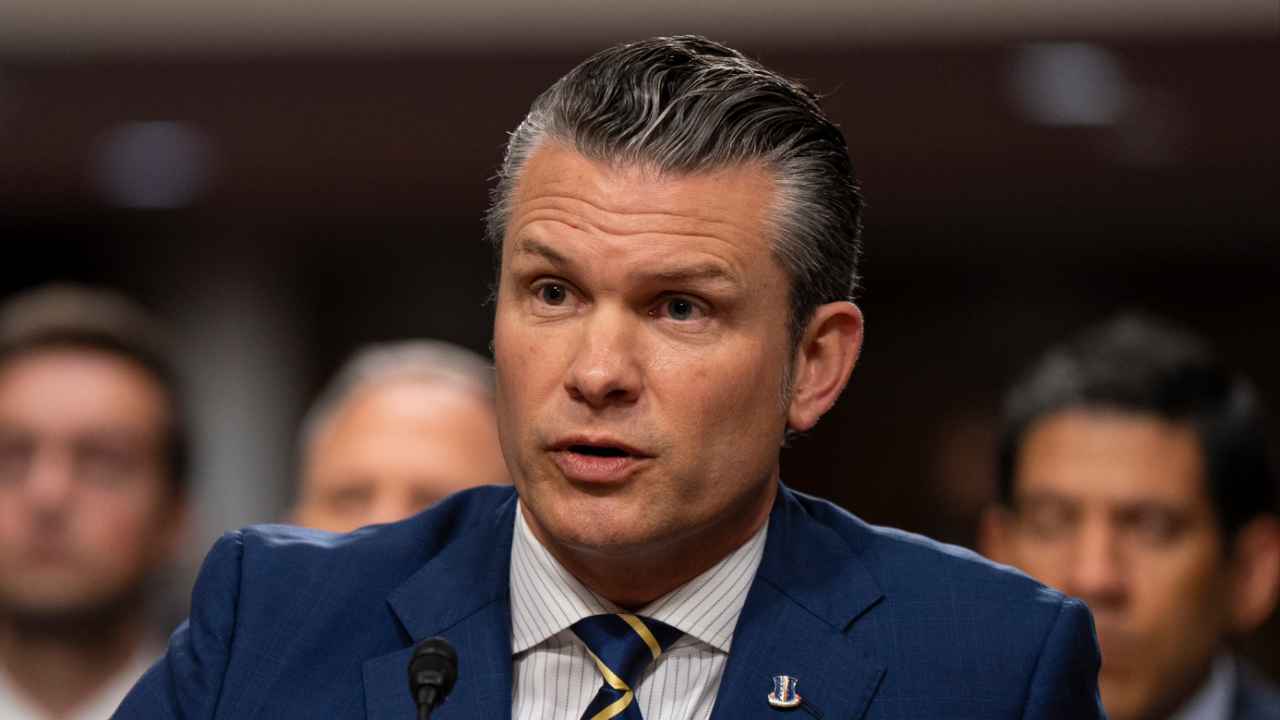
Secretary of War Pete Hegseth on Nov. 14 named Tarleton State University in Texas and the University of West Florida as the newest members of America’s Corps of Cadets. The program designates participating schools as “Distinguished Military Colleges” and, in Hegseth’s words, grants them “priority in officer commissioning.” He closed the announcement by telling the two schools, “Welcome, Patriots, and Godspeed.”
Hegseth made the announcement in a recorded video message posted to his official account. “Congratulations to Tarleton State University and the University of West Florida on becoming the newest members of America’s Corps of Cadets!” the post read.
Speaking in front of American and department flags, Hegseth said he had “recently” directed “the launch of six strategic initiatives that would govern the War Department’s direction for years to come.” One of them, he said, was “a new Corps of Cadets, America’s Corps of Cadets, partnering with institutions that have committed to producing honorable leaders with unwavering character, grit, and courage.”
“Today, I’m proud to announce that America’s Corps of Cadets welcomes the Argonauts of the University of West Florida and the Texans of Tarleton State University into our ranks, now included in the initial cohort of institutions as distinguished military colleges,” Hegseth said. “It is our salute to you, as you salute service this weekend.”
The program dates to Hegseth’s State of the Force address at Marine Corps Base Quantico, Virginia, on Sept. 30. In the department’s transcript of that speech, he listed six announcements: autonomous warfare, the future of warfare, “the Nation’s Insurance Policy,” “the Next Great American Base,” a new corps of cadets and an Office of Religious Affairs.
In the same speech, Hegseth named the first five schools: Louisiana State University, Liberty University, Tuskegee University, Mississippi State University and Hillsdale College. “These schools have stepped forward to answer the call to duty and establish new Corps of Cadets in partnership with the Department of War,” he said, adding that “there are a number more that we plan to announce soon.”
He described the designation as “reviving a category previously used in our department.” He said member schools “maintain exceptionally high standards of cadet discipline, tactical instruction, and military organization” and “earn a prestigious ‘Honor School’ status, which grants priority in officer commissioning, which you all know is a big deal.”
Hegseth framed the program as a response to where the military draws its officers. He said the service academies at West Point, Annapolis and Colorado Springs “commission the most officers in our force,” and that “the next largest source of future officers is our six existing Senior Military Colleges and their Corps of Cadets.”
Beyond those, he said, the military relies on “a wide variety of commissioning sources. Many from institutions that have drifted, in some cases, have careened away from founding values.” He went on: “From the Ivy Leagues to most liberal arts colleges, our colleges and universities have become anti-American, DEI-worshiping, woke factories.” That characterization of American higher education is Hegseth’s own.
The speech also addressed the war with Iran. Hegseth told the audience of noncommissioned and junior officers that they and their peers had “destroyed Iran’s Navy, destroyed Iran’s Air Force, destroyed their air defense systems, their leadership, and their military industrial capacity.” Those battlefield assessments are his and were not accompanied by supporting data in the address.
The new designation is distinct from senior military college status, which is set by Congress. Federal law, at 10 U.S.C. 2111a, lists six senior military colleges by name: Texas A&M University, Norwich University, the Virginia Military Institute, The Citadel, Virginia Polytechnic Institute and State University, and the University of North Georgia.
That statute bars the department from terminating or reducing a Senior Reserve Officers’ Training Corps unit at those colleges unless the college requests it. It also directs the Army to ensure that qualified graduates who want to serve as active-duty officers can do so. None of the newly designated schools appears on that list.
Tarleton State, a member of the Texas A&M University System in Stephenville, Texas, said in its own announcement that it is the first Texas university included in the program. The school said its Texan Corps of Cadets, reactivated in 2016, now has 215 cadets, welcomed 103 first-year cadets this fall and has commissioned more than 100 officers since 2022.
“This historic milestone represents our unwavering commitment to serving the United States of America and honoring our proud military heritage,” Tarleton State President James Hurley said in the release. The university said the department’s memorandum describes the designation as a stepping stone for schools that choose to pursue senior military college status.
The University of West Florida said in a university news release that it will establish a Corps of Cadets. “Our region has a deep and proud connection to the military, and UWF has long been committed to serving those who serve our nation,” UWF President Manny Diaz Jr. said. The university said it will hold a press conference next week with details on how the corps will be implemented.
Both schools said cadets may pursue commissions through existing Reserve Officers’ Training Corps programs. Tarleton State said its cadets may also follow a civilian leadership track with no military obligation.
Hegseth’s announcement rests on a mix of verifiable actions and his own characterizations. The Department of War’s transcript confirms that he created America’s Corps of Cadets on Sept. 30 with five initial schools and promised more, and both universities confirmed their designation on Nov. 14. His statement that the program grants “priority in officer commissioning” is the department’s stated policy, but the speech and the two university releases do not explain how that priority will work in practice. His description of the two new schools as part of the “initial cohort” is his framing, since they were named six weeks after the first five. His claim that most U.S. colleges have become “anti-American” and his battlefield assessments of Iran are his own views. Federal law still recognizes only six senior military colleges, and the new designation does not change that list.