
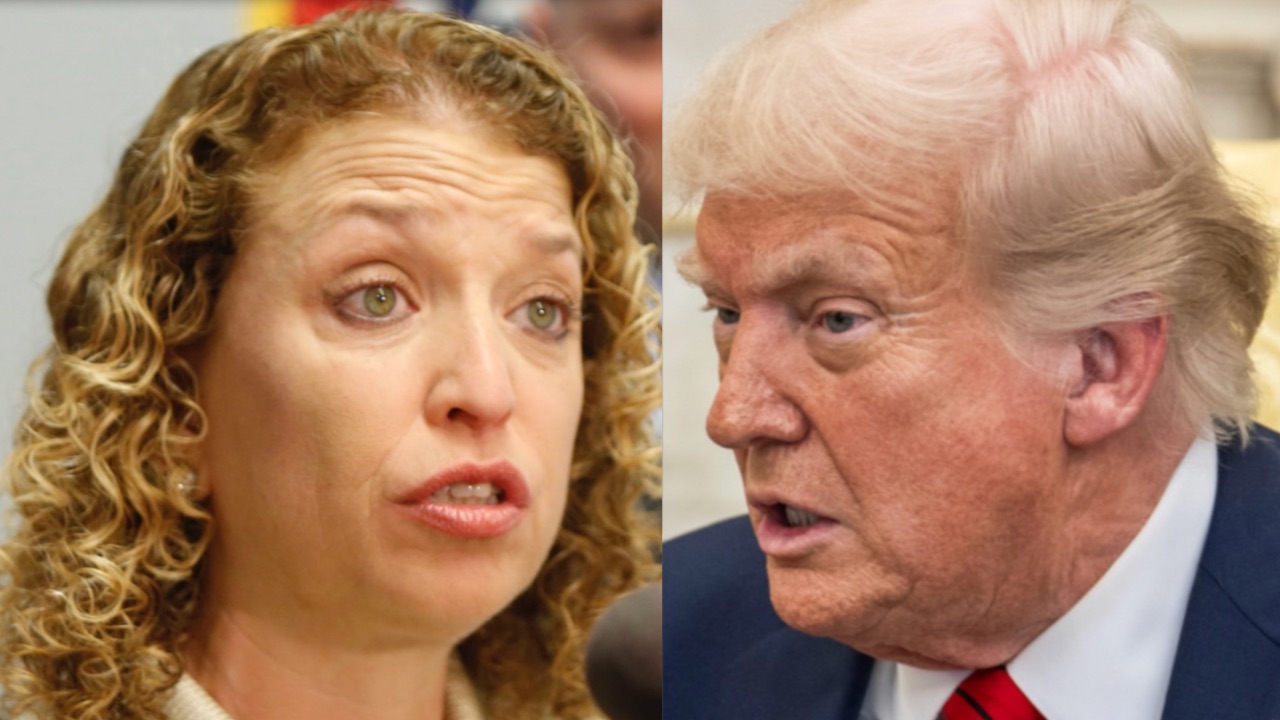
Rep. Debbie Wasserman Schultz, the top Democrat on the House appropriations panel that funds military construction and veterans programs, blamed “gross Trump incompetence” on Saturday for the travel disruption that followed Friday’s nationwide halt to U.S. departures, as Transportation Secretary Sean Duffy defended the administration’s air traffic control upgrades and pointed to a contractor’s work on an aging telecommunications line.
“Americans shouldn’t suffer such gross Trump incompetence. Thanks to every air traffic controller, airline, FAA and TSA staffer working to fix grounded flights. Travelers deserve timely, safe air travel,” the Florida Democrat wrote in a post on X. “Democrats will demand it, plus answers on what Trump did with $12.5B Congress sent for air traffic modernizing and hires. MAGA controlled all of government for 2 years, yet clearly slept at the switch.”
Her post quoted a news report published two and a half hours earlier stating that “thousands of flights have been canceled for today after yesterday’s ground stop.” Flight-tracking data from FlightAware’s daily cancellation page showed more than 5,500 cancellations within, into or out of the United States on Saturday. Wasserman Schultz posted before the administration publicly explained what it believed caused the outage.
That explanation came later Saturday at a Transportation Department news conference. “In at least one of our remote FAA locations, a contractor was doing routine maintenance to switch telecommunication lines from old copper wire, and they were bringing it over to fiber,” Duffy said, according to C-SPAN’s recording of Duffy’s remarks. “That contractor that does the work for us is L3Harris. They’re our legacy provider.” He said L3Harris “actually owns” the network the FAA uses “to control the airspace.”
Duffy used the same word as Wasserman Schultz in describing the open question. “What we’re working to determine was whether we had incompetence, meaning was it user error or installator error from L3Harris, or did they install a faulty router?” he said. “We haven’t determined what the fault was. Was it the router or were they not doing great work for us at L3Harris?”
He said the equipment “started flooding other routers in our air traffic control system,” generating “over 1,000 connection attempts every four to five seconds,” which disrupted communication with aircraft and “caused some disruption with our radar feeds.” On whether a foreign government was involved, he said, “We don’t believe this was cyber at all. This was an FAA system that didn’t meet the moment. Our contractor didn’t meet the moment or the equipment didn’t meet the moment.”
L3Harris said in a statement on X that it has been “modernizing the communications infrastructure supporting the National Airspace System in close coordination with the FAA” and, with its telecom partners, “has completed more than 70% of the planned airspace communications conversion from legacy copper wires to a fiber optic system.” The company added: “We are supporting the FAA in its investigation to understand the conditions that led to the Nov. 13 ground stop of our nation’s air travel.”
FAA Administrator Bryan Bedford opened his remarks with “a sincere apology to the American traveling public,” according to C-SPAN’s recording of Bedford’s remarks. He said that of 20,000 flights still scheduled when the stop began, about 8,000 were recovered and 12,000 were not, roughly 9,000 of them commercial. “We do anticipate somewhere between 4,000 and 5,000 of the 41,000 flights that are scheduled today likely will cancel,” he said, adding, “I do think the worst is behind us.”
FAA Command Center records trace the stoppage. Advisory 111 declared a national ground stop “due to extraordinary circumstances and for reasons of safety,” and the FAA said in its statement on the ground stop that it acted “following communication issues impacting multiple Air Route Traffic Control Centers.” The order was lifted in a cancellation advisory about four hours and 20 minutes after it took effect. Homeland Security Secretary Markwayne Mullin said in remarks posted by DHS that the FAA, the Department of War and the State Department were “all working together” on the response.
The money Wasserman Schultz cited comes from Section 40003 of Public Law 119-21, the July 2025 reconciliation law branded the One Big Beautiful Bill. The enacted text of the law appropriates FAA funds available until Sept. 30, 2029, including “$4,750,000,000 for telecommunications infrastructure modernization and systems upgrades,” $3 billion “for radar systems replacement” and “$100,000,000 for air traffic controller advanced training technologies.” It requires the FAA administrator to report to Congress every 90 days on spending.
Duffy defended the use of that money. “Over the past year, we’ve put our $12.5 billion down payment from Congress to work overhauling America’s air traffic control infrastructure,” he wrote in a Nov. 14 post on X, listing “70% of telecom lines upgraded with high-speed fiber” and “469 radio sites modernized.” He added: “We are building safely and quickly but the job isn’t finished.” In remarks attached to that post, he said lawmakers “weren’t quite sure that we would spend the money well,” adding, “That’s the history of the FAA that goes back from Republicans and Democrats.”
In a follow-up post, Duffy wrote that modernization “isn’t a partisan issue, it’s a national safety priority” and that “now we need Congress to step up with the resources to build a state-of-the-art system.” The FAA’s fact sheet on the Brand New Air Traffic Control System calls the law’s funding a “$12.5 billion down payment” and says the agency needs an “additional $20 billion.”
Wasserman Schultz is ranking member of the Military Construction, Veterans Affairs, and Related Agencies subcommittee, according to the House Appropriations Committee Democrats’ subcommittee page. She has also attacked the administration over the war with Iran, writing in an Oct. 25 post that “everything should be on the table: ending Trump’s illegal war in Iran, raising wages, crackdowns on oil price gouging.”
Other Democrats have called for scrutiny. Sen. Tammy Duckworth of Illinois, ranking member of the Senate aviation subcommittee, wrote on X that “the safety of our skies is built on redundancies” and that the ground stop “will warrant a thorough and complete investigation.” Sen. Maria Cantwell of Washington, the top Democrat on the Commerce Committee, said her committee will review “technology issues related to how planes communicate through primary frequencies, backup frequencies, and other issues.”
The FAA said Saturday the system was stabilizing. “The system is stable and we’re returning to normal operations,” the agency wrote in a Nov. 14 update.
Wasserman Schultz’s description of “gross Trump incompetence” and her statement that Republicans “slept at the switch” are her political assessments, as are Duffy’s suggestion that L3Harris may have done poor work and his statement that the administration is “building safely and quickly.” Official records and statements confirm that Congress appropriated $12.5 billion for FAA air traffic control improvements in July 2025, including $4.75 billion for telecommunications; that the FAA ordered a nationwide ground stop Friday after communication issues at multiple Air Route Traffic Control Centers; that Duffy tied the outage to copper-to-fiber conversion work L3Harris says it has been carrying out for the FAA; and that the root cause, whether contractor error or faulty equipment, remains under investigation.