
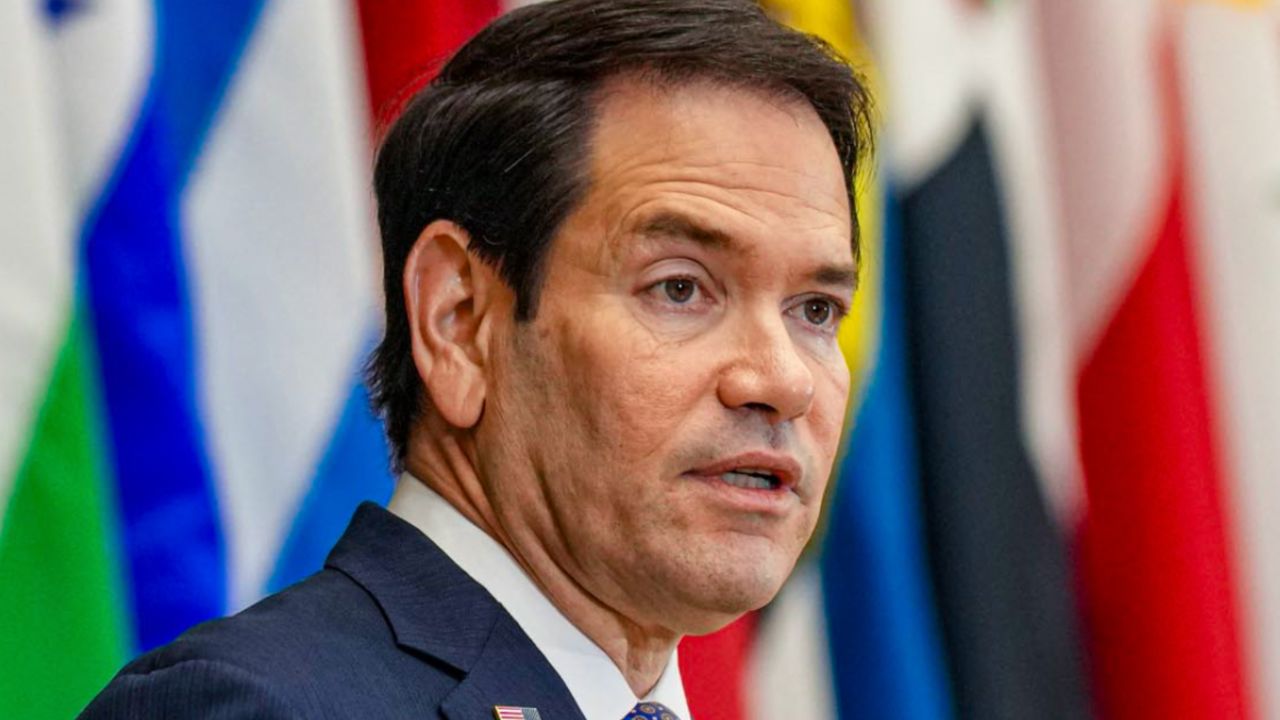
WASHINGTON — Secretary of State Marco Rubio accused international legal institutions and their supporters of seeking to weaken American sovereignty on Friday, arguing that legal objections to U.S. military operations were part of a broader effort to restrict the country’s ability to defend its interests.
Speaking at the Federalist Society’s National Lawyers Convention on November 13, Rubio criticized what he described as the political use of international law against the Trump administration’s military operations, immigration enforcement and other government policies.
“For these people, the fundamental purpose of the law, American law and international law alike, is to weaken the United States,” Rubio said, according to the State Department’s official transcript.
“It is to undermine our power as a sovereign nation to act. It is to hinder the American Government’s ability to defend American interests at home and abroad,” he continued.
Rubio argued that international institutions, nongovernmental organizations and legal activists were using international rules to constrain Washington while presenting their positions as universal principles.
“For this global elite, international law is not a neutral body of rules,” he said, describing it as an instrument used to advance political interests.
The secretary cited several administration policies that have faced international criticism, including military strikes against suspected drug-trafficking vessels, the January capture of Venezuelan leader Nicolás Maduro and immigration enforcement within the United States.
Rubio’s remarks reflected the administration’s argument that the United States should retain broad freedom to act against perceived threats without submitting its decisions to international institutions it considers unaccountable.
That position has become particularly significant as Washington faces scrutiny over its use of military force in Latin America.
Since September 2025, American forces have carried out strikes against vessels in the Caribbean and eastern Pacific that U.S. officials allege were connected to drug-trafficking organizations.
The administration has defended the campaign as lawful military action against designated terrorist organizations. U.N. human rights officials and independent experts have disputed whether alleged drug trafficking provides a sufficient legal basis for the attacks.
In September 2026, U.N. special rapporteur Ben Saul concluded that the strikes violated international law and that there were reasonable grounds to believe the reported killings constituted crimes against humanity.
His assessment was not a criminal judgment against American officials, and the administration has maintained that the operations are justified by national security concerns.
Rubio also defended the January 3 military operation that captured Maduro and his wife, Cilia Flores, in Venezuela before transporting them to the United States to face federal charges.
The operation prompted objections from United Nations officials over the international prohibition on the use of force against another sovereign state.
In remarks delivered to the Security Council on January 5, U.N. Secretary-General António Guterres expressed concern that international legal rules had not been respected during the intervention.
The U.N. Charter generally prohibits the threat or use of force against another state’s territorial integrity or political independence, subject to recognized exceptions including self-defense and Security Council authorization.
The United States is a party to the charter. Its obligations under the treaty are separate from the administration’s objections to the conclusions of individual U.N. officials.
The administration has maintained that the Maduro operation served American law-enforcement and national security interests.
A Justice Department memorandum prepared before the operation concluded that Trump possessed domestic constitutional authority to order the mission without advance congressional approval. The opinion did not establish that the intervention complied with all applicable international-law obligations.
Rubio also directed criticism at the International Criminal Court, which prosecutes individuals accused of serious international crimes within its jurisdiction.
The United States has not ratified the treaty establishing the court and has long opposed the possibility of American personnel facing prosecution without Washington’s consent.
However, the Rome Statute permits jurisdiction over nationals of nonmember countries in certain circumstances, including when alleged crimes occur on the territory of a state that has accepted the court’s authority.
The Trump administration has imposed sanctions on the court and individual officials, arguing that the institution has improperly asserted authority over Americans and U.S. allies.
In October, Washington expanded its sanctions against the institution. A Treasury Department general license temporarily authorized specified transactions supporting the court’s operations through April 7, 2027.
Rubio defended the sanctions during Friday’s speech, arguing that the ICC was attempting to impose legal obligations on citizens of countries that had not accepted its founding treaty.
His argument extended beyond current military disputes. Rubio described American history as a period of territorial expansion, technological development and the pursuit of new frontiers, portraying those developments as expressions of national ambition.
He contrasted that history with what he described as demands that the United States accept restrictions imposed by international institutions and legal activists.
Supporters of international legal institutions argue that common rules governing military force, sovereignty and individual accountability are necessary to protect countries and civilians from unlawful actions, including those undertaken by powerful governments.
The institutions Rubio criticized also exercise different forms of authority. The ICC prosecutes individuals within its jurisdiction, while the U.N. Charter establishes legal obligations between states. Independent U.N. human rights experts issue assessments but do not themselves determine criminal guilt.
Rubio did not announce a new military operation, treaty withdrawal or legal policy during the speech.
His remarks instead presented a broad defense of the administration’s approach to American power, linking its military operations and opposition to international judicial oversight to a wider argument that Washington should resist external constraints on its national security decisions.