
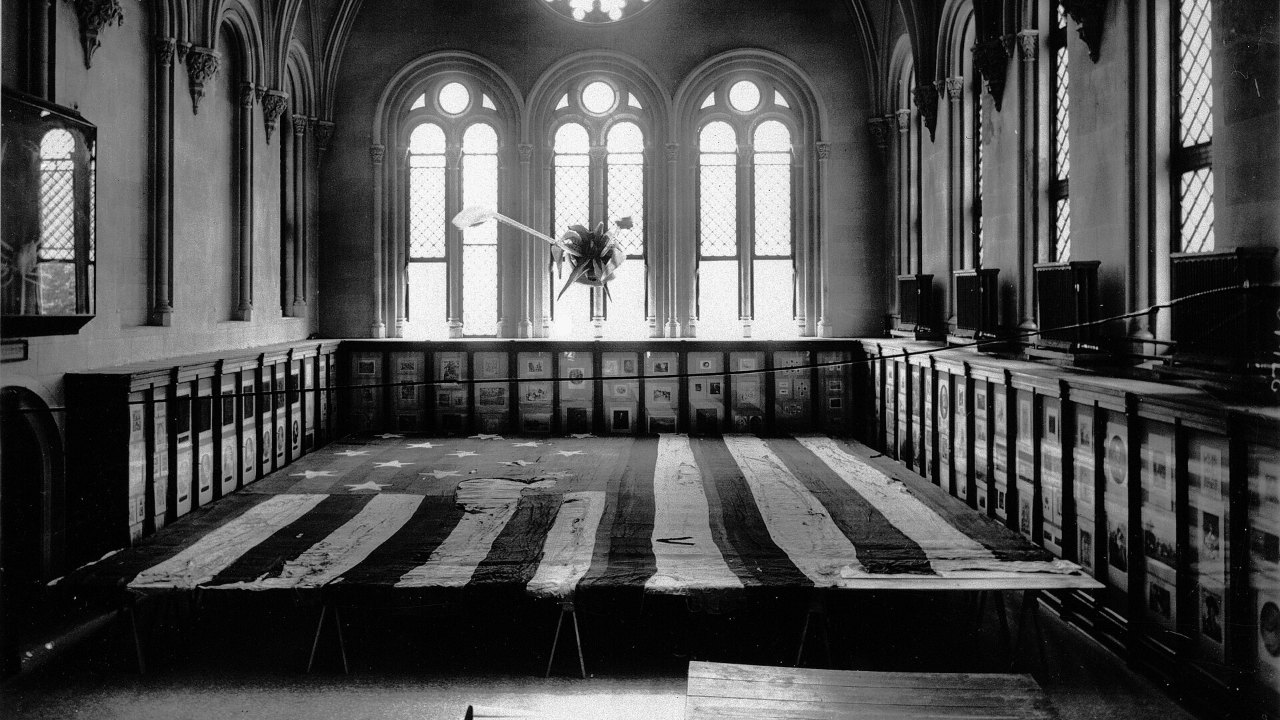
Its makers needed the floor of a Baltimore brewery to lay it out. The great garrison flag of Fort McHenry measured 30 feet by 42 feet, with each of its 15 stripes two feet wide and each star 24 inches from point to point.
It was built that big on purpose, for a commander who wanted the British to see it, and it is the flag Francis Scott Key saw over the fort on the morning of Sept. 14, 1814, the sight that inspired him to write “The Star-Spangled Banner.”
Those dimensions come from the National Park Service, which runs Fort McHenry National Monument and Historic Shrine. Its page on the great garrison flag states that “the 30′ x 42′ flag was the one that Francis Scott Key saw on the morning of September 14, 1814,” and that “the larger of the two flags had stripes two feet wide, and stars 24 inches from point to point.”
A flag ordered to be seen
The order came from the fort’s commander. In the summer of 1813, according to the Park Service, Maj. George Armistead asked for two flags: a large garrison flag and a smaller storm flag. His stated reason, as the Park Service quotes it, was “to have a flag so large that the British will have no difficulty in seeing it from a distance.”
The storm flag was no small banner either. The Park Service gives its size as 17 feet by 25 feet.
Seven weeks of work
The flag maker was Mary Pickersgill, a 37-year-old widow who made ship and signal flags in Baltimore, the Park Service says. She worked for seven weeks with her daughter Caroline, her nieces Eliza and Margaret Young, a 13-year-old indentured servant named Grace Wisher, and possibly her mother, Rebecca Young.
Per the Park Service, the women “pieced together strips of loosely woven English wool bunting.” The garrison flag was laid out on “the expansive floor of a brewery near Mrs. Pickersgill’s Pratt Street house.” Both flags were finished on Aug. 19, 1813, more than a year before the bombardment.
The 15 stars and 15 stripes were correct for the time. “In 1814, the United States flag had 15 stars and 15 stripes,” the Park Service notes. The Smithsonian adds that they represented the 15 states of the union in 1795, and that the United States did not settle on 13 stripes until the Third Flag Act of 1818.
Which flag flew in the rain
The garrison flag is the one Key saw at dawn, but it may not be the one that flew through the night. The Park Service describes the smaller storm flag as the one “which many historians believe was the flag that flew during the rainy bombardment.”
That flag has not survived; the Park Service says it has been lost to history. By that account, the 30-by-42-foot flag Key saw in the morning light was not necessarily the one over the fort during the bombardment.
Thirty by 34 today
The garrison flag survived, though not intact. The Smithsonian’s National Museum of American History, which displays it in Washington, says in its Star-Spangled Banner FAQ that the flag “is now 30′ x 34′,” because “nearly eight feet were snipped off the end to give away as souvenirs” during the 1800s.
Armistead kept the flag after the battle. According to the museum, it passed to his wife, Louisa, then to their daughter Georgiana Armistead Appleton and on to her son, Eben Appleton, who donated it to the Smithsonian in 1914. A century after Armistead asked for a flag the British could not miss, it went to the national museum, where the Park Service says it is on display.