
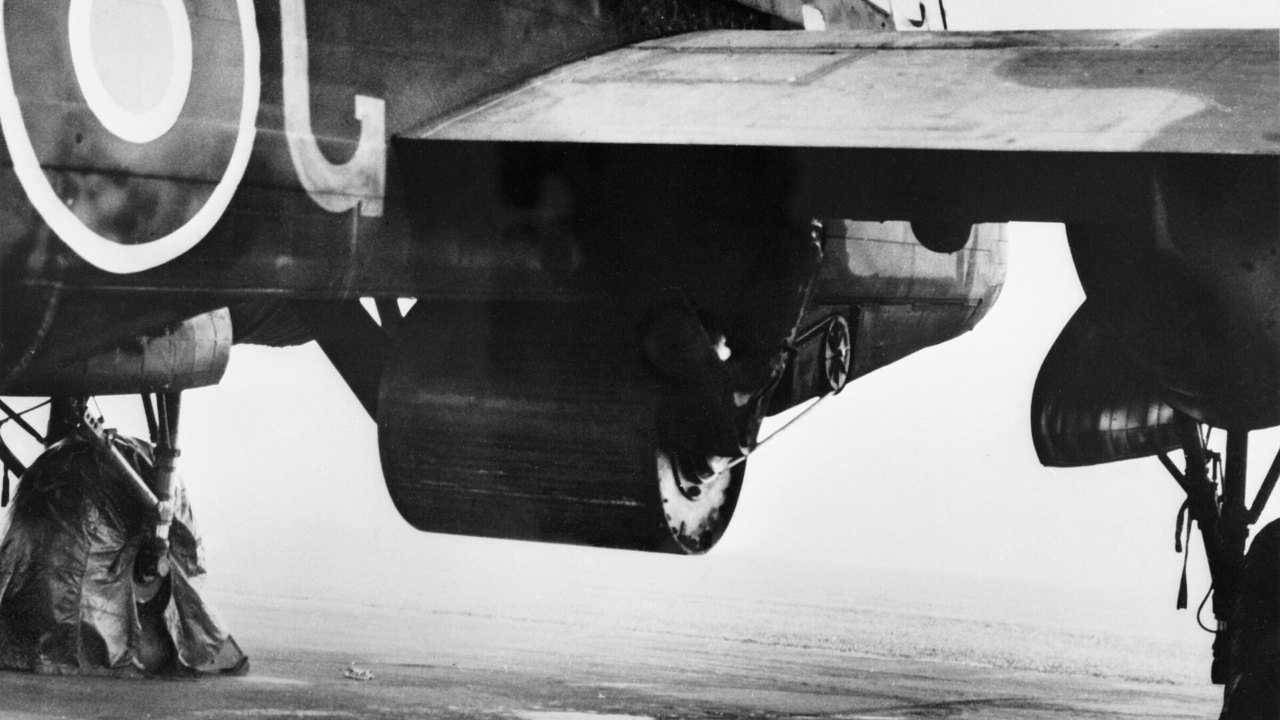
The first test bombs broke apart when they hit the water. Barnes Wallis had to fix that, and then hand the RAF a weapon that only worked if a Lancaster crew crossed a German reservoir at night, at treetop height, at one exact speed and one exact range from the dam. In May 1943, 617 Squadron did it.
The weapon was Upkeep, the bouncing bomb behind Operation Chastise. Its trick was spin, and every number the crews had to hold existed to make that spin pay off at the dam wall.
Historic England laid out those numbers in “The Story of the Dambusters: Operation Chastise, May 1943,” a May 15, 2023, article by Nicky Hughes on its Heritage Calling blog. The Lancasters had to “fly at a precise tree top-brushing altitude of 60 foot (18 metres) at a speed of 232 mph,” the article says, “before dropping the spinning four tonne bomb at exactly 1,276 foot (389 metres) from the dam.”
Why backspin made it bounce
Wallis, who had worked at Vickers-Armstrong on the R100 airship and the Wellington bomber, according to Historic England, was “known for thinking out of the box.” Trials began at Chesil Beach, where “barrel-shaped bombs were dropped from a Wellington aircraft” from December 1942 into early 1943.
They did not go well at first. “The bombs initially shattered on impact with the water,” Historic England says. Wallis made changes, “including adding a backspin on the bomb which improved its bouncing ability.” In later trials, the article says, “the bomb bounced more than twenty times and travelled over 1,200 metres.”
Spun backward, the bomb skipped instead of plunging. The Imperial War Museums’ account of the raid describes the same effect: the drum-shaped bomb “would spin backwards across the surface of the water before reaching the dam.” IWM also records how Wallis first tried the idea out, by “bouncing marbles across a water tub in his back garden.”
What the spin did at the wall
The bounce was only half the job. The spin also had to finish the attack once the bomb reached the dam. Historic England says the bomb would “use its reverse spin to bounce across the water surface towards the dam wall,” and that on striking the dam the backspin would “force it downwards deep underwater where it would explode like a depth charge.”
The Imperial War Museums’ history of the Dambusters raid puts it this way: “Its residual spin would then drive the bomb down the wall of the dam before exploding at its base.” IWM gives the same release figures Historic England does, 60 feet and a ground speed of 232mph, and notes the dams were guarded by torpedo nets and anti-aircraft guns.
The finished weapon also lost its outer shell. At Reculver, Historic England says, test bombs “were steel cylinders with wooden casings.” The wood broke away on impact, “and it was decided to dispense with the casings.” The article gives the finished bomb’s length as 1.5 metres.
Holding 60 feet in the dark
The crews were given simple tools to hold those figures. Historic England says height was checked with “two intersecting spotlights under the aircraft,” and the release point was judged with “a simple wooden triangular sight focused on the dam’s twin turrets.”
The squadron built for the job began “daily intensive training in modified Lancaster bombers,” including “practising low level night flying and navigation,” according to Historic England. IWM says the unit, first codenamed Squadron X, was formed in late March 1943 with aircrew from Britain, Canada, Australia, New Zealand and the United States.
The night of May 16-17, 1943
“Nineteen Lancaster bombers took off in three waves at ten minute intervals from RAF Scampton,” Historic England says, carrying 133 airmen. Wing Commander Guy Gibson led the first wave against the Möhne Dam. IWM says Gibson’s aircraft attacked first, at 12:28 a.m., and that five aircraft had to drop their bombs before the dam was breached.
“The remaining aircraft breached the Eder Dam after several unsuccessful attempts,” Historic England says. IWM puts the Eder’s collapse at 1:52 a.m. The third target held: “The earthen Sorpe Dam remained intact.”
The raid came at a high price for the squadron. Historic England records that eight aircraft and 53 aircrew were lost; IWM gives the same 53 dead and says three became prisoners of war. IWM says almost 1,300 people died on the ground, and it judges that the raid had a limited effect on German industrial production but gave a significant morale boost in Britain.
Gibson received the Victoria Cross. According to IWM, the raid established 617 Squadron as a specialist precision-bombing unit, and Historic England notes that Wallis received £10,000 for his war work, which he gave in 1951 to a fund for the children of RAF personnel.