
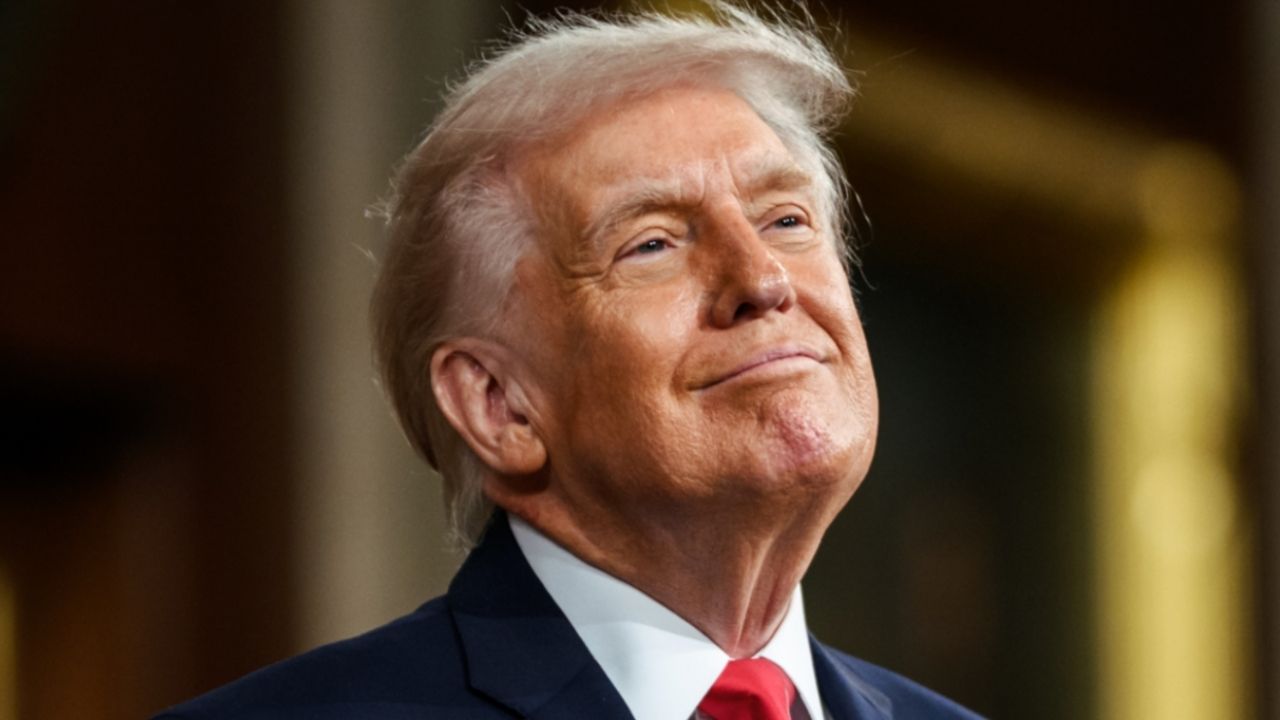
President Donald Trump told Stephen Hubbard on Friday that he thought the retired Michigan teacher had been treated “reasonably well” during more than four years in Russian custody, as the two met in the Oval Office days after Russia freed Hubbard, who told the president he “wouldn’t have lasted another year” in prison.
“This is Stephen Hubbard, who has become a very well-known person,” Trump said, according to the transcript. “In fact, you could run for office tomorrow, probably — when right now you wanna get a little rest. But he came in from Russia and he, uh, I think I can say that you were treated reasonably well, right?”
“Yes, and even sympathetically by — some of the guards,” Hubbard replied, finishing a thought Trump had interrupted. Trump answered, “I think that’s great.”
CBS News was first to report plans for the meeting. Inviting reporters into the Oval Office, Trump called Hubbard a “very special man” who “suffered greatly,” the network reported. Hubbard, 74, a retired teacher, had been jailed in Russia for more than four years after Russian authorities accused him of fighting as a mercenary for Ukraine. He returned to the United States last week.
Asked by CBS News senior White House reporter Jennifer Jacobs about the moment he learned he was being released, Hubbard said he had heard such promises before. “I had heard it many times before, and I reached the state where seeing is believing,” he said, according to both CBS and the Factba.se transcript. “Actions speak louder than words. I never trusted what they said. Only when they started giving me new clothes and leading me to the exit of the prison. I went out and I saw the car and I was accompanied by a couple of Russians. Then I believed, finally believed, on the drive from Moscow to St. Petersburg, ‘I’m really going somewhere.'”
When Trump asked how long he had been held, Hubbard answered, “Four and a half.” Trump offered him a ride on Air Force One to a Florida rally and later said he had delayed leaving for Florida because he “wanted to wait for Stephen.”
Russia freed Hubbard during a St. Petersburg meeting between U.S. special envoy Steve Witkoff and Russian President Vladimir Putin, NBC News reported last week. Witkoff thanked Putin on camera for freeing Hubbard and later met Hubbard before he boarded a flight home. Kremlin spokesman Dmitry Peskov said Putin released Hubbard “on humanitarian grounds,” NBC reported. Trump wrote on Truth Social that Hubbard was on his way home and that “the United States, out of respect for President Trump, was not required to give anything in return — an unprecedented situation for Russia.”
Trump has repeatedly tied Hubbard’s release to his decision not to impose congressional Russia sanctions while negotiations were underway. “We were in the midst of negotiating,” Trump told reporters last week, CBS reported. “And a lot of stupid people said, and people that don’t know how life works, they said, ‘Why aren’t you putting Russia sanctions and all this’ in the midst of a negotiation to try to get a long-term hostage back from Russia. If I would have done that, you would not have Mr. Hubbard coming back.”
In the Oval Office on Friday, Hubbard volunteered that “the Russians laugh at these sanctions,” adding, “It brings disrespect on my country.” Trump used that exchange to defend his timing again, saying it would have been absurd to ask Putin for Hubbard’s release while announcing new sanctions. The president has not reimposed those sanctions since Hubbard’s release, CBS reported.
Russian prosecutors had alleged that Hubbard voluntarily joined a territorial defense battalion in Izyum, where he had lived since 2014, after the full-scale invasion began in 2022, and that he regularly received financial compensation. A Russian court convicted him of serving as a mercenary in a closed-door trial in 2024. Hubbard’s lawyer, Martin De Luca, has said Hubbard told him the charges were false and that he was not part of any combat unit. Hubbard’s son, Joseph Coleman, a Greek Orthodox priest living in Cyprus, told NBC that there was “no evidence” his father fought for Ukraine and that he believed his father “was in the wrong place at the wrong time.”
Coleman’s family statement after the release thanked both Trump and Putin. “Never once did we waver as we prayed for success in these negotiations, and we must acknowledge that this humanitarian move by President Putin in this matter is deeply appreciated,” Coleman said on behalf of the family, according to NBC. De Luca said Coleman had written Putin “a long and very emotional letter” last month describing fears that Hubbard would die without seeing his children and grandchildren.
John Herbst, a former U.S. ambassador to Ukraine, told NBC that despite White House framing of a one-sided release, “it was not a freebie.” He linked the timing to the U.S. decision not to extradite Russian war blogger Mikhail Zvinchuk, who had been detained in Montenegro. Washington has for years accused Moscow of arbitrarily detaining Americans and using their cases in prisoner swaps; Hubbard’s case followed the August release of former Marine Robert Gilman after more than four years in a Russian prison, NBC reported.
Asked Friday whether the administration had a strategy for other Americans still detained in Russia, Trump said the number “seems to be eight” and that “we’re working on them also.” Hubbard said he had been “isolated from all other foreigners” and described earlier being under artillery fire with Russian soldiers who “tend to forget about me” while scrambling to save their own lives.
Trump’s description of Hubbard’s treatment as “reasonably well,” and Hubbard’s agreement that some guards treated him “sympathetically,” sit alongside Hubbard’s statement that he would not have survived another year in custody, and alongside Russia’s mercenary conviction, which Hubbard and his lawyer dispute. Trump has said he spoke directly to Putin and that no swap was required; the White House and the Kremlin have not published a joint accounting of what, if anything, accompanied the release beyond the humanitarian framing both sides used.