
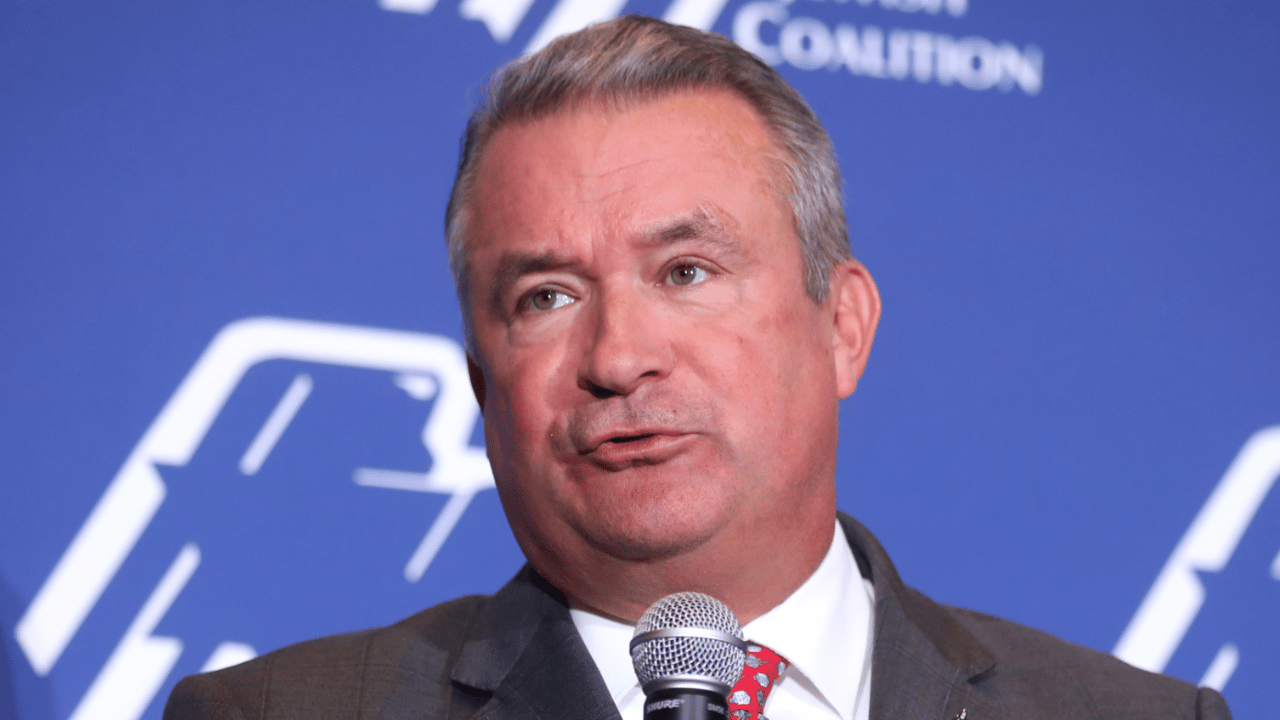
Rep. Don Bacon, a Nebraska Republican, said Thursday that “Congress must investigate” after the Defense Department’s inspector general declined a bipartisan request to examine Starshield communication restrictions that interrupted Ukrainian military operations in mid-October.
In a post on X, Bacon wrote “Congress must investigate” as he shared a National Review item by contributing editor Andrew C. McCarthy headlined “Pentagon IG Refuses to Investigate Starshield Restrictions That Enabled Russian Attacks on Ukraine.” The article asks “who ordered the restrictions on the Starshield military application.”
The underlying inquiry request came from nine senators. On Oct. 15, Sens. Jeanne Shaheen, a New Hampshire Democrat and ranking member of the Senate Foreign Relations Committee, and Thom Tillis, a North Carolina Republican, led colleagues Durbin, Collins, Reed, Cornyn, Coons, Murkowski and Blumenthal in a letter to Defense Department Inspector General Platte Moring III. The senators asked for an immediate investigation into reported Oct. 12–14 speed restrictions on SpaceX Starlink terminals and related Starshield services in Ukraine, citing Ukrainian military testing that identified limits above about 63 miles per hour and a SpaceX acknowledgment of a 100-mile-per-hour service restriction. They wrote that the limits “disrupted critical communications capabilities supporting Ukrainian unmanned aerial vehicles and fixed-wing and rotary-wing aircraft” and “degraded Ukraine’s ability to conduct defensive operations against Russian drone and missile attacks on civilian infrastructure.” They also sought findings on whether U.S. diplomatic, military or security personnel were unable to reach bunkers during Russian air raids amid disruptions to intelligence-sharing and early-warning capabilities, and whether any Defense Department or other U.S. officials directed, authorized or had advance knowledge of the changes.
The Associated Press first reported the mid-October Starlink speed limits that slowed Ukrainian drones. AP later explained that the affected military-grade service was Starshield, SpaceX’s government variant of Starlink. SpaceX chief executive Elon Musk has said that “Starshield, a different system, is controlled by the U.S. government. What they decide to do is up to them.”
CNN reported that it obtained Inspector General Moring’s Tuesday letter declining the senators’ request. Moring wrote that the senators’ questions “should be directed to the US Air Force and Space Force,” which “are better suited to address the matters raised in your letter and to coordinate any Department responses to your questions.” Mollie Halpern, a spokesperson for the inspector general’s office, told CNN the office “carefully considered the congressional request and determined that the matters raised were best addressed by the Department” and that “Should new information come to light, we may reconsider.” Shaheen said in a Wednesday statement that “it is concerning that the inspector general has apparently decided not to investigate satellite communication disruptions that Ukraine relies on to protect its civilians,” adding that “The Trump Administration and SpaceX have provided conflicting accounts of what led to those disruptions, which weakened Ukraine’s defenses and put American personnel in Ukraine at risk unnecessarily.” The Associated Press also reported the inspector general’s decision not to investigate the interruption.
Sen. John Cornyn of Texas, a signatory, also released the bipartisan letter as a PDF from his office. The letter asked the inspector general to preserve communications, contractual records and technical directives among the Defense Department, SpaceX and other agencies, and sought written confirmation of the inquiry’s status by Nov. 1. Ukrainian officials have said the speed caps made high-speed drones easier to target and hampered the interception of fast Russian drones.
Bacon, a retired Air Force brigadier general, sits on the House Armed Services Committee. A congressional investigation could use subpoena power, which the inspector general’s office does not hold over private companies such as SpaceX. The National Review headline Bacon shared said the restrictions “Enabled Russian Attacks on Ukraine”; the senators’ letter described the effect as degraded Ukrainian defensive operations and risk to U.S. personnel, and the inspector general made no finding either way because it did not open an inquiry.
CNN reported that speeds were fully restored only the Saturday after the senators’ letter. Who directed the temporary limits remains unresolved. The Space Force’s contractual role, flagged in the senators’ letter, remains central to any remaining inquiry: the letter said “at least some relevant services are provided through contractual arrangements administered by the U.S. Space Force.”
No committee has announced an investigation in response to Bacon’s call, and Republicans control both chambers’ committees. The inspector general’s office has referred the senators’ questions to the Air Force and Space Force and said it could reconsider if new information emerges. Whether the speed caps enabled Russian attacks, as the National Review headline asserts, or mainly degraded Ukraine’s defensive drone and aircraft operations, as the senators wrote, has not been determined by any official review.