
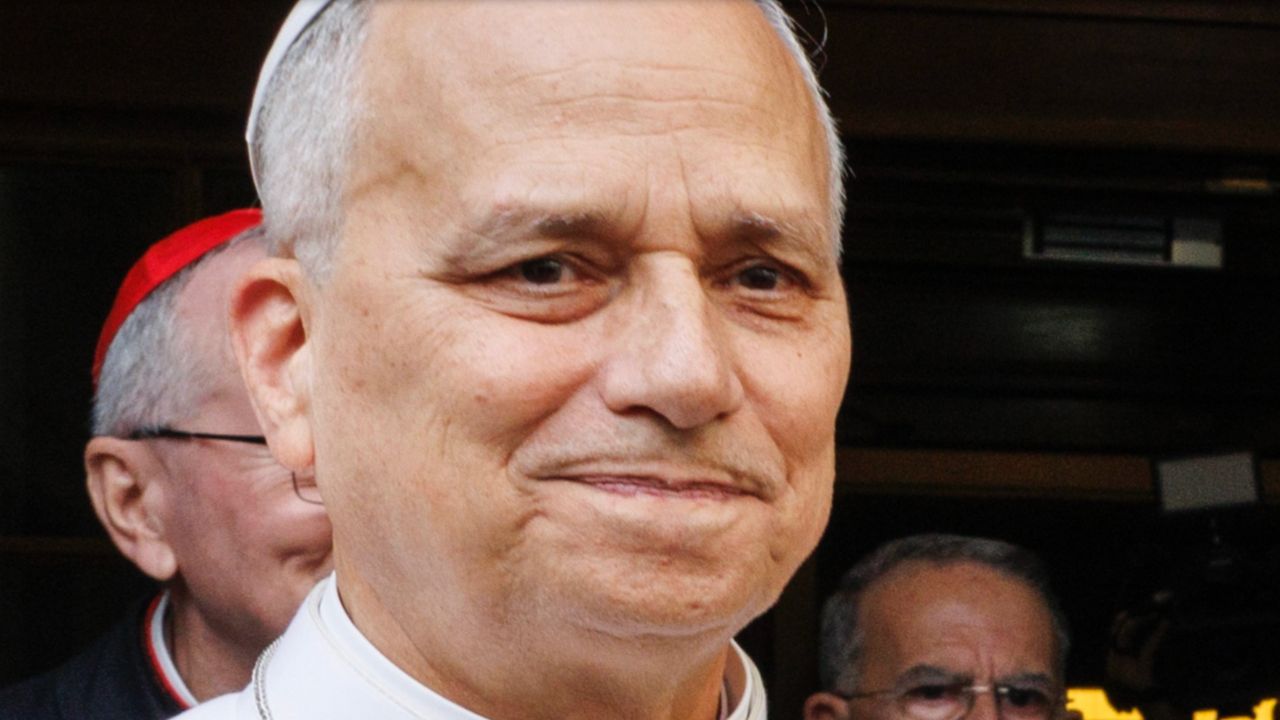
Pope Leo XIV told religious leaders gathered in Assisi that “there is no such thing as a holy war,” rejecting religious justifications for armed conflict in a video message released by the Holy See Press Office on Tuesday for the close of an interfaith peace meeting marking 40 years since Pope John Paul II’s 1986 World Day of Prayer for Peace.
“We must rebuild peace everywhere, not prepare for more wars. War can never be waged in the name of God,” Leo said. “For us believers, ‘to fight in the name of religion means attacking religion itself.’ There is no such thing as a holy war: only peace is holy.”
The American pontiff had been scheduled to attend the meeting in person but sent the recorded message instead while recovering from Oct. 13 lung cancer surgery, The Associated Press reported. In the message, he said he “would very much like to have been with you at the tomb of Saint Francis on this important anniversary, to see your faces and bear witness together to the fact that living as brothers and sisters is already possible!”
The gathering, titled “Unarmed and Disarming Peace,” ran from Oct. 25 to 27 and was organized by the Community of Sant’Egidio and the Vatican’s Dicastery for Interreligious Dialogue. Vatican News said participants included Archbishop of Canterbury Sarah Mullally, along with Muslim, Buddhist and other Christian leaders, in the Umbrian town associated with St. Francis. Leo also greeted Bishop Felice Accrocca of Assisi and the Franciscan orders, and noted that the meeting fell in the year marking the 800th anniversary of St. Francis’s death.
John Paul II convened the first Assisi gathering of world religious leaders on Oct. 27, 1986, during the Cold War. Leo recalled that John Paul afterward urged believers to “continue to live the spirit of Assisi,” and quoted Pope Francis, who said in 2013 that the 1986 day “should not and could not have remained an isolated event.”
Leo said the world today is “very different” from 1986. “After 1989, many believed that globalization would ensure lasting peace for the world,” he said, before quoting his May 15 encyclical Magnifica Humanitas: “an almost blind faith was placed in the ability of the markets to generate prosperity, democracy and stability. In reality, rather than automatically generating unity and peace, globalization has provoked fundamentalist, identity-based and nationalistic reactions.” Against that backdrop, he said, quoting the encyclical again, there has been a “troubling revival of war as an instrument of international politics.”
He cited the Catechism of the Catholic Church’s observation that “the accumulation of arms strikes many as a paradoxically suitable way of deterring potential adversaries from war,” and said that view betrays “the memory of the twentieth century and the senseless slaughter of millions of human lives.”
“Precisely in these times marked by a ‘culture of power,’ there is a need to cultivate the spirit of Assisi, which entails a rejection of the religious justification of war, a spirit of mediation and dialogue, and contemplative reflection combined with creative action in the service of a future of peace,” Leo said. Peace, he added, “must once again become the common ideal of all peoples, the guiding star for all our choices, the standard that exposes injustice, and the shared horizon for all.”
Leo described prayer as something that “may seem weak in the face of the powers of the world, but it is the humble strength of believers,” and asked God to “touch the hearts of those who seek war and terrorism.” He urged religious leaders to foster dialogue “so that the language of arrogance may give way to the language of peace, negotiation and understanding,” and closed by asking that God “make us unarmed instruments of his peace,” quoting the Gospel of Matthew: “Blessed are the peacemakers, for they shall be called children of God.”
Leo did not name any government, religious figure or conflict in the message. The AP placed his remarks in the context of Russia’s war in Ukraine and of religious language used around other conflicts, including by some U.S. officials.
The message came as the Vatican increased its humanitarian work in Ukraine following a localized ceasefire around the southern city of Oleshky. According to the AP, the pope’s almsgiver, Monsignor Luis Marín de San Martín, began a multi-day visit to Ukraine on Tuesday with winter supplies. The AP also reported that Leo raised a ceasefire and aid deliveries with Russian President Vladimir Putin in an Oct. 16 call from the hospital, then followed up with Ukrainian President Volodymyr Zelenskyy after returning to the Vatican. The Assisi message does not mention those calls.
The AP quoted Vatican Foreign Minister Archbishop Paul Richard Gallagher brushing aside disputes over who secured the Oleshky ceasefire, including White House statements crediting first lady Melania Trump, and saying what matters is that the ceasefire holds and allows evacuations and aid to proceed.
Leo’s message presented the rejection of “holy war” as Catholic teaching drawn from his own encyclical, without saying which leaders or conflicts he had in mind. Links to particular wars, including Russia’s war in Ukraine, and to rhetoric by U.S. officials come from news coverage of the message rather than from Leo.