
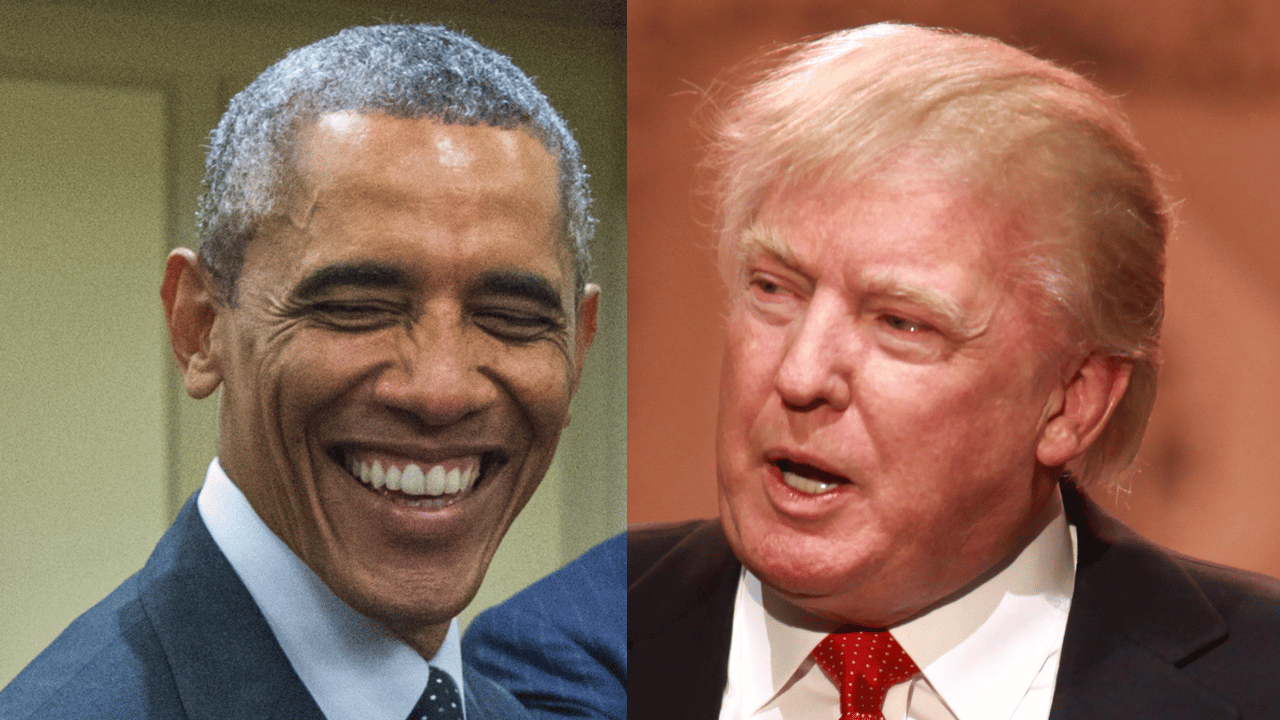
Former President Barack Obama sarcastically referred to Canada as “that well-known evil empire” at a rally in Cleveland on Saturday, mocking President Donald Trump’s “big trade war” with one of the closest U.S. allies a day after Trump signed a proclamation adding 100 Canadian product lines to a 50% U.S. tariff.
“The big trade war he’s starting now is with that well-known evil empire, Canada. Canada,” Obama said. “I mean, these are the people who gave us maple syrup and Martin Short. These are the Canadians. They’re the nicest people. They’re so nice. They’re like our friendly neighbors to the North. And he’s like picking a fight with them.”
The line was a joke at Trump’s expense, not a description of Canada. Obama repeated “Canada” for effect, then immediately praised Canadians as “the nicest people” to make his point that the tariff fight targets a friendly neighbor. “Evil empire” echoes the phrase President Ronald Reagan used for the Soviet Union in 1983. Obama did not say Trump or his administration had used the term for Canada.
Obama spoke at a rally for Amy Acton, the Democratic nominee for governor of Ohio, and former Sen. Sherrod Brown, the party’s Senate nominee, 10 days before the Nov. 3 election. The speech was carried on a livestream Obama posted on X and by C-SPAN’s live coverage.
The “evil empire” line came in a passage on prices. “Our current president loves tariffs. Loves them,” Obama said. “He was warned at the time when you impose tariffs, consumers pay the tab,” he added, saying imported parts raise the cost of cars built in the United States. “In fact, tariffs helped contribute to rising prices.” Earlier in the speech he blamed the war with Iran for higher oil and diesel prices.
After the Canada remarks, Obama said: “And instead of bringing down deficits, like he said, with these tariffs, we’re now running a debt to the tune of $40 trillion.” Treasury Debt to the Penny data put total public debt outstanding at about $40.4 trillion as of Oct. 22.
Obama did not mention a specific tariff action. On Friday, Trump signed a proclamation under Section 338 of the Tariff Act of 1930 that removes 22 tariff lines from the additional 50% duty on certain Canadian goods and adds 100 others, effective Oct. 30. A White House fact sheet said products such as plywood sheets, some paper products and certain machinery would be removed and replaced with “certain valves, carpets, waste products, and others.” The duties apply even to goods that qualify under the U.S.-Mexico-Canada Agreement (USMCA) and are added on top of Section 232 tariffs, it said.
The trade dispute did not begin this week. In the July 20 motor vehicle proclamation, one of three issued that day, Trump cited Canada’s 25% tariff on certain U.S. vehicles and its quotas on U.S. automakers, saying Canada’s imports of U.S. vehicles fell about 22% to roughly $20.3 billion over 12 months. Friday’s fact sheet said China and Canada were the only two countries that “have chosen to retaliate against President Trump’s tariffs rather than negotiate a deal.”
The duties took effect on Aug. 22, after talks collapsed. Canadian Prime Minister Mark Carney said in an Aug. 21 statement that “last-minute changes in the U.S. proposed terms were unfair, uneconomic, and called into question the reliability of any deal.” CBC News reported that sticking points included a late U.S. move to exclude medium- and heavy-duty trucks from tariff relief, a U.S. bid to limit Canada’s trade deals with other countries, and French-language labelling and streaming rules. Vice President JD Vance accused Canada of “a bunch of unreasonable last-minute demands,” and U.S. Trade Representative Jamieson Greer called the labelling claim a “funny, fake story,” the CBC reported.
The tariffs cover about US$20 billion of Canadian goods, or about C$28 billion, from wine and cement to hockey equipment, the BBC reported. Canada answered on Sept. 8 with counter-tariffs of 15% to 50% on C$27.6 billion of U.S. goods, including steel, aluminum, dairy, appliances and farm equipment. A Sept. 8 White House fact sheet announced bans on imports of certain Canadian alcohol, dairy and other products from Sept. 29.
Section 338 is one layer. Canada’s Trade Commissioner Service lists U.S. Section 232 tariffs of 15% to 50% on steel, aluminum and copper, 25% on autos and trucks with U.S. content exempt, and 10% on softwood lumber. Trump’s 2025 “fentanyl” tariffs on Canada ended after the Supreme Court ruled in February in Learning Resources v. Trump that the emergency-powers law he used “does not authorize the President to impose tariffs.” On July 1, Greer said in a statement that the United States “did not agree to renew the USMCA in its current form,” though the pact remains in force.
Carney said, “You’re at war when you get attacked. We got attacked,” according to the BBC, which reported that Ontario Premier Doug Ford said Trump “can’t be trusted.” Car trips by Canadians to the United States in September were 31.1% below September 2024, Statistics Canada said.
In Congress, the Senate voted 50-46 on Oct. 29, 2025, to end the emergency behind the earlier Canada tariffs, with Republicans Susan Collins, Mitch McConnell, Lisa Murkowski and Rand Paul joining Democrats, the Senate roll call shows. The House followed 219-211 on Feb. 11, the House clerk’s record shows. Section 338 lacks that fast-track vote, Democratic Sen. Tim Kaine told Semafor in September.
Some Republicans facing voters have broken with Trump. Collins called the new tariffs “a mistake” in August, the Associated Press reported. Michigan Senate nominee Mike Rogers said in an Oct. 7 ad, “Canada is not our enemy. We need to end this tariff war now,” CNBC reported.
On Friday, Collins wrote in a post on X that she was “pleased to have secured additional tariff exemptions” for products crucial to Maine agriculture, including blueberries, potatoes, apples and seaweed, and that she would “encourage a broader trade agreement with Canada, our neighbor, ally, and largest trading partner.”
Trump told reporters on Friday that Canada wants a deal. “Canada’s working very hard to make a deal with us. And I hate to say this, but we have all the cards in both of them,” he said of Canada and Mexico, according to a transcript of the gaggle, which the White House also posted as video of the exchange. Asked later whether Rogers’ call to end the tariff war could hurt him, Trump said, “Canada wants very much to make a deal because of tariffs,” adding that Canada had been “making $90 billion a year for many years with us.”
Census data do not support that figure. The goods trade deficit with Canada was $48.3 billion in 2025 and has not reached $80 billion in any year since 1985; Trump himself put it at $60 billion in an Aug. 24 Truth Social post. That post also threatened 50% tariffs on Canadian vehicles, parts and steel from Jan. 1, 2027, saying, “WE DON’T NEED CANADA, THEY NEED US!” Census data rank Canada second among U.S. goods trading partners in 2025, behind Mexico’s total trade.
Speaking in Istanbul on Friday, Carney said Canada was ready to sign “this afternoon if the U.S. were there,” but would wait “months from now or longer than that, or another administration” for “a proper deal,” the National Post reported. He also said allegations of Canadian meddling in the U.S. midterms had “no merit,” the newspaper reported, after the U.S. Embassy in Ottawa published an Oct. 21 fact sheet saying Canadian ministers and premiers “openly describe plans to influence American politics.”
Asked on Saturday about criticism from Obama and former President Bill Clinton, Trump told reporters in Palm Beach, Florida, that “Obama was a lousy president,” according to a transcript of those remarks. Canada did not come up in that exchange.
Obama’s description of the dispute as a trade war Trump is “starting now” is his characterization. The record shows the current Section 338 tariffs date to July, took effect in August after talks collapsed, and were followed by Canadian counter-tariffs and U.S. import bans; Friday’s proclamation changes which products are covered. His $40 trillion figure matches Treasury data, though he did not say how much accrued under Trump. Trump’s $90 billion figure is not supported by Census goods data. No response from the White House or the Canadian government to Obama’s Canada remarks was found as of Sunday.