
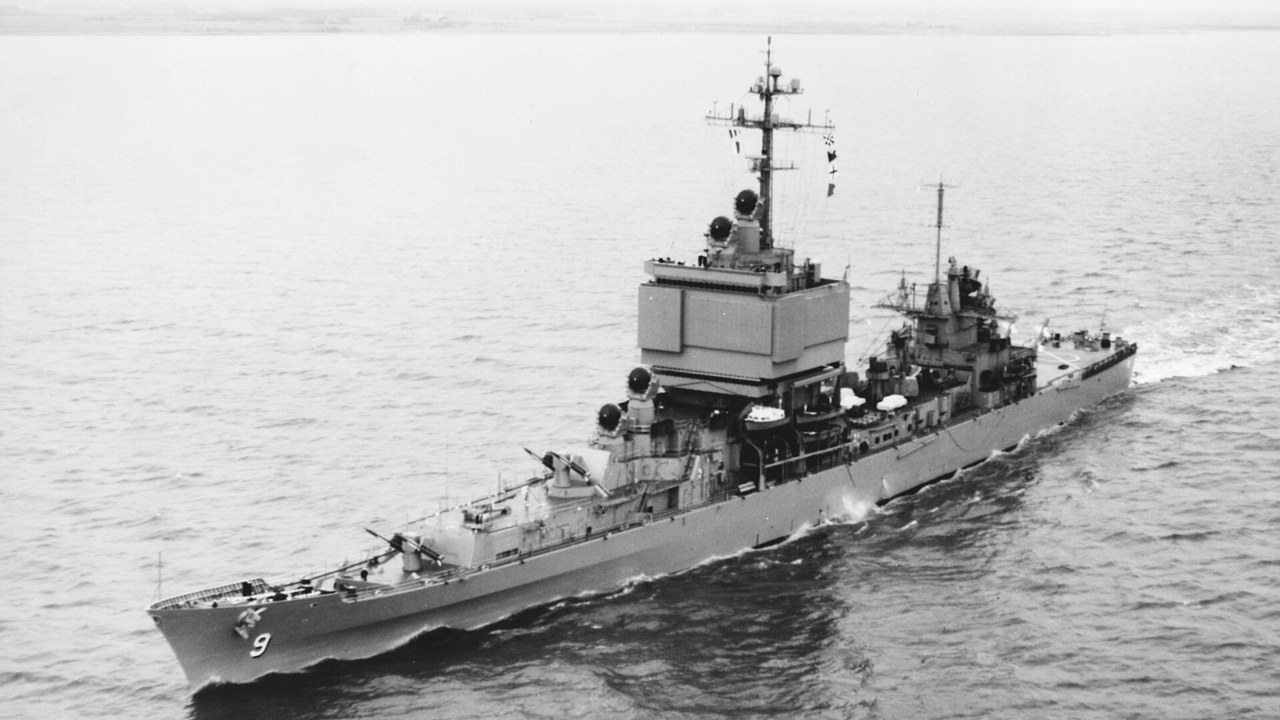
Two C1W reactors gave USS Long Beach (CGN-9) something no surface warship had carried before: a nuclear plant driving her screws. When she was commissioned at the Boston Naval Shipyard on Sept. 9, 1961, she also closed a chapter, because every U.S. cruiser that followed her would rise from a scaled-up destroyer hull rather than a cruiser’s.
That combination of first and last is why the ship still holds a singular place in the Navy’s own paperwork more than three decades after she left service. She was one of a kind in another sense, too, the only ship of her class.
The record comes from the Navy’s Naval Vessel Historical Evaluation for ex-Long Beach, a final determination dated Dec. 23, 2025, and posted with Naval Sea Systems Command’s ship disposal documents for Puget Sound Naval Shipyard. Under its significance criteria, the evaluation calls her “The first nuclear-powered surface warship in history” and the “Sole member of the Long Beach class, and the last cruiser built for the United States Navy to a cruiser design.”
From CLG(N)-160 to CGN-9
Long Beach went through several designations before she touched water. The evaluation says she was originally ordered as CLG(N)-160, reclassified CG(N)-160 and then “again reclassified as CG (N)-9 on 1 July 1957.” She was the third Navy ship named for the city of Long Beach, Calif., according to the same document.
Her keel was laid on Dec. 2, 1957, at Bethlehem Steel Company’s Fore River Shipyard in Quincy, Mass., the evaluation records. She was launched on July 14, 1959, with Mrs. Craig Hosmer as sponsor, and got underway on nuclear power for the first time on July 5, 1961, two months before commissioning.
The evaluation’s data table lists the plant as two C1W nuclear reactors and two General Electric turbines producing 80,000 shaft horsepower through two propellers. It gives her full-load displacement as 15,540 tons, her length as 721 feet 3 inches and her speed as 30 knots. Her main battery, per the document, was two twin Mk 10 launchers with Terrier surface-to-air missiles, later replaced by Standard ER missiles.
The last traditional cruiser hull
The evaluation spells out what “cruiser design” means in this case. Long Beach was “the last ship built on a traditional ‘cruiser hull’ in the U.S. Navy,” it says, and “all subsequent cruisers were built on scaled-up destroyer hulls.”
The Naval History and Heritage Command marks the same milestone in its art collection. A caption in its exhibit on the 100th anniversary of the Chief of Naval Operations reads: “The first nuclear powered surface ship, USS Long Beach (CGN-9) was commissioned in September 1961.”
Three decades of deployments
The ship’s timeline in the evaluation runs from the Atlantic to the Persian Gulf. Her homeport moved to Norfolk, Va., on Oct. 2, 1961, and her first Mediterranean deployment began Aug. 1, 1963. She shifted to Long Beach, Calif., on March 15, 1966, and began her first Western Pacific deployment on Nov. 7, 1966.
The document lists a deployment to the Gulf of Tonkin on May 1, 1967, and an awards section that includes the Vietnam Service Medal, the Navy Unit Commendation for May 7 to Oct. 20, 1968, and a Combat Action Ribbon dated April 26, 1972. On Oct. 19, 1987, she took part in the Kuwaiti tanker reflagging and provided anti-aircraft cover during Operation Nimble Archer, the evaluation says. Her 14th Western Pacific deployment, beginning May 28, 1991, supported Operation Desert Storm.
Her final years included counter-narcotics patrols in Central America and the Caribbean in 1993, according to the timeline. A deactivation ceremony was held at Norfolk Naval Station on July 2, 1994, and she was decommissioned on May 1, 1995.
What is left at Puget Sound
Little of the original profile survives. The evaluation says the superstructure was removed and the reactors were defueled at Newport News in 1995, and the hull was towed through the Panama Canal to Puget Sound. A limited-scope hull preservation availability at Puget Sound Naval Shipyard in 2015 removed her bow and stern.
That is why the determination rated the ship “Ineligible” for the National Register of Historic Places despite her firsts. “Ex-Long Beach fails the integrity portion of eligibility,” it concludes, noting that character-defining features such as main armament, superstructure, bow and stern have been lost. The document lists her status as “Stricken, Final Disposition Pending,” with the hull at the shipyard’s Mooring Alpha in Bremerton, Wash.