
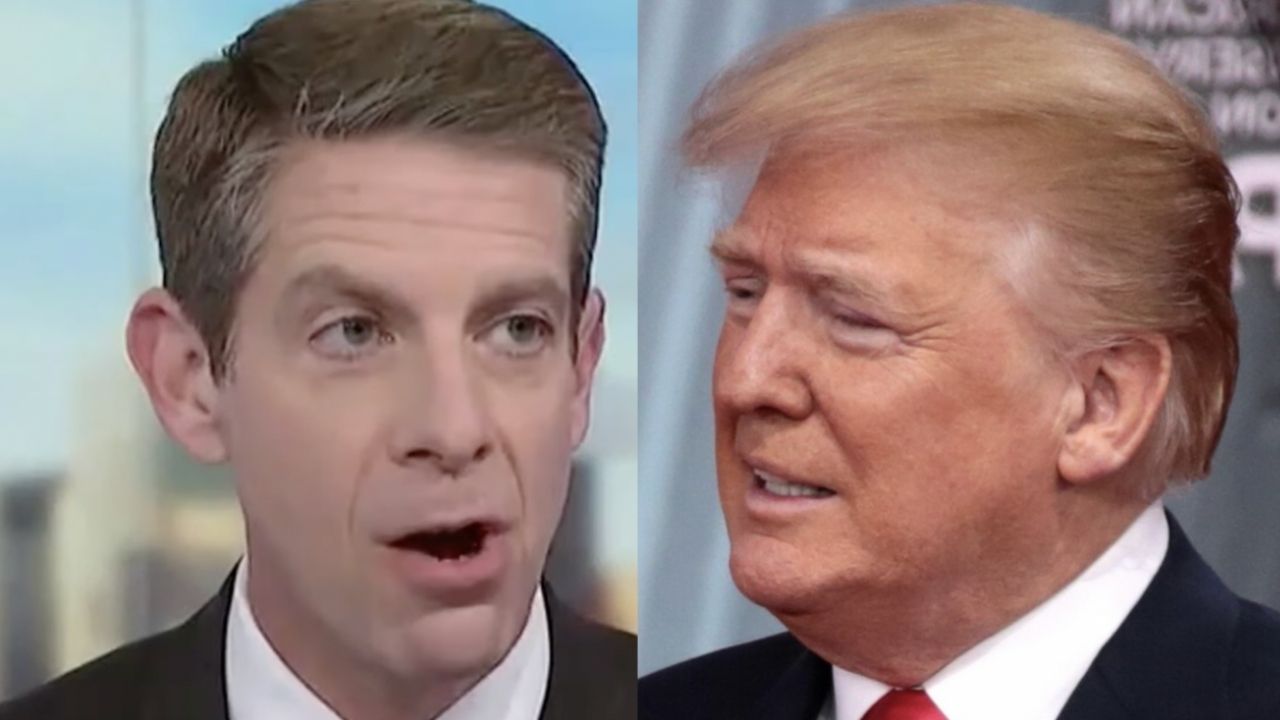
WASHINGTON — Rep. Mike Levin (D-Calif.) said Saturday that a bid by the Trump family’s crypto company to become a bank is “C-O-R-R-U-P-T-I-O-N.” He noted that the regulator deciding the application is “run by a Trump appointee, who Trump can fire.” His post followed a report on World Liberty Financial’s path to a federal trust bank charter.
Levin posted the following on X at 5:08 p.m. on Oct. 24, 2026:
This is C-O-R-R-U-P-T-I-O-N.
Remember World Liberty Financial? The Trump family crypto venture that’s generated more than $550 million for Trump while in office, run by the son of his Middle East envoy, and nearly half-owned by UAE-linked investors?
The Trump family crypto company now wants to become a bank.
The regulator deciding whether to approve it is run by a Trump appointee, who Trump can fire.
And if it gets approved, Trump’s family business stands to make more money.
The bank would hold the dollars backing its own stablecoin, so it could keep more of the profits instead of sharing them with another bank.
And here’s the kicker: it would get the credibility that comes with being a federally chartered bank without having government-backed deposit insurance. That means that there is no guarantee you get your money back if things go wrong.
The Trump family is raking in money and his Administration is setting the rules of the game. While Trump is getting richer, Americans are getting nothing.
The Report Levin Linked
Mother Jones reported that one of the Trump family’s most lucrative businesses is on its way to becoming a bank, regulated by an agency led by a Trump appointee. In August, the Office of the Comptroller of the Currency, one of the three major U.S. bank regulators, said World Liberty Financial could begin the process of establishing itself as a national trust bank. Sen. Elizabeth Warren (D-Mass.) has criticized the approval as a conflict of interest and corruption.
The Trump family and associates launched World Liberty Financial in 2024. They described it as a decentralized-finance company meant to challenge traditional banking. The report said the public cannot use the company for many ordinary banking functions, though it created a stablecoin, USD1, designed to hold a value of $1. A national trust bank, it noted, would not offer savings accounts, auto loans, credit cards or ATMs.
The report laid out the profit mechanics behind Levin’s claim. Stablecoin companies take in dollars, invest them in Treasury notes and keep the interest. World Liberty currently partners with an existing bank to hold the money for customers, which means splitting the profits. If it wins final approval as a bank, it could hold the funds itself and keep all of the profits.
The current Comptroller of the Currency, Jonathan V. Gould, was appointed by Trump and can be fired by him, the report said. Four other stablecoin issuers have received at least conditional approval from the agency, three of them since 2025. One crypto company received a conditional charter under the Biden administration, but its final approval stalled until December, when the current agency approved it.
Hilary Allen, a banking law professor at American University, told the outlet that the agency’s openness to stablecoin bank charters reflects influence from above. She said the Trump family’s own financial interest is clear. She also raised the deposit-insurance concern that Levin cites: World Liberty and other crypto banks would not be backed by the Federal Deposit Insurance Corporation. Even so, the “bank” label offers an implied stamp of government approval.
World Liberty has not yet become a bank. It has only preliminary approval and must raise capital and clear additional steps. As part of its application, Eric Trump signed a “passivity agreement,” under which the Trump family agrees not to take a management role, influence board decisions or involve itself in regulatory matters. The agency will oversee that commitment. World Liberty spokesperson David Wachsman said in an email that “There are no conflicts of interest” and that the company received no special treatment. He added that competitors were approved earlier and more quickly.
Levin’s Specific Claims and the Public Record
Levin’s post cites “more than $550 million” generated for Trump while in office. It did not name a source for that figure. Trump disclosed in July that he took in nearly $1.2 billion from crypto businesses in 2025, including $526 million from World Liberty Financial.
World Liberty said in a release that the board of its planned bank would be chaired by Zach Witkoff, the son of Trump’s special envoy, Steve Witkoff. On ownership, House Democrats’ correspondence with the Treasury Secretary has cited reports that investors connected to the UAE royal family bought a stake of nearly $500 million. Other published accounts put it at 49 percent. The company has said Trump has had no involvement in World Liberty since taking office.
Levin has criticized Trump’s finances before. In a statement after Trump’s 2026 State of the Union address, he said Trump had “personally profited to the tune of $1.4 billion” before lecturing the country about corruption.
Levin’s voting record on stablecoin legislation is mixed. On July 17, 2025, he voted yes on final passage of the GENIUS Act, which created the first federal framework for payment stablecoins. The House passed it 308-122, with 102 Democrats in favor and 110 opposed. Trump signed it the next day. Some Democrats who opposed the bill argued it did not stop the Trump family from profiting from USD1.
Related Developments
On Oct. 22, a shareholder of Circle, a competing stablecoin issuer, sued Trump and World Liberty in federal court in Washington. The suit alleges violations of the Constitution’s foreign emoluments clause over two UAE-linked transactions. A White House spokesperson called the suit frivolous and said there are no conflicts of interest, and World Liberty said the claims are without merit. The allegations have not been tested in court. The agency’s preliminary approval also remains conditional, including capital requirements World Liberty must meet before it can operate as a bank.