
In an Alaskan winter, a small drone’s battery lasts about a twentieth as long as it does in the Pacific, according to the general who commands the Army’s 11th Airborne Division. Maj. Gen. John Cogbill gave that figure, and the temperatures behind it, in an interview with Military Times published Oct. 13, 2026. His point was that the cold is the condition his soldiers train for, not an exception to it.
Cogbill leads the division known as the Arctic Angels. In his own words, it is built around one environment: “But we optimize for the Arctic, because we’re the only Arctic division.”
Speaking with Military Times editor-in-chief J.D. Simkins in the Oct. 13 interview, Cogbill described soldiers who arrive from warmer posts. “They may be coming from Hawaii. They may be coming from Fort Polk,” he said. Once in Alaska, he added, “they are going to be expected to operate anywhere from -20 to -40, which was the range of temperatures during our last Joint Pacific Multinational Readiness Center rotation in February.”
Forty below, by the division’s own saying
Asked about those conditions, Cogbill offered the line the interview is built around. “We have a saying that everything breaks at 40 below,” he told Military Times. His next sentence was “Everything, except morale.”
The February rotation he cited is on the Army’s own record. An army.mil article dated Feb. 14, 2026, by Correy Mathews, describes the 1st Infantry Brigade Combat Team (Air Assault), 11th Airborne Division, flying a nighttime air assault into the Yukon Training Area during Joint Pacific Multinational Readiness Center 26-02. The article says CH-47 Chinook and UH-60 Black Hawk helicopters carried the troops “as temperatures dropped and snow reached waist-deep across the landing zone.”
The Army describes JPMRC 26-02 as “designed to prepare and validate forces for large-scale combat operations.” A Feb. 12 army.mil article by the same author reports that the division’s 2nd Infantry Brigade Combat Team (Airborne) jumped into Husky Drop Zone as the rotation’s opposing force, after planning around “deep snow, sub-zero temperatures and limited daylight.” That article calls the unit “the Army’s only airborne brigade permanently stationed in the Arctic.”
Drone batteries in the cold
The battery figure came in Cogbill’s answer about small drones. “The difference is, if we want to fly these drones in Alaska during our winter training exercise, the battery life will be about 1/20th of what it is in the Pacific,” he said, according to Military Times. He added that the division is “trying to figure out ways to prolong battery life, to build drones that are more capable in high wind, high altitude and sub-freezing temperatures.”
Drones are already part of the division’s live-fire work. “Our brigades at Joint Base Elmendorf-Richardson recently went through nine company iterations of combined arms live fire,” Cogbill said. “In every single one of those live fires, they were employing FPV drones in a strike capability and in a reconnaissance capability.” FPV, or first-person view, describes a drone flown through the feed from its own camera.
On artificial intelligence and autonomy, Cogbill told Military Times the division runs exercises “every 90 days to help us see the strengths and weaknesses of the algorithms.”
Supply lines through waist-deep snow
The cold reaches logistics, too. “Sustainment is harder when you’re talking about moving things off-road through waist-deep snow,” Cogbill said in the interview. “Battery life is shortened, which means you have to resupply more often.” He also said, “Water can’t be delivered in bulk.”
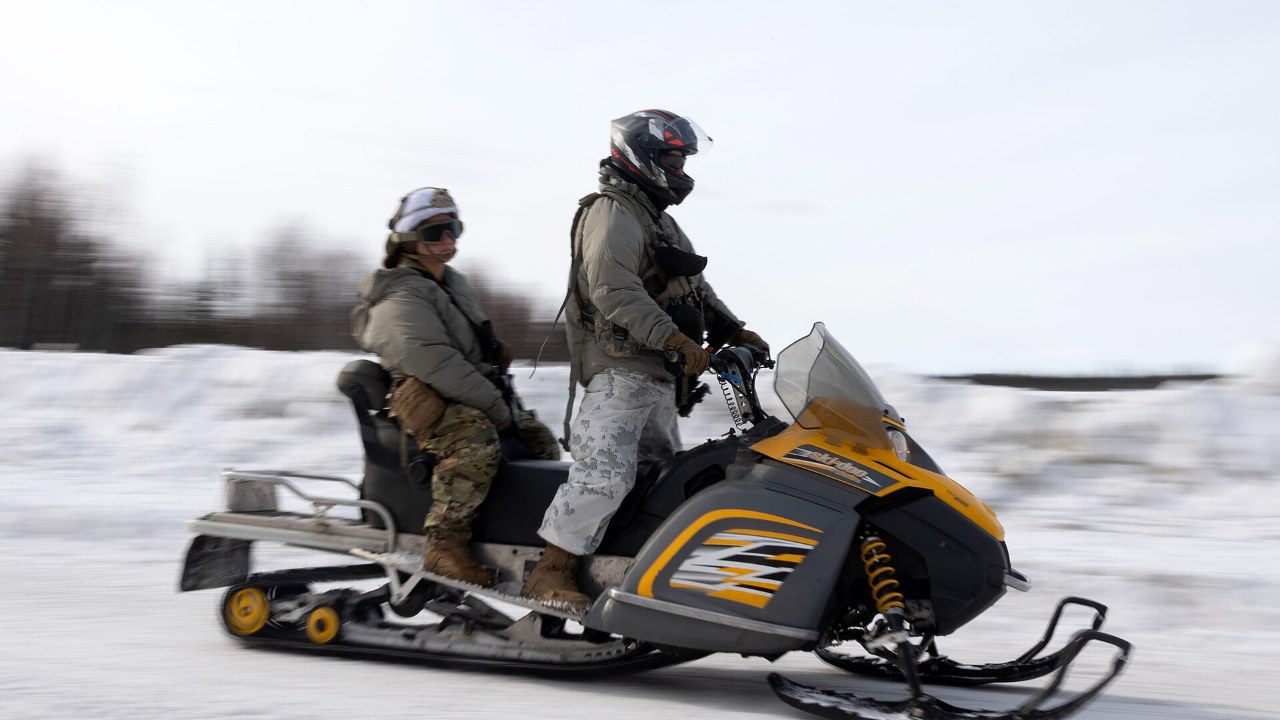
For moving across that snow, he pointed to the Cold Weather All-Terrain Vehicle, or CATV, which he called “the workhorse for moving soldiers and equipment over snow.”
Six months to Arctic-tough
New arrivals come in, the Military Times article says, with “trepidation in their eyes.” The article describes a path of cold-weather indoctrination and field time over roughly six months, and of the soldier at the end of it Cogbill said, “That’s when they truly become Arctic-tough.”
He told Military Times how most of them leave the assignment: “Most people come here a little bit nervous, but they leave kicking and screaming.” His summary of the assignment was shorter still: “Winter is always coming in Alaska.”