
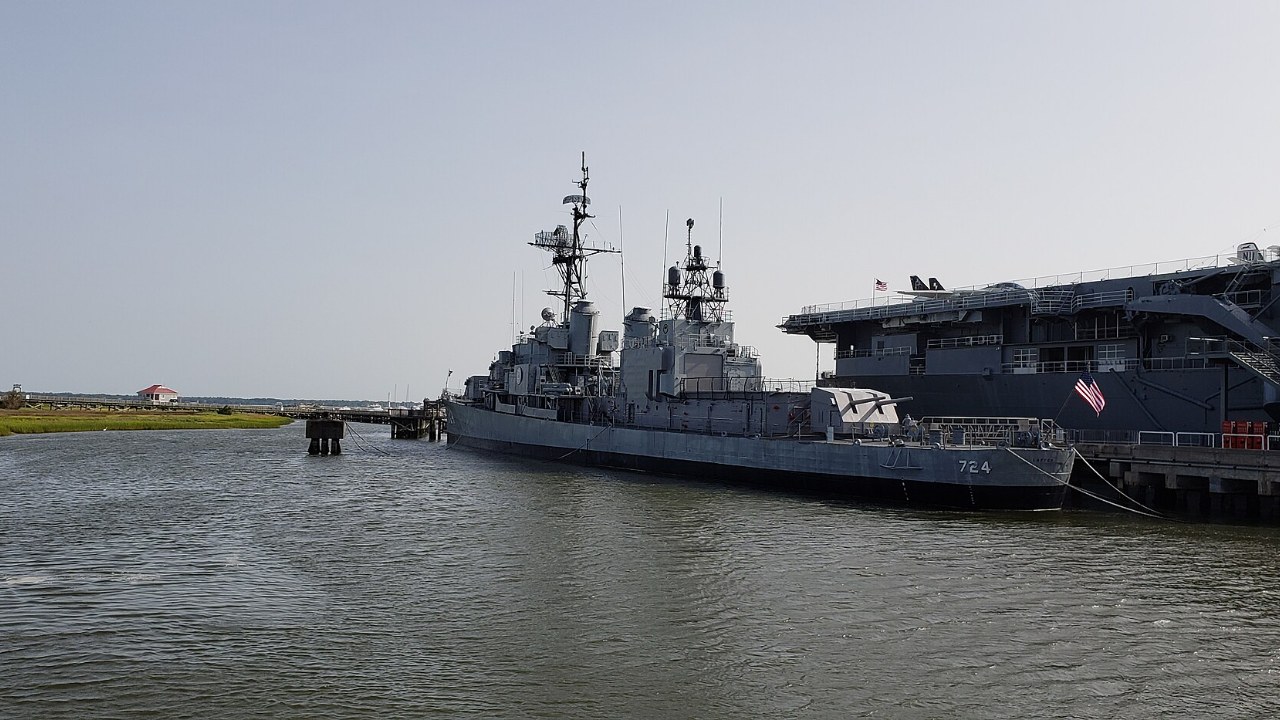
Radar Picket Station No. 1 sat about 30 nautical miles northwest of the northern tip of Okinawa, and on the morning of April 16, 1945, the destroyer USS Laffey (DD-724) was holding it. Before 10 a.m. she had been attacked again and again from the air, set afire and left steering in circles, and she was still afloat.
The Sumner-class destroyer is now a museum ship at Patriots Point Naval & Maritime Museum in Mount Pleasant, South Carolina, and the museum’s account of that morning is specific about the scale of it.
In a press release dated April 13, 2026, announcing its annual memorial for the crew, Patriots Point said that in roughly 80 minutes the Laffey was attacked by 22 kamikaze aircraft. Six of them crashed into the ship, and she was hit by four bombs, the museum said. The release honored the 32 sailors killed aboard her during the Battle of Okinawa.
On the picket line
The Naval History and Heritage Command’s H-Gram 045 account of the action places Laffey on Station No. 1 under Cmdr. Frederick Julius Becton.
The attack came during Kikusui No. 3, a mass raid that NHHC says involved 165 kamikaze aircraft and 150 others. Radar first detected the incoming aircraft at 0808, the first engagement came at 0830, and the last attack, by a Japanese Judy dive bomber, came in at about 0947, per the H-Gram.
A combat air patrol fought over the ship through the morning. NHHC lists four FM-2 Wildcats from the escort carrier Shamrock Bay, Marine Corsairs of VMF-441 from Yontan Airfield, Corsairs from the carrier Intrepid and Hellcats from San Jacinto among the aircraft that came to her defense.
How the record counts the hits
The counts in the record are not all the same, and the differences are worth stating. Patriots Point’s release gives 22 attacking aircraft. The Presidential Unit Citation quoted by NHHC says the ship faced “approximately 30 enemy Japanese planes,” and Becton’s Navy Cross citation, also quoted in the H-Gram, says she fought “for over two hours,” while the H-Gram’s own narrative calls it an 80-minute attack.
On the hits, the sources line up more closely. Becton’s citation says the destroyer was “crashed by six of the overwhelming aerial force,” matching the museum’s six. The H-Gram’s aftermath section counts “four direct bombs hits,” the same as Patriots Point, although the Unit Citation says she was “struck by two bombs.” NHHC notes that one early strike may be counted as a near miss in some accounts.
The human cost is recorded plainly. Patriots Point’s ship page puts it at 32 men killed and 71 wounded out of a crew of 336; NHHC gives 32 dead and 71 or 72 wounded.
A ship that kept steaming
The damage was mechanical as much as anything. According to the H-Gram, fragments ruptured hydraulic lines in the steering gear and jammed the rudder at 26 degrees to port, forcing the ship to steam in tight circles. Flooded after compartments pulled her stern down, Mount 53 and two 40 mm quad mounts were out of action, five 20 mm mounts were destroyed, and her air and surface search radars were gone. Becton assessed the ship as 30 percent combat effective, NHHC says.
He did not give her up. The H-Gram records his answer when abandoning ship was raised: “No! I’ll never abandon ship as long as a single gun will fire!”
The landing craft LCS(L)-51 came alongside around 1100 to help fight fires, NHHC says. The destroyer-minesweeper Macomb then took Laffey in tow toward Kerama Retto at four knots, a slow job with the rudder jammed, before the tugs Pakana and Tawakoni took over. After emergency repairs, she left on April 22 under her own power, bound for Seattle by way of Saipan and Pearl Harbor.
From Normandy to Patriots Point
Okinawa was not the ship’s first close call. Patriots Point says she was built at Bath Iron Works in Maine, commissioned in February 1944 and supported the Normandy invasion at Utah Beach, where a German shore battery shell pierced her hull but failed to explode.
Laffey received the Presidential Unit Citation for what it called “extraordinary heroism in action as a Picket Ship on Radar Picket Station Number One,” per NHHC. The museum says the crew’s performance earned her the name “The Ship That Would Not Die.”
She went on to serve in the Korean War and in the Cold War Mediterranean as an anti-submarine ship, was decommissioned in 1975 and became a museum ship at Patriots Point in 1978, according to the museum. Its April 2026 release said the Laffey was closed at the time for maintenance and repairs, and that its memorial that month, marking the 81st anniversary of the attack, was held aboard the carrier USS Yorktown (CV-10), overlooking the destroyer, with a reading of the names of the 32 sailors killed.