
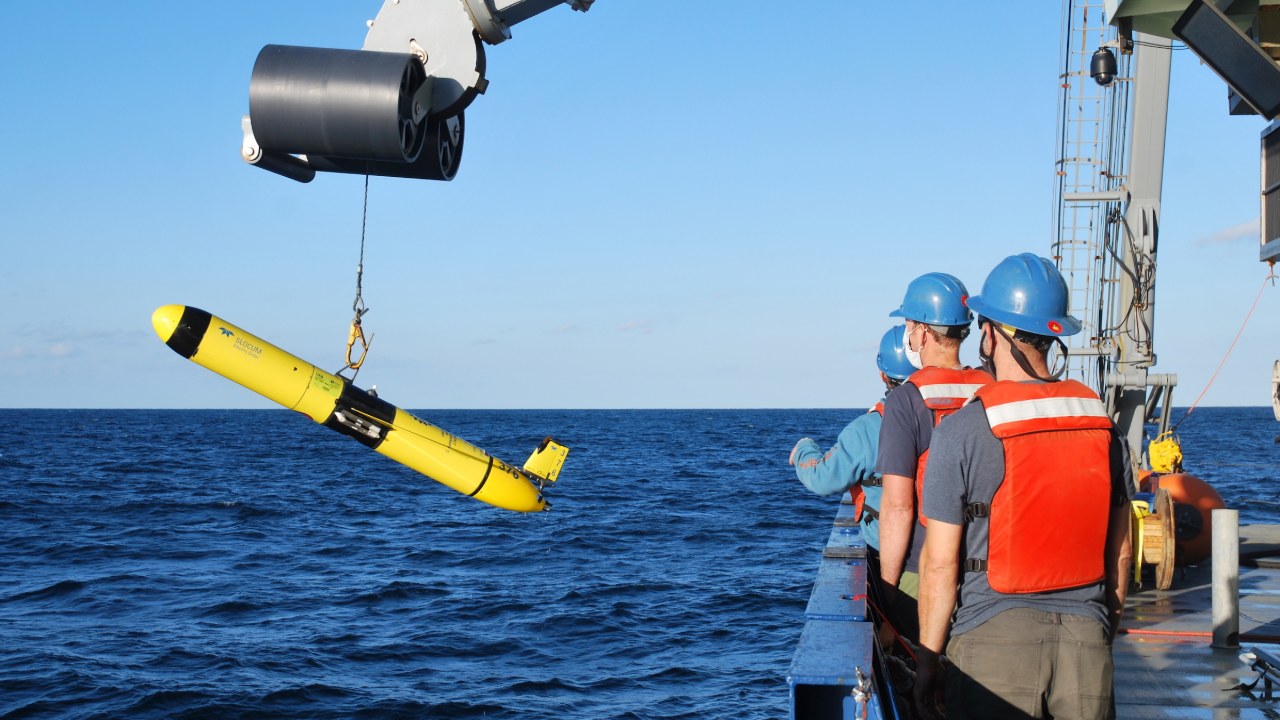
Five Royal Navy Slocum G3 ocean gliders spent 64 days working beneath the waters around the British Isles with no crew aboard, collecting oceanographic data on their own. The Royal Navy announced the finished mission on Sept. 15, 2026, and called it the largest and longest drone deployment in the service’s history.
The gliders carry no weapons. Their job is to measure the water itself and pass that picture to the specialists who support submarine and anti-submarine operations, according to the service.
The Royal Navy’s Sept. 15, 2026 release opens with the record: “Royal Navy experts have completed the largest and longest deployment of drones in the Service’s history.” The release says “the five Slocum G3 gliders operated entirely independently,” and describes “the 64-day data-gathering mission” as led by the Devonport-based Meteorological and Oceanographic (METOC) Information Warfare Group, or MIWG. The release’s headline calls it a two-month Atlantic mission; the text places the gliders in the waters around the British Isles.
What five gliders measured
In the release’s own words, five “ocean gliders” spent more than two months beneath the waves. According to the same release, they spent the deployment “recording conductivity, temperature and depth to calculate water properties including salinity and levels of fluorescence.” The Royal Navy did not give a distance covered or the specific sea areas each glider worked.
The Slocum line comes from Teledyne Marine, whose Slocum glider product page describes the family as providing “efficient, long-duration ocean monitoring and data collection.” The Royal Navy release does not say how many G3 gliders the service owns in total.
Chief Petty Officer Natalie Johnston “was central to the deployment,” the release says, “and led the team through the generation, operation, and recovery of the gliders.”
Why the Royal Navy wants the data
The release ties the gliders directly to submarine and anti-submarine work. “The information gathered by these sensors supports Anti-Submarine Warfare, submarine operations, and wider Defence activity,” it says, letting specialists use environmental data “for tactical advantage.”
The gliders are part of the Future Military Data Gathering Programme, per the release, and support Atlantic Bastion, which the Royal Navy describes as the UK’s initiative to improve situational awareness, resilience and anti-submarine warfare capability “across the North Atlantic and other contested maritime environments.”
Commander Neil Masson, MIWG’s commanding officer and the Royal Navy’s head of Information Warfare METOC, put the result this way in the release:
“This deployment proves that autonomous systems are now part of how the Royal Navy gathers environmental intelligence.”
Masson added that MIWG “has delivered persistent oceanographic collection at scale, improving our understanding of the underwater environment and giving commanders the information they need to gain warfighting advantage.”
193,000 observations in two years
The gliders are one piece of a larger uncrewed network. Alongside them, the release says, the Royal Navy has deployed ocean-profiling floats across the Euro-Atlantic region that send near real-time data to the Met Office and the UK Hydrographic Office. Those floats, the release says, are “generating thousands of observations” of their own.
The output is the figure the service leans on. “In 2024 and 2025 alone, autonomous oceanographic systems generated more than 193,000 observations,” the release says, a number it calls “equivalent to over half the total number collected through traditional methods during the previous 77 years.”
The team’s work has already been recognized inside the service. At the Information Warfare Symposium, according to the release, MIWG received the Departmental Award for Information Warfare Excellence and the Information Warfare METOC Innovation Award. The Royal Navy presents the 64-day deployment as a step in what it calls its transformation toward a “Hybrid Navy.”
Top image: A Slocum glider is recovered at sea during an Ocean Observatories Initiative cruise. It is not a Royal Navy glider. Image Credit: Ocean Observatories Initiative — Public domain / Wikimedia Commons
This article was produced with the assistance of AI and reviewed by Combat Rated editors prior to publication.